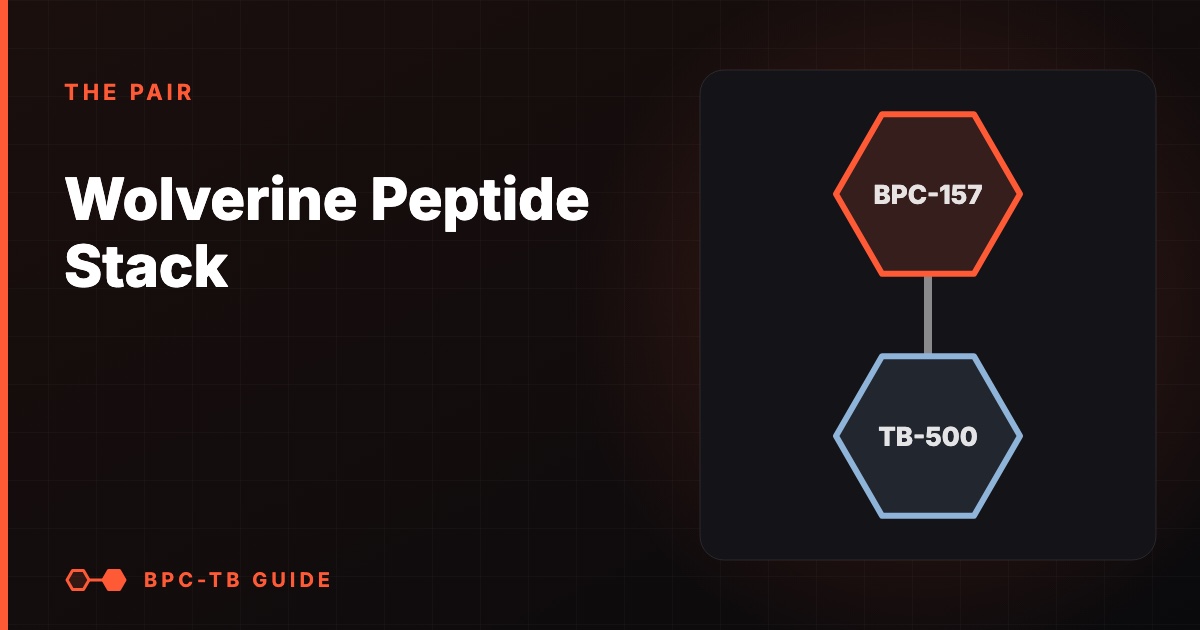
Quick answer: The "Wolverine peptide stack" is a nickname, not a product or a drug. Most sources use it for BPC-157 plus TB-500; one clinic page counts four peptides. No FDA-approved drug contains BPC-157 or TB-500 as of 2026-10-09, and no published human study tested the pair together. Sports bodies prohibit both. Claims about fast recovery come from clinics, shops and forums, not from human trials.
- Approved product
None. No FDA-approved drug contains BPC-157 or TB-500 (as of 2026-10-09)
- FDA
Both listed as "nominated but withdrawn" on a page current as of 2026-04-22; advisory meeting held 2026-07-23; no final decision found (as of 2026-10-09)
- WADA
BPC-157 in S0, TB-500 in S2.3 of the 2026 List, prohibited at all times (as of 2026-10-09)
- Human trials
None of the pair together; three small BPC-157 reports; none of TB-500 for an injury (as of 2026-10-09)
Search for the Wolverine stack and you will find pages that disagree on the basics: how many peptides it contains, where the name came from, whether it is legal and whether it has been tested in people. This page lays out each version of the definition, who uses it, what is sold under the name, and what regulators and studies actually say. Everything is attributed, and nothing here is a recommendation. For the homepage overview of the pair, see BPC-157 and TB-500.
Where the name came from
Every source we read that explains the nickname points to the same place: the Marvel and X-Men character Wolverine, known for rapid recovery from injury. One health publisher's page says the stack was "dubbed" that for its supposed regenerative effects. A South Florida clinic page ties the name to the character's regenerative ability, and a telehealth-style clinic page says it is named for the character's rapid recovery. A peptide-education blog calls it "the colloquial name."
That is all the sources offer. No page we read says who first used the name, in what year, or in what setting. We could not find an inventor, a company or a date, so this page does not give one. An Australian government-funded men's health information site (page dated 2026-02-20, updated 2026-04-24) is blunter than the clinics. It calls the stack "a marketing term, not a scientific one" and says most information comes from blog posts and user anecdotes.
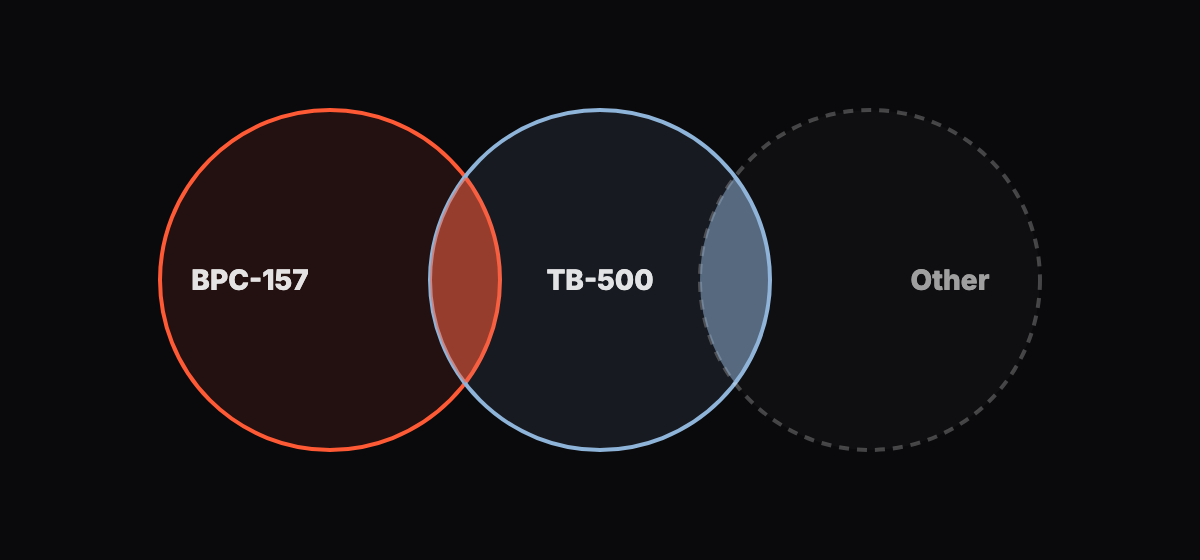
That matters for how you read everything else. A nickname gives a pair of unrelated compounds the feel of one product with one set of properties. Each compound has its own separate record, and those records are very different in size. The BPC-157 page and the TB-500 page cover them one at a time.
Which stack? Four definitions in use
| Version | What is in it | Who uses this definition |
|---|---|---|
| Two-peptide stack | BPC-157 and TB-500 | The most common definition. A health publisher's page (dated 2026-08-03), the Australian health information site, several clinic pages, a peptide-education blog and a peptide-protocol reference site all use it. |
| Four-peptide stack | BPC-157, TB-500, CJC-1295 and ipamorelin | One Houston clinic page (dated 2026-04-14), which says the first two "work at the injury site" and the second two work "at the systemic level." |
| Single-peptide use | BPC-157 alone | A US news article (dated 2026-09-18) calls BPC-157 itself "the 'Wolverine' peptide" and says users often combine it with TB-500. |
| Expanded versions | Two-peptide stack plus GHK-Cu and sometimes a growth-hormone-releasing peptide | A peptide-protocol reference site describes these as "expanded versions." The Glow and Klow names cover related blends. |
Table current as of 2026-10-09. Definitions are attributed to the pages that use them; none is an official or scientific standard.
Notice what the table shows. The two-peptide version dominates, and even clinics that sell the four-peptide version often describe the extra pair as an add-on to the base two. A South Florida clinic page defines the stack as two peptides and handles a growth-hormone-releasing pair as a separate add-on. So when someone says "the Wolverine stack," you cannot tell what they mean without asking which peptides they are counting.
Why the four-peptide version has its own record
The extra pair in the four-peptide version, CJC-1295 and ipamorelin, belong to a different class. The WADA 2026 List names CJC-1295, sermorelin, tesamorelin and ipamorelin together under S2.2.4, growth-hormone-releasing substances. FDA's compounding page, current as of 2026-04-22, lists both CJC-1295 and ipamorelin acetate in the same "nominated but withdrawn" table that holds BPC-157 and TB-500 (ipamorelin acetate also appears in the category 2 table under the 503B policy). The entry for CJC-1295 mentions serious adverse events, including increased heart rate. None of that is evidence about BPC-157 or TB-500, and none of the evidence about those two covers the growth-hormone pair. That is one reason the definitions cannot be merged.
The Glow and Klow relatives
Some pages describe "Glow" as the two-peptide stack plus GHK-Cu and "Klow" as Glow plus KPV. Those are covered on the Glow and Klow page, because GHK-Cu and KPV bring their own evidence and their own regulatory entries.
Claims about the stack, graded
| Claim as marketed | Who says it | What supports it | Grade |
|---|---|---|---|
| "Targets tendon and ligament injuries, muscle strains, and postsurgical recovery" | A South Florida clinic page | Rat tendon, ligament and muscle studies. No controlled human study found. | Animal or lab studies only |
| "BPC-157 works at the injury site while TB-500 works systemically" | Clinic pages | No source measured where either peptide acts in people. | No published support found |
| "The two are synergistic because they act on complementary stages" | Clinic pages | One 2026 rat Achilles study (32 rats). Its authors reported no added benefit from the combination over either agent alone, though one score, the Movin score, was significantly lower in the combination group. | Animal or lab studies only |
| "A four-peptide protocol adds systemic growth-hormone effects" | A Houston clinic page | No study of the four together was found. | No published support found |
| "An alternative to long-term NSAID use" | A clinic page | No source compares the stack with an anti-inflammatory medicine. | No published support found |
| "Newly approved for compounding" | One health publisher's page | FDA's pages, current as of 2026-04-22 and 2026-08-06, list both as nominated but withdrawn. We found no final decision as of 2026-10-09. | Contradicted by sources |
| "Both are FDA Category 2" | Several commercial pages | FDA's page current as of 2026-04-22 lists both as nominated but withdrawn from category 2. These pages are stale. | Contradicted by sources |
| "Only mild side effects" | Forum posts | Two of the three small BPC-157 reports say no adverse events or side effects were reported, and the knee series abstract does not describe any; about 30 people in total. FDA says TB-500's risks in humans "are unknown." | No published support found |
Grades use the fixed five-level key. Table current as of 2026-10-09. The full ledger by claim is on the benefits page, and forum statements are graded on the forum claims page.
What the research shows about the pair
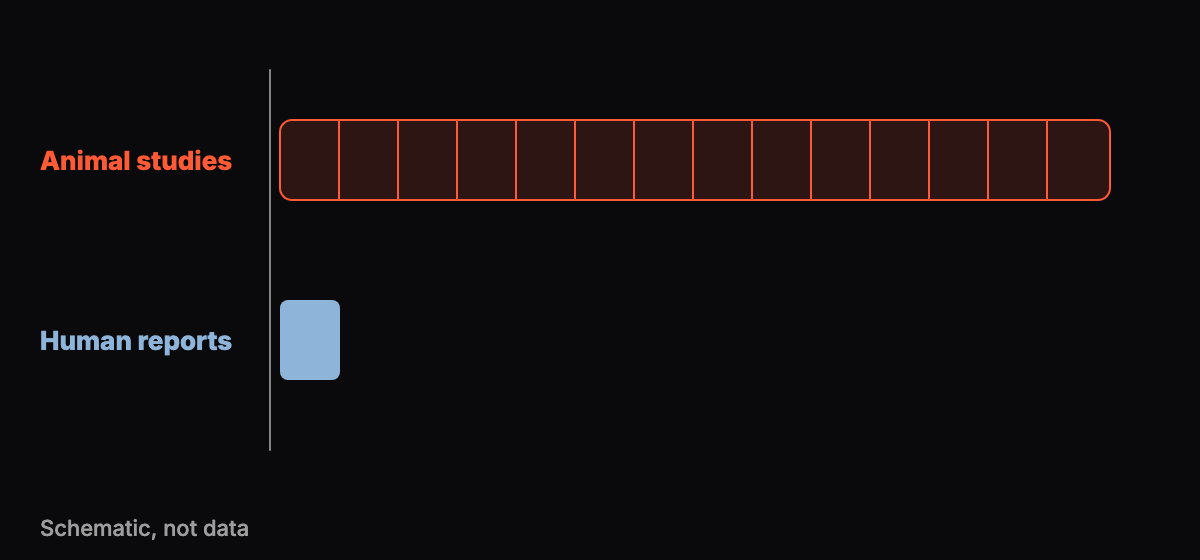
The cleanest answer to "has the stack been tested?" is: separately, mostly in animals, and together only once.
In animals. BPC-157 has a large animal literature, but a PubMed count made for this site on 2026-10-09 found that 172 of 220 relevant records list the same Zagreb author. A 2019 independent review said only a handful of research groups had studied the peptide in depth. TB-500 has far less. Work on the parent protein, thymosin beta-4, is mostly in rats and mice, and parts of it are contested: a 2012 knockout-mouse paper concluded that the protein was dispensable for heart development and adult heart function.
Together. The only head-to-head test we found is a 2026 rat Achilles study from a Turkish training hospital. It used 32 male rats in four groups of 8: control, BPC-157, TB-500 and both, given by injection into the abdomen for four weeks. Maximum load to failure was higher in the BPC-157 and TB-500 groups than in controls, reaching significance in the TB-500 group. The Bonar score, a tendon-structure measure, was significantly lower in the TB-500 group. The Movin score was significantly lower in the TB-500 group and in the combination group. BPC-157 alone showed numerically lower scores that did not reach significance on the totals. The authors called it an exploratory rat model and said the combination did not confer additional benefits over either agent alone. It says nothing about people.
In people. A 2025 systematic review of BPC-157 in orthopaedic sports medicine identified 544 articles and included 36 studies: 35 preclinical and one clinical. The one clinical study is a retrospective chart review of knee pain at a private clinic. Its abstract says 4 of the 16 people reached by phone received BPC-157 plus thymosin beta-4, a group far too small to say anything about a combination. It had no comparison group and no validated outcome measure. We found no published human study of BPC-157 plus TB-500 as of 2026-10-09.
Registered trials. ClinicalTrials.gov lists four records that mention BPC-157, none with posted results. A Phase 2 trial of acute hamstring strain is listed as recruiting, and a rotator cuff pilot is not yet recruiting. For TB-500, the only registry entry using that name describes itself as a "fictional" example record. It is not a study.
What is sold under the name
Retail pages and clinic pages use "Wolverine" to describe several kinds of product. None is an FDA-approved drug. Listing the types helps you recognize what a page is selling, which is a different question from whether any of it is supported.
- Two-peptide blend vials. A single container sold with both peptides in it, usually as a freeze-dried powder. The blend page explains what such a label can and cannot prove.
- Separate single-peptide vials sold as components of a "stack."
- Kits and protocols that bundle the two with other peptides, sometimes described by a clinic as a four-peptide protocol.
- Capsules, sprays and oral forms. A 2023 FDA warning letter, dated 2023-06-12, described a firm selling BPC-157 and TB-500 in injectable and nasal spray forms.
- Supplement-style products. FDA's BPC-157 briefing says BPC-157 "is marketed in the United States as an ingredient in dietary supplement products." A registered consumer product study involved a gummy with BPC-157. FDA's text on whether such sales are lawful was not part of what we read, so we make no claim either way.
- Clinic-dispensed preparations. One published BPC-157 pilot used material made by a compounding pharmacy. FDA's briefing found no reported compounded drug products containing BPC-157 from outsourcing facilities between January 2017 and June 2025.
FDA's BPC-157 briefing notes websites selling BPC-157 and TB-500 combination products "for research purposes only and not for human or veterinary use." FDA's adverse event data are thin, but one report is worth knowing about: a person developed widespread skin and gum darkening after using a product labeled for research purposes only that contained both BPC-157 and TB-500. It recurred when the product was used again. FDA said it cannot tell which ingredient was responsible, and it cannot draw definitive safety conclusions from reports alone. Two more complaints to FDA's foods complaint system involved blended TB-500 and BPC-157 products and received no safety assessment.
A product page cannot answer how much of either peptide a container holds, whether the TB-500 is the fragment or the whole protein, or how pure it is. The dosage page explains why no human dose is set, and the dosing chart page covers where circulating charts come from. This site publishes no chart, and the calculator page explains why there is no calculator either.
One health publisher, clinic pages and FDA: what each says
Three kinds of source describe the stack in different terms.
| Topic | One health publisher's page (dated 2026-08-03) | Clinic pages | FDA's own pages |
|---|---|---|---|
| Definition | Two synthetic peptides, BPC-157 and TB-500 | Two or four peptides | BPC-157 and TB-500 are separate substances with separate briefings |
| Regulatory framing | Says peptides are "newly approved for compounding" and says they have not been approved by the FDA | Several say neither is an approved drug; some older pages say "Category 2" | Page current as of 2026-04-22 lists both as nominated but withdrawn; advisory meeting 2026-07-23; no final decision found as of 2026-10-09 |
| Human testing | Says the stack "has not been tested in humans" | Say evidence is mostly animal and "smaller human trials" | Briefings: no human data on TB-500 found; BPC-157 had five small clinical studies, short and limited |
| Safety | Lists reported effects such as injection site irritation and stomach upset | Often describe side effects as minor | Briefings cite "lack of clinical and nonclinical safety information" for TB-500 |
Table current as of 2026-10-09. The publisher and clinic columns are claims attributed to pages we read; the third column is FDA's wording.
Where they disagree, FDA's own pages are the primary source. The health publisher's phrase "newly approved for compounding" does not appear in the FDA pages we read. FDA's compounding overview says a compounder may use a bulk substance only if it meets a USP monograph, is a component of an FDA-approved drug, or is on FDA's 503A bulks list. FDA's briefings say neither peptide has a monograph or is in an approved drug. A discussion at an advisory committee is not an approval. The committee on 2026-07-23 was asked whether to place each form on the list. News outlets reported a narrow vote in favor. FDA's meeting page, current as of 2026-08-06, posts briefing documents but no vote summary, and it describes advisory committee recommendations as non-binding. As of 2026-10-09 we found no FDA final decision, proposed rule or enforcement statement on either substance. Check FDA's page for any change.
The same publisher's claim that the stack "has not been tested in humans" is also stronger than the record. Three small BPC-157 human reports exist, and thymosin beta-4 (a different substance) has been through human trials. The accurate statement is that no controlled trial of the pair, or of TB-500 for an injury, has been published.
Clinic pages are the loudest voices in the search results, and they are marketing documents. They are useful for learning what is being claimed. They are not evidence. A government-funded Australian health site, a US news article that quotes physicians saying these peptides have not been adequately studied in humans, and FDA's own briefings sit on the other side of the ledger.
Sports and the stack
The WADA 2026 List, in effect from 2026-01-01, names BPC-157 in S0 non-approved substances, which are prohibited at all times and are Specified Substances. It names "Thymosin-ß4 and its derivatives e.g. TB-500" in S2.3, also prohibited at all times but not Specified. Some websites put both in S0; the List text does not. The sports page covers what that means for drug-tested competitors, and USADA's athlete advisory (page dated 2026-10-06) says an updated List takes effect on 2027-01-01, so check the current version each year.
Questions this page does not answer
If you came here for a dose, a schedule or a "how to" for the stack, no source we read supports one. The dosage page explains why. If you came for the legal position, read what FDA says and what FDA status means for sale. For the topics people pair with the stack, the evidence is covered on the tendon page, the joint pain page and the muscle recovery page. The question of whether TB-500 and the natural protein are the same is on the thymosin beta-4 page.
Sources
- FDA: Certain bulk drug substances for use in compounding that may present significant safety risks page current as of 2026-04-22, read 2026-10-09
- FDA: Bulk drug substances used in compounding under section 503A page current as of 2026-05-14, read 2026-10-09
- FDA: July 23-24, 2026 meeting of the Pharmacy Compounding Advisory Committee page current as of 2026-08-06, read 2026-10-09
- FDA briefing document: BPC-157 read 2026-10-09
- FDA briefing document: TB-500 read 2026-10-09
- WADA: Prohibited List 2026 List in effect 2026-01-01, read 2026-10-09
- USADA: 2027 Prohibited List athlete advisory page dated 2026-10-06, read 2026-10-09
- Vasireddi et al. 2025, HSS Journal PMID 40756949
- Lee and Padgett 2021, Alternative Therapies in Health and Medicine PMID 34324435
- Gwyer et al. 2019, Cell and Tissue Research PMID 30915550
- Bicer et al. 2026, Joint Diseases and Related Surgery PMID 42542926
- Mendias and Awan 2026, Sports Medicine PMID 41966639
- Thymosin beta-4 knockout mouse study, 2012, Circulation Research PMID 22158707
- ClinicalTrials.gov: hamstring strain trial record record read 2026-10-09
- Pages read as claim sources and not linked: a health publisher's page (dated 2026-08-03), an Australian government-funded health information site (2026-04-24), a US news article (2026-09-18), and clinic and education pages dated 2026-02 to 2026-08.
FAQ
Is the Wolverine stack one product?
No. It is a nickname that different pages apply to different combinations. Most mean BPC-157 plus TB-500, one clinic page means four peptides, and one news article applies the name to BPC-157 alone. Always check which peptides a source is counting.
Why is it called Wolverine?
Every source we read that explains the name points to the Marvel and X-Men character known for rapid recovery. No page we read says who coined it or when.
Has the Wolverine stack been tested in humans?
Not as a pair, as far as we could find. BPC-157 has three small uncontrolled human reports from one author team, and thymosin beta-4 has human trials in eye, skin and heart settings, but a different substance. As of 2026-10-09 we found no published human trial of BPC-157 plus TB-500.
Is the stack approved by FDA?
No. FDA states neither BPC-157 nor TB-500 is a component of an approved drug. Both are on a page FDA lists as "nominated but withdrawn," current as of 2026-04-22. The July 2026 advisory committee was non-binding, and we found no final decision.
Is the stack banned in sports?
Both peptides are on the WADA 2026 List and prohibited at all times. BPC-157 is in S0 and TB-500 in S2.3. A four-peptide version adds substances that appear elsewhere on the List.
Is there a dosing chart for the stack?
Charts circulate on forums and shop blogs, but no published source supports a human dose for either peptide, so this site does not provide one. The reasons are on the dosing chart page.
Not medical advice. See the medical disclaimer.