Quick answer: No FDA-approved drug contains BPC-157 or TB-500 as of 2026-10-09. For joint pain, we found one small uncontrolled human report on BPC-157 (knee pain), no human trial of TB-500, and no controlled human trial of injected GHK-Cu. Care with human trial support includes exercise, weight management and several medicines that NIH and guideline sources describe. This page grades each compound and each claim.
"Peptide" is a broad word. It covers approved medicines that were studied for decades and it covers compounds sold with a story and a nickname. When someone says peptides help joint pain, the first question is which peptide, and the second is which kind of evidence. This page answers both for the compounds that come up most with the "Wolverine stack" and its relatives.
Approved drugs and unapproved compounds are different things
An approved drug has passed FDA review for a stated use, with a label that lists what it is for, how it should be used and what harms were seen. An unapproved compound has none of that, whatever the website says.
No FDA-approved drug contains BPC-157 or TB-500 as of 2026-10-09. FDA's page on bulk drug substances for compounding, current as of 2026-04-22, lists both under "nominated but withdrawn". FDA's TB-500 briefing for its advisory committee cites a lack of clinical and nonclinical safety information. For the full regulatory picture, see the legal status page.
Several peptide-based medicines are approved for other conditions, (insulin is one example). Approval for those uses says nothing about joint pain, and it does not carry over to BPC-157, TB-500 or any blend. Writers who list approved peptide drugs next to unapproved ones are mixing two categories.
What care for joint pain looks like in the evidence
Most joint pain in adults that is not from an injury is osteoarthritis. The National Institute of Arthritis and Musculoskeletal and Skin Diseases (NIAMS) page on diagnosis and care, last updated 2024-01-08, says care usually begins with learning about the condition and exercising, then weight management for people who are overweight, braces, and then medicines. It lists oral pain relievers, oral anti-inflammatory medicines, topical creams, and joint injections of steroid or hyaluronic acid. It notes that managing weight can reduce stress on joints. MedlinePlus, an NIH site, gives a similar order.
A 2019 guideline from the American College of Rheumatology and the Arthritis Foundation (PMID 31908149) makes strong recommendations for exercise, weight loss for people with knee or hip osteoarthritis who are overweight, self-management programs, tai chi, and cane use. For knee osteoarthritis it also strongly recommends topical anti-inflammatory medicine, oral anti-inflammatory medicine and joint corticosteroid injections. This is a practice guideline, not a trial, and it names no peptide.
A 2024 Cochrane review of exercise for knee osteoarthritis covered 139 trials and 12,468 people (PMID 39625083). Compared with no care or usual care, it found low-certainty evidence of less pain and moderate-certainty evidence of better function. Most trials had unclear or high risk of bias. A 2022 Cochrane review of add-ons to exercise for hip and knee osteoarthritis covered 62 trials and found mostly low-certainty evidence (PMID 36250418).
The baseline is imperfect too. But it is a baseline with human trials, and the peptide claims below mostly are not.
Studies by compound
BPC-157. The only human joint report we found is a retrospective chart review of knee pain at one private clinic, published in 2021 (PMID 34324435). Sixteen people were analyzed; most received BPC-157 alone and four received it with thymosin beta 4. The authors asked people by phone to rate their own improvement and report that most said they had relief. No validated tool measured function, stiffness or quality of life, and there was no comparison group. A systematic review in the HSS Journal reports this study's outcome with different numbers than the original abstract, so we print none (PMID 40756949). One Australian health information page calls it very small and low quality. It does not show that BPC-157 works for knee pain.
Everything else for BPC-157 and joints is animal or cell work, mostly tendon and ligament models. See the tendon injuries page and the BPC-157 page for those studies, and the benefits page for how each claim is graded.
TB-500 and thymosin beta 4. We found no human trial of either for joint pain or any musculoskeletal injury. Human thymosin beta 4 trials used the full-length protein for eye, skin and heart conditions. The searches on PubMed and ClinicalTrials.gov were run on 2026-10-09. Papers that measured thymosin beta 4 in the joint fluid of people with osteoarthritis or rheumatoid arthritis measured levels; they did not give it to anyone.
GHK-Cu (copper peptide). Human trials of topical GHK-Cu exist, mostly for skin, and are small and mixed. One randomized trial after laser skin resurfacing found no significant difference on objective measures (PMID 16847171). A 2026 sports medicine review writes that no clinical data support GHK-Cu for musculoskeletal conditions (PMID 41476424). Our PubMed search of 2026-10-09 found no controlled human trial of injected GHK-Cu for any condition. The only musculoskeletal study we found is a 2015 rat study of knee ligament reconstruction, in which a benefit at six weeks was gone by twelve (PMID 25731775).
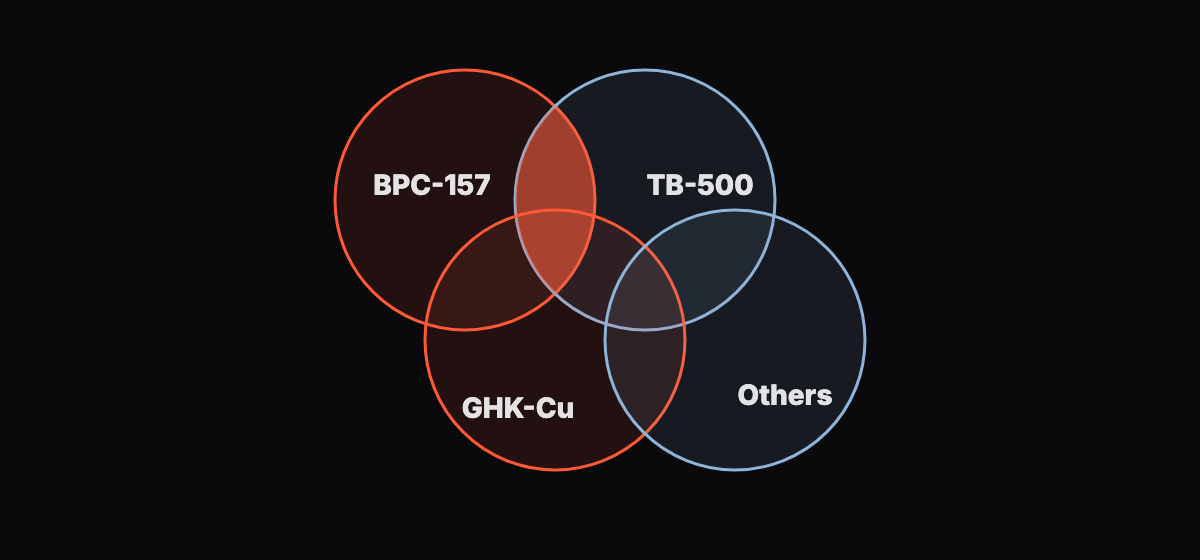
Blends sold under names like Glow and Klow. These combine BPC-157, TB-500 and GHK-Cu, and sometimes KPV. We found no human trial of any such blend. See the Glow and Klow page.
Compound by evidence grade
| Compound or option | Use claimed | What supports it | Grade |
|---|---|---|---|
| Exercise for knee osteoarthritis | Less pain, better function | 139 trials in a 2024 Cochrane review, low to moderate certainty | Human trials support |
| BPC-157 | Knee and joint pain relief | One uncontrolled chart review of 16 people; animal tendon and ligament studies | Small human reports only |
| BPC-157 | Cartilage or osteoarthritis repair | Animal and cell studies; no human osteoarthritis trial found | Animal or lab studies only |
| TB-500 | Joint pain relief | No human trial found; one rat tendon study | No published support found |
| GHK-Cu, injected | Joint or tissue repair | One rat ligament study, benefit gone by 12 weeks; no human injection trial | Animal or lab studies only |
| Glow, Klow and other blends | Joint pain relief | Clinic pages; no trial of any blend found | No published support found |
As of 2026-10-09. Grades use the fixed five-level key on our editorial policy page. A grade describes the published record, not whether a product is safe.
How to read a joint pain claim
A short list helps when a page says a peptide "supports joint health".
- Who says it? A clinic or shop page selling a visit or a product is making a claim. One clinic-style education page we read says a blend "may provide relief" for osteoarthritis-related joint pain and cites no trial. That is a claim.
- What was measured? Pain scores rated by phone months later are weak evidence. Imaging, function tests and a control group are stronger.
- Who was compared? Without a placebo group, improvement can come from rest, weather, regression to the mean or expectation. Joint pain waxes and wanes, which makes uncontrolled reports especially hard to read.
- In what species? A rat knee is not a person's knee. Recovery times and loads differ.
- What is the source of the compound? Unapproved products can differ from their labels. See the side effects page for what is documented about quality and safety.
What to ask a clinician
A licensed clinician can examine the joint, say which diagnosis fits and which options have human trial support. If you are considering any peptide, ask about its FDA status, the evidence for your specific use, how it could interact with your medicines, and who would monitor you. The muscle recovery page covers a nearby question, and the home page lists every guide.
Sources
- NIAMS: Osteoarthritis, diagnosis and steps to take (page on care) page last updated 2024-01-08, read 2026-10-09
- MedlinePlus: Osteoarthritis read 2026-10-09
- FDA: Certain bulk drug substances for use in compounding that may present significant safety risks page current as of 2026-04-22, read 2026-10-09
- FDA briefing document: TB-500 read 2026-10-09
- American College of Rheumatology and Arthritis Foundation 2019 guideline, Arthritis Care and Research 2020 PMID 31908149
- Cochrane 2024, exercise for knee osteoarthritis PMID 39625083
- Cochrane 2022, add-ons to exercise for hip and knee osteoarthritis PMID 36250418
- Lee and Padgett 2021, Alternative Therapies in Health and Medicine PMID 34324435
- Vasireddi et al. 2025, HSS Journal PMID 40756949
- Randomized trial of topical GHK-Cu after laser resurfacing, 2006 PMID 16847171
- AJSM 2026 primer on injectable peptide therapy PMID 41476424
- Rat knee ligament reconstruction with GHK-Cu, Journal of Orthopaedic Research 2015 PMID 25731775
FAQ
Does BPC-157 help joint pain?
One small, uncontrolled chart review of knee pain reports that most people said they had relief. It had no comparison group and no validated measure, so it cannot show that BPC-157 caused the change. The rest of the evidence is from animals.
Is TB-500 used for joint pain in human trials?
No trial we found tested TB-500 or thymosin beta 4 for joint pain as of 2026-10-09. Human trials of the full protein were for other conditions.
Are any peptides approved for joint pain?
The care sources we read (NIAMS, the guideline, Cochrane) name no peptide drug for osteoarthritis joint pain. BPC-157 and TB-500 are not approved for any use.
What do guidelines recommend for knee osteoarthritis?
The 2019 guideline strongly recommends exercise, weight loss for people who are overweight, self-management programs, tai chi and cane use, plus certain anti-inflammatory medicines and joint steroid injections for the knee.
Why do people say injected peptides work for sore joints?
Mostly because of personal reports and clinic pages. Joint pain changes over time on its own, so a report without a control group cannot separate a peptide effect from other causes.
Is GHK-Cu proven for joints?
No. A 2026 review writes that no clinical data support it for musculoskeletal conditions, and we found no controlled human trial of the injected form.
Not medical advice. See the medical disclaimer.