Quick answer: No FDA-approved drug contains BPC-157 or TB-500 as of 2026-10-09, in any form. We found no human study of a capsule or nasal spray of either compound. Rat studies of BPC-157 used drinking water, and FDA's briefing found no human pharmacokinetic data for oral, subcutaneous, nasal or transdermal use. Whether capsules or sprays do anything in people is unknown.
Searches for "capsules" and "oral" reflect a reasonable wish to avoid injections. This page asks only what the sources say about each route: which ones studies used, what is known in people, and what FDA has said about routes and quality. It gives no amounts and no how-to detail.
Route by evidence
The table below lists the routes that appear in the sources we reviewed. The middle columns separate animal work from human work, because the two are easy to blur.
| Route | What studies used | What is known in people | Where it comes from |
|---|---|---|---|
| Injection into the abdominal cavity | The main route for rat studies of BPC-157 and TB-500, including the 2026 rat tendon study | Not used in people | Rat studies, PMIDs 14554208 and 42542926 |
| Injection into a joint | A small knee-pain case series at a private clinic | Uncontrolled, no placebo group; shows nothing about effect | PMID 34324435 |
| Injection into the bladder wall | A small pilot at a private clinic | Single-arm, self-reported questionnaire | PMID 39325560 |
| Intravenous | BPC-157 in two participants; full-length thymosin beta 4 in healthy volunteers | The thymosin beta 4 studies report mild or moderate adverse events; the BPC-157 pilot is too small to establish safety | PMIDs 40131143, 20536472, 34346165 |
| Rectal enema | Older studies of BPC-157, as counted by FDA | FDA calls them short, with small samples and limited safety information | FDA BPC-157 briefing |
| Drinking water (oral) | Several rat studies of BPC-157 | No human oral pharmacokinetic data found by FDA | PMIDs 39861766, 18818478, 26872976 |
| Skin cream | Rat studies of BPC-157 | No human transdermal data found by FDA | PMIDs 20225319, 18668315 |
| Nasal spray | We did not locate a study of nasal use of either compound | No human nasal data found by FDA | FDA BPC-157 briefing |
| Capsule | We did not locate a study of a capsule | None found | Our PubMed and registry searches, 2026-10-09 |
| Eye drops and skin gel | Full-length thymosin beta 4 only | Human trials exist, mostly for eye and skin conditions; not TB-500 | ClinicalTrials.gov, PubMed |
As of 2026-10-09. The FDA entries come from its BPC-157 briefing document, hosted on its July 2026 advisory committee page (current as of 2026-08-06).
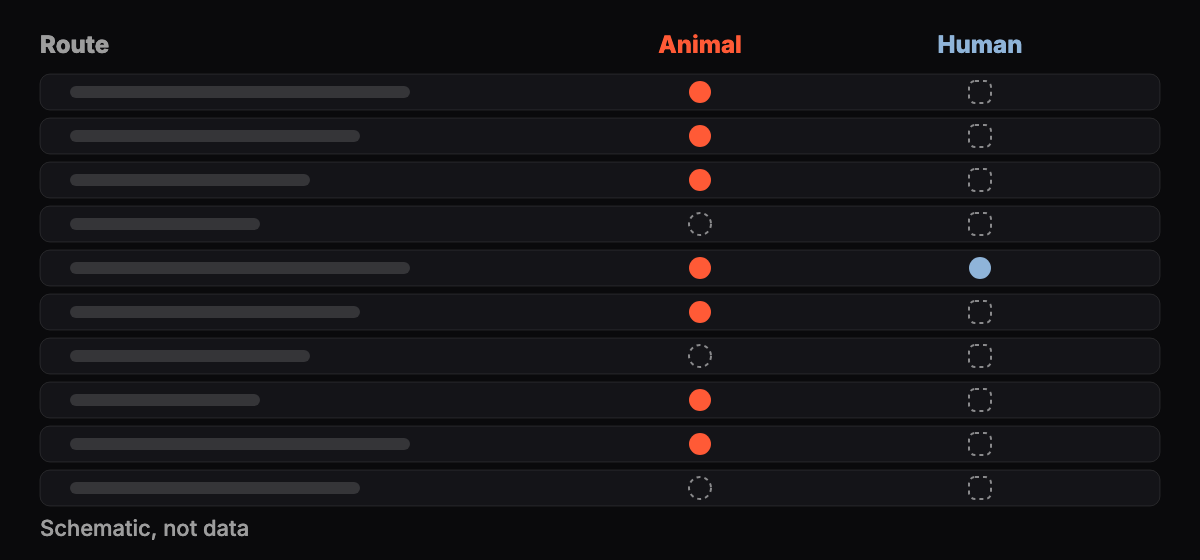
Two things stand out. First, the human evidence that does exist is for injections and enemas, not for anything swallowed or sprayed. Second, the few oral results are in rats, and the other oral products in circulation are described by sellers, not studied by anyone we could find.
What studies tested
BPC-157 by mouth in animals. A 2025 paper in Pharmaceutics gave BPC-157 to rats through the drinking-water route after a quadriceps muscle was detached from bone. It used six rats per group per time point and followed them for up to 90 days, with ultrasound, MRI, biomechanical tests and walking assessments. The authors reported that rats given BPC-157 reached muscle-to-bone reattachment, while controls showed definitive failure to repair (PMID 39861766). Earlier work from the same research tradition tested drinking water in rat models of intestinal fistula (PMIDs 18818478 and 26872976). These are rat results. They do not tell you whether a capsule would reach the bloodstream in a person or do anything once there.
Why stability is a question. Peptides are chains of amino acids, and digestion breaks proteins down, which is why swallowed peptide drugs are a design challenge in general. The group that developed BPC-157 states that it is stable in human gastric juice (PMID 17713731 from 2007, and a 2024 review, PMID 38980576). In the abstracts we read we did not find an independent measurement of that, and we did not find a human study of how much is absorbed.
What independent pharmacokinetics show. A 2022 study by an independent group in China measured BPC-157 in rats and beagle dogs after injection into muscle. It reported an elimination half-life under 30 minutes and bioavailability that differed between the two species (PMID 36588717). It is animal work, with injection, so it does not describe swallowing. A 2026 review in Pharmaceutics identified a gap between that short half-life and the long-lasting effects reported in animals, and argued that the main barrier to clinical use is missing pharmaceutical science, not missing biological activity (PMID 42198317).
TB-500 by any route. FDA's TB-500 briefing says no articles were found in which TB-500 was given to humans by any route, and that the potential risks in humans are unknown. The animal data on TB-500 we reviewed involve injection. The full-length protein, thymosin beta 4, has human trials as eye drops, a topical gel and an intravenous product. Those are different products from TB-500, as the TB-500 page explains in detail.
What FDA says about routes, forms and quality
All statements below are from FDA's pages and briefings read on 2026-10-09, with dates.
- Routes. FDA's bulk drug substances page, current as of 2026-04-22, says BPC-157 "may pose risk for immunogenicity for certain routes of administration." For TB-500 it cites immunogenicity risk from aggregation and impurities. Immunogenicity means the body may build an immune response to a product.
- Gaps by route. The BPC-157 briefing says FDA found no human pharmacokinetic data for oral, subcutaneous, nasal or transdermal use.
- Quality. The briefing describes BPC-157 as "considered not well-characterized" and says neither it nor TB-500 has a USP monograph.
- Supplements. The briefing states that BPC-157 is marketed in the United States as an ingredient in dietary supplement products and that there is no USP dietary supplement monograph. The passage does not address whether such sales are lawful, and we do not say.
- Products and reports. FDA's search of compounding-facility data for 2017 to mid-2025 found no reported compounded drug products containing BPC-157. Its adverse-event database, searched through 2025-12-04, returned three BPC-157 reports, all injectable.
- Warning letter. A letter dated 2023-06-12 describes a firm selling both compounds as injectables and as nasal sprays, and cites safety concerns about the injectable and intranasal routes. FDA's 2025 and 2026 letters to sellers of other peptides say a research-only label does not change intended use.
For the full legal picture, see BPC-157 side effects and documented harms and the legal summary linked from the home page.
Claims about oral and nasal forms, graded
The ledger below grades the claims that follow from selling capsules and sprays, using the site's fixed scale.
| Claim as marketed | Who says it | What supports it | Grade |
|---|---|---|---|
| "BPC-157 is stable in gastric juice" | The research group that developed it, in papers from 2007 and 2024 | Statements in that group's papers; no independent measurement in what we read; no human absorption data | Animal or lab studies only |
| "Oral BPC-157 supports recovery in rats" | Published rat studies, mostly from the same group | Rat models using drinking water; independent replication by this route not found in our reading | Animal or lab studies only |
| A capsule or spray gives the same result as an injection | Implied by capsule and spray products rather than stated in a study | No human study of either form; FDA found no human data for these routes | No published support found |
| A BPC-157 supplement has been studied in people | A product company's registry record | A single-group, unblinded product study with no results posted (ClinicalTrials.gov) | No published support found |
As of 2026-10-09. A registry listing shows that a study was registered, not that it found anything.
The last row needs context. A ClinicalTrials.gov record describes an unblinded, single-group study of a branded supplement gummy, registered by the product's company, with no results posted. We read it as a marketing document, not evidence. A separate entry that uses the TB-500 name describes itself as "fictional," so it cannot count either.
What this means for the capsule question
Read the sources together and the plain answer is that nobody knows. There are rat results for drinking water, a developer's statement about gastric stability, and no human absorption study. For TB-500, there is no human study by any route. That is not proof that oral or nasal forms do nothing. It means no source we found shows that they do. For what a product label can and cannot prove, see How to read a peptide label and COA. For why no amount can be sourced for any route, see the dosage explanation, the calculator page and the blend page. The compound pages cover BPC-157 and TB-500 separately, and the claims review grades the benefit claims.
Sources
- FDA: Certain Bulk Drug Substances for Use in Compounding That May Present Significant Safety Risks page current as of 2026-04-22, read 2026-10-09
- FDA: July 23-24, 2026 Pharmacy Compounding Advisory Committee meeting page current as of 2026-08-06, read 2026-10-09
- FDA briefing document: BPC-157 read 2026-10-09
- FDA briefing document: TB-500 read 2026-10-09
- FDA: warning letters index letter dated 2023-06-12 and letters 2025-2026, read 2026-10-09
- Matek et al. 2025, Pharmaceutics PMID 39861766
- He et al. 2022, Frontiers in Pharmacology PMID 36588717
- Mateescu et al. 2026, Pharmaceutics PMID 42198317
- Vuksic et al. 2007, Surgery Today PMID 17713731
- Klicek et al. 2008, Journal of Pharmacological Sciences PMID 18818478
- Baric et al. 2016, Life Sciences PMID 26872976
- Bicer et al. 2026, Joint Diseases and Related Surgery PMID 42542926
- Lee and Padgett 2021, Alternative Therapies in Health and Medicine PMID 34324435
- Lee et al. 2024, Alternative Therapies in Health and Medicine PMID 39325560
- Lee and Burgess 2025, Alternative Therapies in Health and Medicine PMID 40131143
- Thymosin beta 4 healthy-volunteer study 2010, Annals of the New York Academy of Sciences PMID 20536472
- Thymosin beta 4 first-in-human study 2021, Journal of Cellular and Molecular Medicine PMID 34346165
FAQ
Do BPC-157 capsules work?
No human study of a capsule was found. Rat studies used drinking water, and FDA found no human pharmacokinetic data for the oral route. Whether a capsule does anything in people is unknown.
Is there a BPC-157 or TB-500 nasal spray with evidence?
We did not locate a study of nasal use of either compound, and FDA found no human nasal data. A 2023 FDA warning letter described a firm selling both as nasal sprays and cited safety concerns for that route.
Does BPC-157 survive stomach acid?
The group that developed BPC-157 says it is stable in human gastric juice. We found no independent measurement and no human absorption study, so the claim remains unconfirmed.
Why would the route matter?
The route changes how much of a substance reaches the bloodstream and how the body responds. FDA notes immunogenicity risk "for certain routes of administration," and a rat result by one route does not carry over to another.
Are supplement forms regulated like drugs?
FDA's briefing says BPC-157 is marketed as a dietary supplement ingredient and has no USP supplement monograph. It does not address lawfulness in the passage we read, so we make no claim. FDA does not approve either compound as a drug.
Where is FDA's current position?
On its bulk drug substances page and its July 2026 meeting page. As of 2026-10-09 we found no final FDA decision on listing either substance.
Not medical advice. See the medical disclaimer.