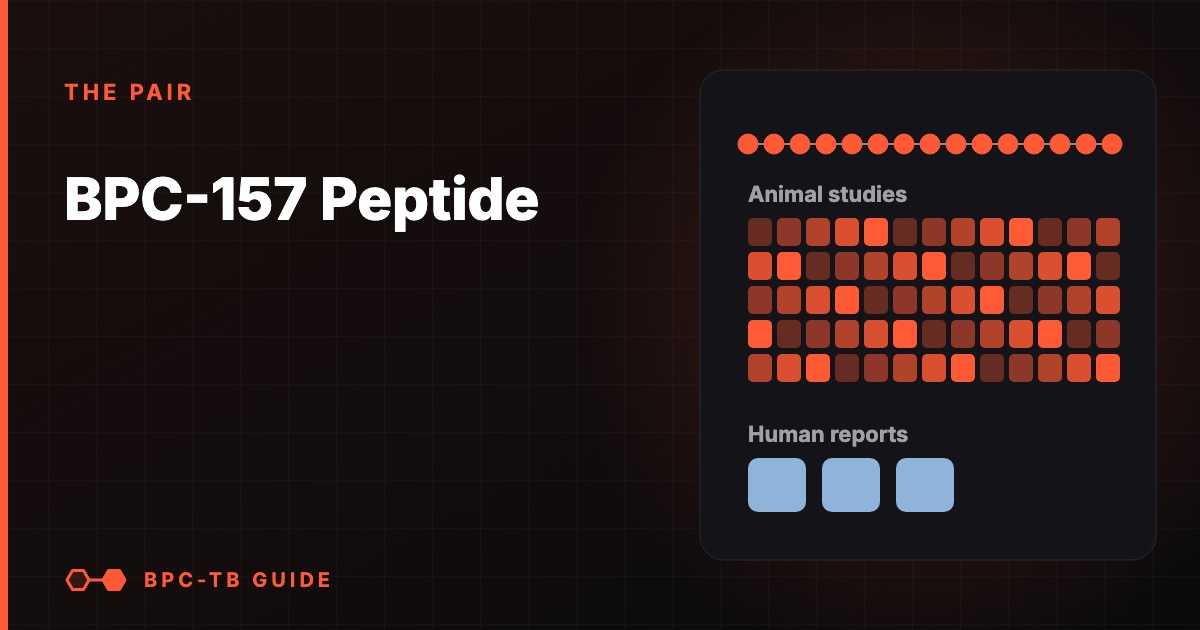
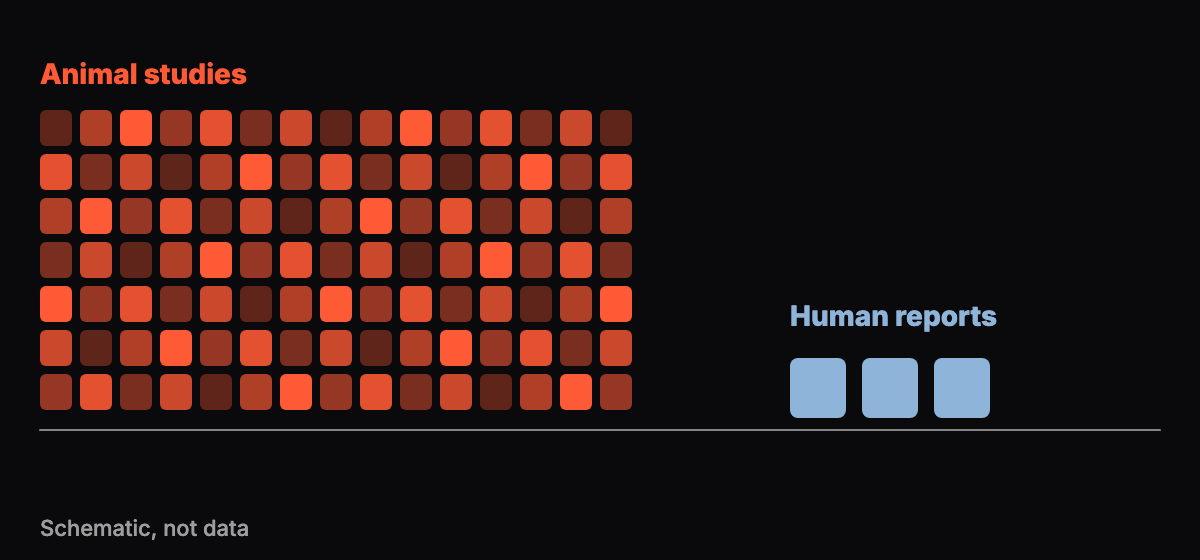
Quick answer: BPC-157 is a synthetic chain of 15 amino acids whose sequence was taken from a protein described in human gastric juice. No FDA-approved drug contains BPC-157 or TB-500 as of 2026-10-09. Most of the animal literature comes from one research group in Zagreb. Human data amount to three small, uncontrolled reports from one clinic team, and no randomized trial results are published.
BPC-157 is the more widely searched half of the Wolverine stack, which pairs it with TB-500. This page sets out where the name came from, who produced the research, what has and has not been done in people, and what FDA and WADA say. We report the evidence; we do not judge any reader's choices. General information, not medical advice.
- Approved product
None; FDA's 2026 briefing says it is not a component of an approved drug (as of 2026-10-09)
- FDA
Listed on the "nominated but withdrawn" table; FDA staff proposed not adding it to the 503A bulks list; no final decision found (as of 2026-10-09)
- WADA
Prohibited at all times under S0, non-approved substances, as a Specified Substance (2026 List, as of 2026-10-09)
- Human trials
Three small uncontrolled pilot reports; four ClinicalTrials.gov records, none with posted results (as of 2026-10-09)
What BPC-157 is and where the name comes from
The sequence given in the research papers is a chain of 15 amino acids, called a pentadecapeptide. "BPC" stands for "body protection compound." In the early 1990s a Zagreb pharmacology group used that name for a larger gastric-juice protein it was characterizing, and described BPC-157 as a 15-amino-acid fragment of it (PMID 8298609). An independent group in Taiwan later wrote that it is "a partial sequence" of that compound, isolated from human gastric juice (PMID 21030672).
Reviews describe the origin in different words. One calls it a peptide "isolated from human gastric juice"; another, a "synthetic pentadecapeptide derived from a gastric protein fragment." We use the plainest version: a synthetic peptide whose sequence was taken from a protein described in gastric juice. Whether the body makes BPC-157 itself is not settled by what we read. Papers also use other names, including PL 14736 and PLD-116.
Who produced the animal literature
We searched PubMed on 2026-10-09 for the name in titles and abstracts and counted 220 records that mention BPC. Of these, 172 list the Zagreb group's senior author, and 172 carry a Zagreb affiliation. About one in five records, 46 of 220, comes from outside that group. Among primary research papers, leaving out reviews and commentary, 139 of 168 include one of the two senior Zagreb authors. The share has fallen recently: of 42 records dated 2025 to 2026, 14 involve them, as outside review articles have appeared. These counts come from our own PubMed search of abstracts, so papers that name the compound only in full text are not counted.
A 2019 independent review put it in its own words: "only a handful of research groups" had studied the peptide, mostly in small rodent models (PMID 30915550). That is not a criticism of any lab. Replication by independent teams is simply how animal findings earn weight, and for BPC-157 it is thin. Independent work does exist: groups in Taiwan, China and Turkey have run tendon, toxicology and gastric studies. A 2026 critical review of rodent studies in one organ system called the evidence base "heterogeneous" and said independent blinded replication would be required (PMID 42794771).
| Evidence type | What exists | What it does not show |
|---|---|---|
| Animal studies | Over 200 PubMed records, mostly rats, mainly one group | That any result carries over to people |
| Cell studies | Tendon cells and blood-vessel cells in dishes | What happens in a living person |
| Human reports | Three small uncontrolled pilot reports | Whether it works or is safe |
| Randomized human trials | None published | Any efficacy |
As of 2026-10-09, from the PubMed searches described above.
What the animal studies tested
Most are rat models in which an injury is created, the animal is given the peptide or saline, and recovery is measured. Examples from the record, with routes only:
- Tendon and ligament. Cut Achilles tendons, tendon-to-bone detachment and a cut knee ligament, mostly by injection into the abdominal cavity (PMIDs 14554208, 16583442, 20225319). The authors report higher load to failure and more organized tissue in the injected rats. Group sizes are not in the abstracts.
- Muscle. A cut thigh muscle and a crushed calf muscle, followed from two weeks to over two months (PMIDs 16609979, 18668315). A 2025 study with 6 rats per group and ultrasound follow-up used drinking water as the route (PMID 39861766).
- Gut. Fistula, colitis, bowel-join and short-bowel models, nearly all from the Zagreb group (for example PMIDs 18818478, 24304574, 19093208).
- Nerve and bone. A cut sciatic nerve, a spinal cord injury, and a rabbit bone gap (PMIDs 19903499, 31266512, 10071911).
Each is an animal finding. The independent 2026 rat study of Achilles repair (PMID 42542926, 32 rats, 8 per group, four weeks) reported that BPC-157 alone showed numerically lower tendon-damage scores but did not reach statistical significance on the total scores, while the TB-500 group did. The authors call it exploratory and say the combination "did not confer additional benefits," although one score favored it. That is one small study.
The small human reports
Three reports exist, all from one author team working in private clinics, all published in the same journal, Alternative Therapies in Health and Medicine.
- Knee pain (2021, PMID 34324435). A retrospective chart review at a private clinic. Seventeen patients were identified and 16 were reached by phone: 12 had BPC-157 only and 4 had it with a thymosin beta 4 product. They were asked by phone, at varying times after the injection, to rate pain relief. The abstract states that "no specific tools" measured function, quality of life or stiffness. It is uncontrolled, unblinded and self-reported, and the combination group is too small to say anything. Two later reviews quote its results differently, so we print no outcome figures.
- Interstitial cystitis (2024, PMID 39325560). Twelve women who had not responded to another drug received one injection by cystoscope. The outcome was a single self-rated questionnaire. There was no placebo and no blinding. The abstract reports no adverse events.
- Intravenous safety pilot (2025, PMID 40131143). Two people, both of whom had received intravenous BPC-157 before. Blood tests and vital signs were taken around infusions over three days. The authors state that future studies are needed to confirm safety.
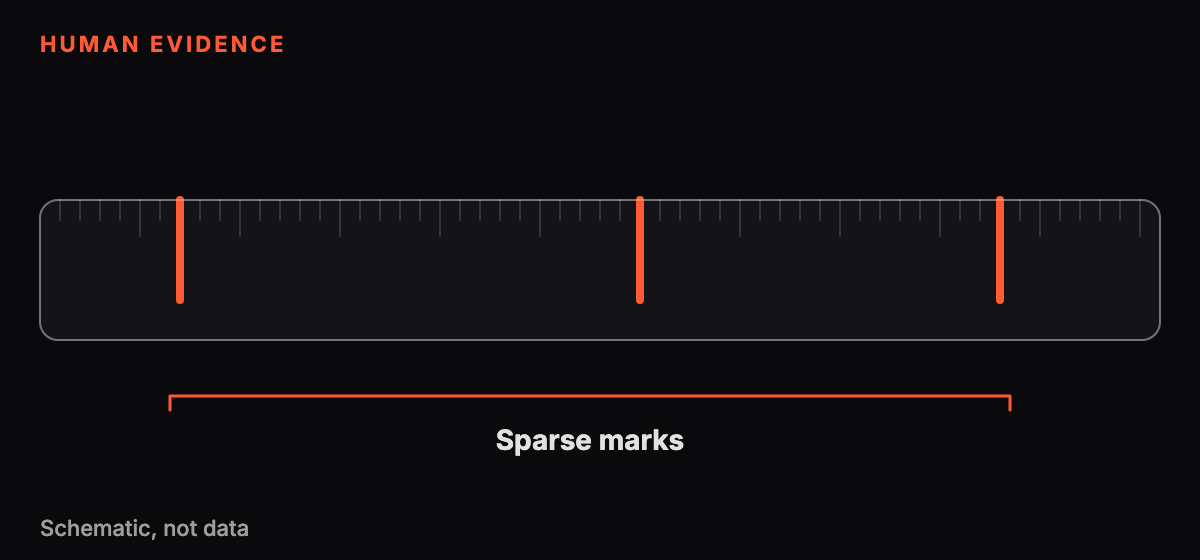
Taken together, about 30 people. A 2026 review put it as "fewer than 30 subjects across three uncontrolled pilot studies" and added that none used standardized pharmaceutical preparations (PMID 42198317). These reports cannot show that BPC-157 works, and they cannot establish safety.
The systematic review
A 2025 systematic review in orthopaedic sports medicine (HSS Journal, PMID 40756949) searched three databases up to 2024-06-03. It identified 544 articles and included 36: 35 preclinical studies and 1 clinical study. Its authors said the work "suggests that BPC-157 shows promise" for musculoskeletal recovery, while rating the evidence at levels IV and V, the lowest tiers. They also wrote: "No clinical safety data were found." They note that adverse effects are possible because of unregulated manufacturing, contamination or unknown safety. Its search ended before the 2025 intravenous pilot appeared. Other 2025 and 2026 reviews reach the same conclusion in their own words: that it should be considered investigational, with human data extremely limited.
ClinicalTrials.gov records
As of 2026-10-09 ClinicalTrials.gov lists four records that mention BPC-157, none with posted results. We searched under the main names and found no registered trial of the inflammatory bowel disease use that papers from the producing group describe.
| Record | What it is | Status shown |
|---|---|---|
| NCT02637284 | Phase 1 safety and pharmacokinetics in healthy volunteers, with placebo | "Unknown"; last update 2015-12-22 |
| NCT07437547 | Phase 2, placebo-controlled, for hamstring muscle strain | Recruiting; start 2026-02-02 |
| NCT07803250 | Pilot after rotator cuff surgery at the University of Arkansas | Not yet recruiting |
| NCT07752381 | An 8-week single-group study of a consumer supplement gummy | Completed; a product study, not evidence about the drug |
As of 2026-10-09. Two reviews say the 2015 study ended without published results, but the registry itself shows only an unknown status. Other registries (European, Chinese, Australian) were not searched.
What FDA says
FDA's bulk-drug-substances page, current as of 2026-04-22, lists BPC-157 under "Bulk drug substances nominated but withdrawn." For BPC-157 it cites a risk of immunogenicity for certain routes and complexities with peptide-related impurities. In its briefing for the July 2026 advisory meeting, FDA said BPC-157 is "considered not well-characterized," that no pharmacopeia monograph exists, and that it is not a component of an approved drug. The use FDA evaluated was ulcerative colitis. FDA counted five small human studies and described them as short, with small samples and limited safety data. It also found three adverse-event reports mentioning BPC-157 and said it could not draw definitive conclusions from them.
FDA staff proposed that BPC-157 not be added to the 503A bulks list. News outlets reported a narrow advisory vote in favor on 2026-07-23, but FDA's meeting page, current as of 2026-08-06, shows no vote summary, and the committee's role is non-binding. As of 2026-10-09 we found no final FDA decision. Details are on our legal status page.
What WADA says
The WADA 2026 List, in effect 2026-01-01, names BPC-157 as an example under S0, prohibited at all times, and states that every substance in that class is a Specified Substance. Reviews disagree about its history on the List, and one says WADA once added and reversed it; the 2026 List text itself names it. See our sports ban page, and check the current List.
Safety information, as stated
Animal toxicology work from a Chinese group tested mice, rats, rabbits and dogs and reported no serious toxicity (PMID 32334036). A separate pharmacokinetic paper reported a half-life under 30 minutes in animals (PMID 36588717). Human safety data are the three pilot reports above. A 2025 review raised a theoretical concern: because the peptide raises a blood-vessel growth receptor in lab tests and the family of such receptors appears in many cancers, it argued caution where cancer might be undetected. The producing group's reply calls that speculation. There are no human data on either side. See side effects.
Claims you will see, and what supports them
Grades use the fixed five-level key; the benefits page explains it.
| Claim as marketed | Who says it | What supports it | Grade |
|---|---|---|---|
| "Repairs tendons and ligaments" | Clinic pages, forum posts, shop blogs | Rat tendon and ligament models, mostly one group; no controlled human study | Animal or lab studies only |
| "Soothes the gut and colitis" | Clinic pages, shop blogs | Rat gut models; a registry search found no registered colitis trial | Animal or lab studies only |
| "Relieves knee pain" | Clinic pages, forums | One small retrospective, uncontrolled series at a private clinic | Small human reports only |
| "Clinically proven" | Shop blogs | No randomized human trial published | Contradicted by sources |
| "Approved for use in people" | Some seller pages | FDA says no approved drug contains it | Contradicted by sources |
| "Capsules and sprays work as well as injections" | Capsule marketing | No human oral study found for these uses | No published support found |
As of 2026-10-09.
Related reading
Compare it with the other half on TB-500 versus BPC-157, and with thymosin beta 4. Dosing, capsules and oral forms and why no dose is set have separate pages. The applied questions are covered under tendon injuries, joint pain, muscle recovery and forum claims; Glow and Klow blends are another product type. The question of where products come from is addressed there. Start from the homepage if you are new.
Sources
- FDA: Certain bulk drug substances for use in compounding that may present significant safety risks page current as of 2026-04-22, read 2026-10-09
- FDA: July 23-24, 2026 Pharmacy Compounding Advisory Committee meeting page current as of 2026-08-06, read 2026-10-09
- FDA: briefing document on BPC-157 read 2026-10-09
- WADA: 2026 Prohibited List in effect 2026-01-01, read 2026-10-09
- USADA: BPC-157, what athletes should know page modified 2026-08-10, read 2026-10-09
- ClinicalTrials.gov: NCT02637284 read 2026-10-09
- ClinicalTrials.gov: NCT07437547 read 2026-10-09
- ClinicalTrials.gov: NCT07803250 read 2026-10-09
- ClinicalTrials.gov: NCT07752381 read 2026-10-09
- Vasireddi et al. 2025, HSS Journal PMID 40756949
- Mateescu et al. 2026, Pharmaceutics PMID 42198317
- McGuire et al. 2025, Current Reviews in Musculoskeletal Medicine PMID 40789979
- Lee and Padgett 2021, Alternative Therapies in Health and Medicine PMID 34324435
- Lee et al. 2024, Alternative Therapies in Health and Medicine PMID 39325560
- Lee and Burgess 2025, Alternative Therapies in Health and Medicine PMID 40131143
- Gwyer et al. 2019, Cell and Tissue Research PMID 30915550
- Demirtas 2026, International Journal of Molecular Sciences PMID 42794771
- Bicer et al. 2026, Joint Diseases and Related Surgery PMID 42542926
- Staresinic et al. 2003, Journal of Orthopaedic Research PMID 14554208
- Sikiric et al. 1993, Journal of Physiology (Paris) PMID 8298609
- Chang et al. 2011, Journal of Applied Physiology PMID 21030672
- Xu et al. 2020, Regulatory Toxicology and Pharmacology PMID 32334036
- He et al. 2022, Frontiers in Pharmacology PMID 36588717
- Matek et al. 2025, Pharmaceutics PMID 39861766
FAQ
What is BPC-157?
A synthetic 15-amino-acid peptide whose sequence was taken from a protein described in human gastric juice. It has been studied mainly in rats and has never been approved as a drug.
Is BPC-157 approved by FDA?
No. No FDA-approved drug contains BPC-157 or TB-500 as of 2026-10-09. FDA's briefing states it has no pharmacopeia monograph and is not a component of an approved drug.
Has BPC-157 been tested in humans?
Three small uncontrolled pilot reports exist, covering about 30 people, plus a few registry records. No randomized trial results are published as of 2026-10-09.
Who has done most of the BPC-157 research?
By our count of PubMed abstracts, 172 of 220 records come from one Zagreb group. Independent labs have published some work, and independent reviews call for replication.
Is BPC-157 banned in sports?
WADA's 2026 List includes it under S0, prohibited at all times. USADA's page says it is unknown whether a safe dose exists. Check the current List each year.
Is it the same as the gummy supplements in a registry?
No. One registry record covers a consumer supplement with BPC-157 on its label, run by the product's own company. We read it as a product study, not evidence about the peptide drug.
Not medical advice. See the medical disclaimer.