Quick answer: No FDA-approved drug contains BPC-157 or TB-500 as of 2026-10-09. Every controlled tendon result we found comes from animals, mostly rats. We found no published human trial of either compound for a tendon or ligament injury. Care options with human trial support exist, such as exercise-based rehabilitation, though Cochrane reviews often grade that evidence as low certainty. This page lays out each study by design.
People who find the "Wolverine stack" online usually arrive with one question: will it help an injured tendon? This page answers only what the published record shows. It separates studies in cells, studies in rats, small human reports and registered trials, and it begins with what the human evidence says about ordinary care, because the comparison matters.
What the human evidence says about ordinary tendon care
Tendon problems are a hard area for research, and the conventional options are not proven beyond doubt either. A fair comparison starts there.
A 2020 systematic review of systematic reviews pooled 25 reviews of randomized trials (PMID 32484976). It reports that exercise-based rehabilitation using eccentric loading was the most common and most consistently supported approach. Shockwave therapy and low-level laser got a "moderate" rating, platelet-rich plasma was called inconclusive, and corticosteroid injections reduced pain in the short term but were not supported over the long term. It does not show that one exercise type is proven for every tendon.
Cochrane reviews, which grade the certainty of evidence, show the same pattern of limits:
- A 2025 Cochrane review of exercise for patellar tendinopathy included 7 trials and 211 athletes. Its authors say they are very uncertain whether strengthening reduces pain compared with no care, and the certainty is low (PMID 40421598).
- A 2014 Cochrane review of platelet-rich therapies for soft tissue injuries found 19 small trials with 1,088 people and concluded the evidence was insufficient to support their use (PMID 24782334).
- A 2015 Cochrane review of injection therapies for Achilles tendinopathy covered 18 studies and 732 people and found insufficient evidence to support routine use. The one major adverse event it reports was an Achilles rupture in a corticosteroid-injection trial (PMID 26009861).
- A 2020 Cochrane review of shock wave therapy for rotator cuff disease covered 32 trials and 2,281 people and reports very few clinically important benefits and some uncertainty about safety (PMID 32128761).
The honest contrast is this. Conventional tendon care has human trials with limited certainty. BPC-157 and TB-500 have almost no human data at all. That is a difference in kind, not only in degree.
The BPC-157 and TB-500 studies, by design
The table lists the main studies we found, in order of how close they are to a person with a tendon injury. Doses are left out on purpose, as they are on every page here.
| Study | Design | Who or what | Stated result | What it does not show |
|---|---|---|---|---|
| Rat Achilles cut, Zagreb group, 2003 (PMID 14554208) | Animal; daily injection into the abdomen vs saline, 14 days | Rats, group size not stated in the abstract | Authors report improved load to failure and function | Anything about people; independent replication |
| Rat Achilles tendon-to-bone detachment, 2006 (PMID 16583442) | Animal; daily injection, 21 days | Rats, group size not stated in the abstract | Authors report better function and collagen organization, and less harm from a corticosteroid | The same group wrote the paper; no human data |
| Rat ligament cut, 2010 (PMID 20225319) | Animal; three routes, followed 90 days | Rats | Authors report functional and tissue improvements | Group sizes not given in the abstract |
| Tendon cells in a dish, Taiwan, 2011 (PMID 21030672) | Cell culture | Rat tendon explants and cells | BPC-157 sped outgrowth of tendon explants and cell migration | Any result in a living animal or person |
| Rat Achilles cut and repaired, Istanbul, 2026 (PMID 42542926) | Animal; four groups, four weeks | 32 rats, 8 per group | TB-500 alone reached significance on strength and tissue scores; BPC-157 alone did not on total scores | Human effect; dose-finding; durability |
| Thymosin beta 4 in a sealant, rat ligament, 2013 (PMID 23523891) | Animal; local placement at the wound | Rats | Authors report better collagen organization and mechanical properties | TB-500; injection away from the injury |
| Knee pain chart review, 2021 (PMID 34324435) | Human; retrospective, uncontrolled, phone follow-up | 16 people at one private clinic | Authors report that most people said they had relief | Whether BPC-157 caused it; it concerns knee pain, not tendon |
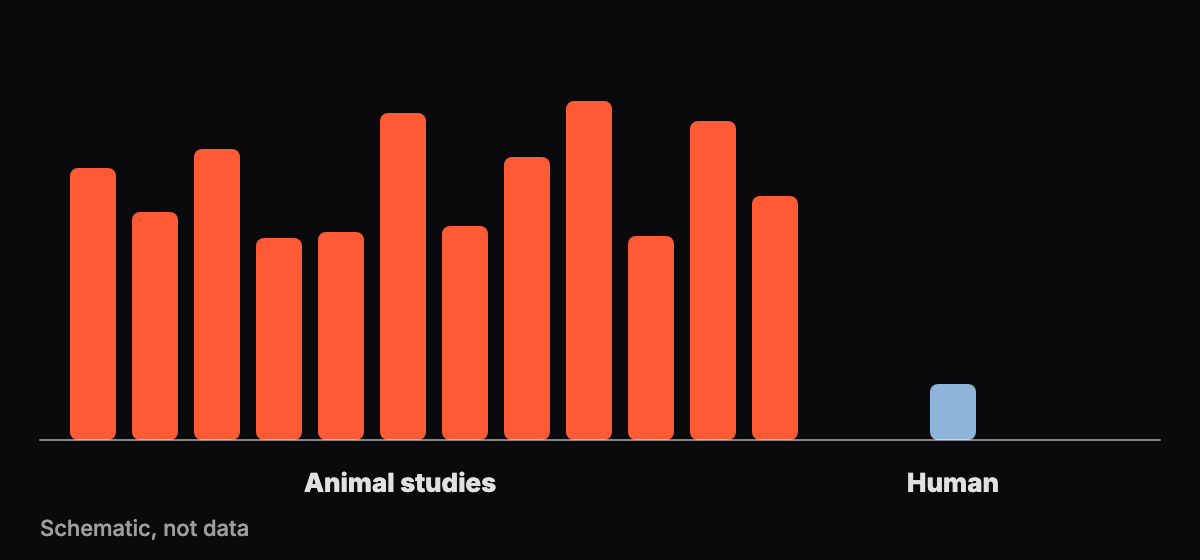
As of 2026-10-09, this is the whole table. Most of the animal rows come from one research group in Zagreb. In a count of 220 PubMed records that mention BPC-157, we counted 172 that list the Zagreb group's senior author, so replication by unrelated laboratories is thin.
The one study that tested the pair together
The rat Achilles study from Istanbul, published in Joint Diseases and Related Surgery in 2026, is the only direct comparison of BPC-157, TB-500 and both together we found (PMID 42542926). It used 32 rats, 8 per group, with a cut and repaired Achilles tendon, and ran four weeks.
The authors report that the TB-500 group had a significantly higher load to failure than the control group and significantly lower Bonar and Movin tendon scores. The combined group had a significantly lower Movin score, which is one score. BPC-157 alone showed numerically lower total scores without reaching statistical significance. The authors state that the combination did not confer additional benefits over either agent alone, and they call the work an exploratory rat model study.
Read that carefully. A single small study in rats, with one injury model, is the strongest tendon result in this literature, and it did not favor the stack over a single compound. It also does not tell us what happens in a person, at what exposure, or over what time.
What reviews conclude about human data
A 2025 systematic review in the HSS Journal searched to 2024-06-03, identified 544 articles and included 36 studies: 35 preclinical and 1 clinical (PMID 40756949). Its authors write that the compound shows promise for recovery from musculoskeletal injuries, based on level IV and V evidence, and that no clinical safety data were found. A 2025 narrative review says only three pilot studies have examined BPC-157 in people and that it should be considered investigational (PMID 40789979). A 2026 review in the American Journal of Sports Medicine says human orthopaedic data are lacking for thymosin beta 4 and TB-500 (PMID 41476424).
For TB-500 the evidence is thinner still. The name is not used consistently: some papers describe a short fragment of thymosin beta 4, others the whole protein. Results from the whole protein cannot be carried over to the fragment. Every human trial of thymosin beta 4 we found used the full-length protein for eye, skin or heart conditions. Our search of PubMed and ClinicalTrials.gov on 2026-10-09 found no trial of thymosin beta 4 or TB-500 for tendon, muscle or joint injury. See TB-500 and thymosin beta 4 for the distinction.
Registered trials
ClinicalTrials.gov lists four records that mention BPC-157 as of 2026-10-09, and none has posted results. Two relate to musculoskeletal injury. One is a Phase 2 placebo-controlled study of an acute hamstring strain, listed as recruiting (NCT07437547). The other is a small pilot after rotator cuff repair surgery, listed as not yet recruiting (NCT07803250). A hamstring strain involves muscle and its tendon junction, and a rotator cuff repair involves tendon, so both are on topic, but neither has produced a result. The other two records are an older Phase 1 safety study of unknown status and a supplement product study that is not a drug trial.
A registration is not a result. One registry entry that carries the name TB-500 describes itself as a fictional example record, so a listing alone is not proof that a study exists.
What FDA says
FDA's page on bulk drug substances for compounding, current as of 2026-04-22, lists BPC-157 and the thymosin beta-4 fragment also known as TB-500 under "nominated but withdrawn". FDA's briefing document on TB-500 for its advisory committee cites a lack of clinical and nonclinical safety information and says the potential safety risks in humans are unknown. The same briefing notes that FDA-approved therapies for wound management exist. The committee met on 2026-07-23; FDA's meeting page, current as of 2026-08-06, posts briefing documents but no vote summary, and we found no final FDA decision as of 2026-10-09. Check FDA's pages for anything newer. Our legal status page has the detail, and the side effects page covers what is documented about safety.
Why animal tendon results do not transfer cleanly
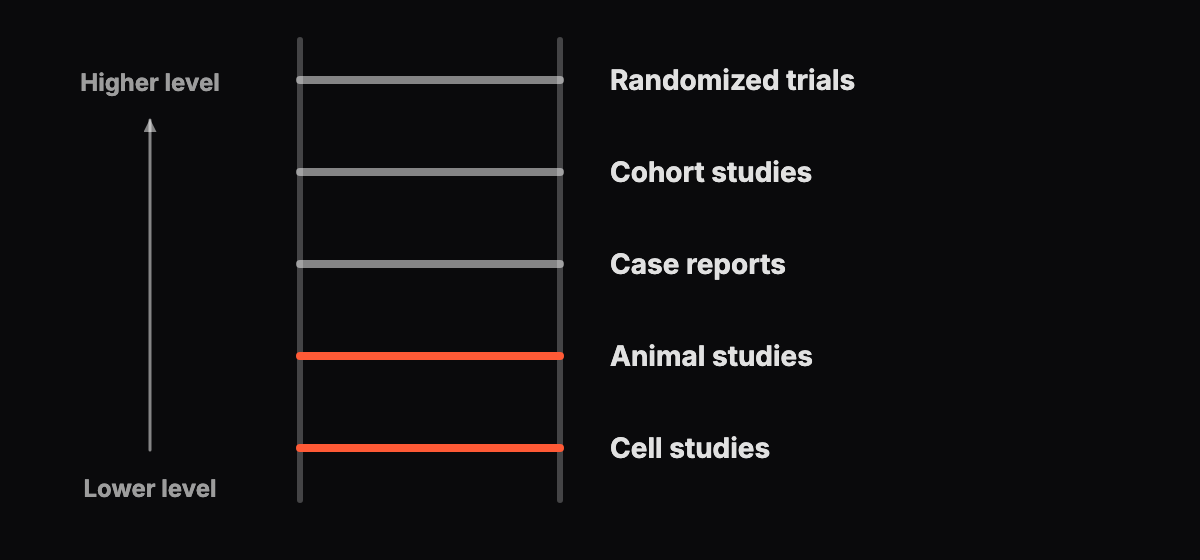
A rat tendon that is cut and repaired in a laboratory is a clean, controlled injury. Many human tendon problems build up slowly from overuse, which makes them a different problem. Rats also recover quickly, and groups of eight animals can produce a significant score by chance or by the choice of measure. Independent critical reviewers have described the BPC-157 animal base as heterogeneous, with short observation periods and a need for blinded replication (PMID 42794771, a review of ischemia studies, not tendon work). That does not mean the animal results are wrong. It means they are a reason to run careful human trials, which is what the two registered studies above may eventually do.
A claim that a compound "supports tendon repair" therefore needs a label: this is an animal finding, and the human question is open. Our benefits page grades each common claim in the same way, and the joint pain and muscle recovery pages apply the same method to related questions.
What a reader can reasonably do with this
Nothing on this page tells you what to do medically. If you have a tendon injury, a licensed clinician can examine it, explain which options have human trial support and what that support looks like, and note anything that would make an unapproved product riskier for you. If you want to compare how the two compounds differ, our TB-500 vs BPC-157 page sets them side by side, the BPC-157 page covers the human reports in detail, and the Wolverine stack page explains the nickname. The home page lists every guide.
Sources
- FDA: Certain bulk drug substances for use in compounding that may present significant safety risks page current as of 2026-04-22, read 2026-10-09
- FDA: July 23-24, 2026 meeting of the Pharmacy Compounding Advisory Committee page current as of 2026-08-06, read 2026-10-09
- FDA briefing document: TB-500 read 2026-10-09
- Bicer et al. 2026, Joint Diseases and Related Surgery PMID 42542926
- Vasireddi et al. 2025, HSS Journal PMID 40756949
- McGuire et al. 2025, Current Reviews in Musculoskeletal Medicine PMID 40789979
- Lee and Padgett 2021, Alternative Therapies in Health and Medicine PMID 34324435
- Staresinic et al. 2003, Journal of Orthopaedic Research PMID 14554208
- Krivic et al. 2006, Journal of Orthopaedic Research PMID 16583442
- Cerovecki et al. 2010, Journal of Orthopaedic Research PMID 20225319
- Chang et al. 2011, Journal of Applied Physiology PMID 21030672
- Thymosin beta 4 in fibrin sealant, rat ligament, Regulatory Peptides 2013 PMID 23523891
- AJSM 2026 primer on injectable peptide therapy PMID 41476424
- Demirtas 2026, International Journal of Molecular Sciences PMID 42794771
- Systematic review of systematic reviews on tendinopathy care, 2020, Scandinavian Journal of Medicine and Science in Sports PMID 32484976
- Cochrane 2025, exercise for patellar tendinopathy PMID 40421598
- Cochrane 2014, platelet-rich therapies for soft tissue injuries PMID 24782334
- Cochrane 2015, injection therapies for Achilles tendinopathy PMID 26009861
- Cochrane 2020, shock wave therapy for rotator cuff disease PMID 32128761
- ClinicalTrials.gov NCT07437547 read 2026-10-09
- ClinicalTrials.gov NCT07803250 read 2026-10-09
FAQ
Is there a human trial of BPC-157 or TB-500 for tendon injuries?
Not a published one. As of 2026-10-09 we found no published human trial of either compound for a tendon injury. Two BPC-157 studies are registered, one for a hamstring strain and one after rotator cuff repair surgery, and neither has posted results.
Do the rat studies show the pair works?
They show some results in rats. The one study that tested both together reported that the combination did not add benefit over a single compound, and that BPC-157 alone did not reach significance on the main tendon scores.
What is the strongest evidence for tendon care in general?
Reviews of randomized trials point most often to exercise-based rehabilitation, though Cochrane reviews often grade the certainty as low. Injections and other options have mixed or insufficient evidence in the reviews cited above.
Why do clinic pages say these peptides support tendon repair?
Clinic and shop pages are marketing and often cite the animal studies. A claim from a clinic page is graded here as a claim, never as evidence.
Are these compounds approved for tendon problems?
No. No FDA-approved drug contains BPC-157 or TB-500 as of 2026-10-09, and FDA has approved neither for any tendon or ligament use.
Is TB-500 the same as thymosin beta 4?
Sources differ. FDA's briefing handles them as different substances. Studies of the whole protein do not carry over to the fragment sold under the TB-500 name.
Who should I ask about a tendon injury?
A licensed clinician who can examine the injury. Bring written questions about any peptide to the visit.
Not medical advice. See the medical disclaimer.