Quick answer: TB-500 is the name sold for a short piece of the natural protein thymosin beta 4, though sources do not agree on what a bottle labeled TB-500 holds. No FDA-approved drug contains TB-500 as of 2026-10-09. We found no published human trial of it, only animal and laboratory work. WADA prohibits it at all times (2026 List, section S2.3).
TB-500 is one half of the pairing that forums nickname the Wolverine stack. This page covers the half that is hardest to pin down, because the name is used for more than one thing. It explains what the name refers to, what has been tested in animals and people, what FDA and WADA say, and which common claims have nothing behind them. General information, not medical advice.
- Approved product
None found in FDA, DailyMed or European Medicines Agency product data (as of 2026-10-09)
- FDA
Listed on FDA's "nominated but withdrawn" table; FDA staff proposed not adding it to the 503A bulks list; no final FDA decision found (as of 2026-10-09)
- WADA
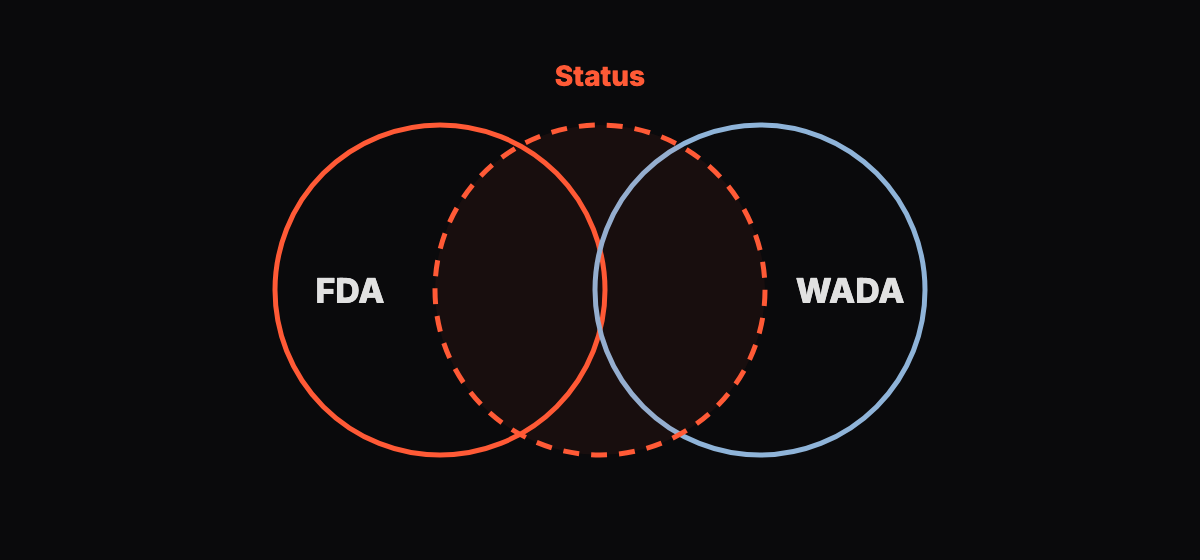
Prohibited at all times, section S2.3 of the 2026 List, as "Thymosin-ß4 and its derivatives e.g. TB-500" (as of 2026-10-09)
- Human trials
No real registered or published human trial of TB-500 found; full-length thymosin beta 4 has been tested in people (as of 2026-10-09)
What TB-500 is
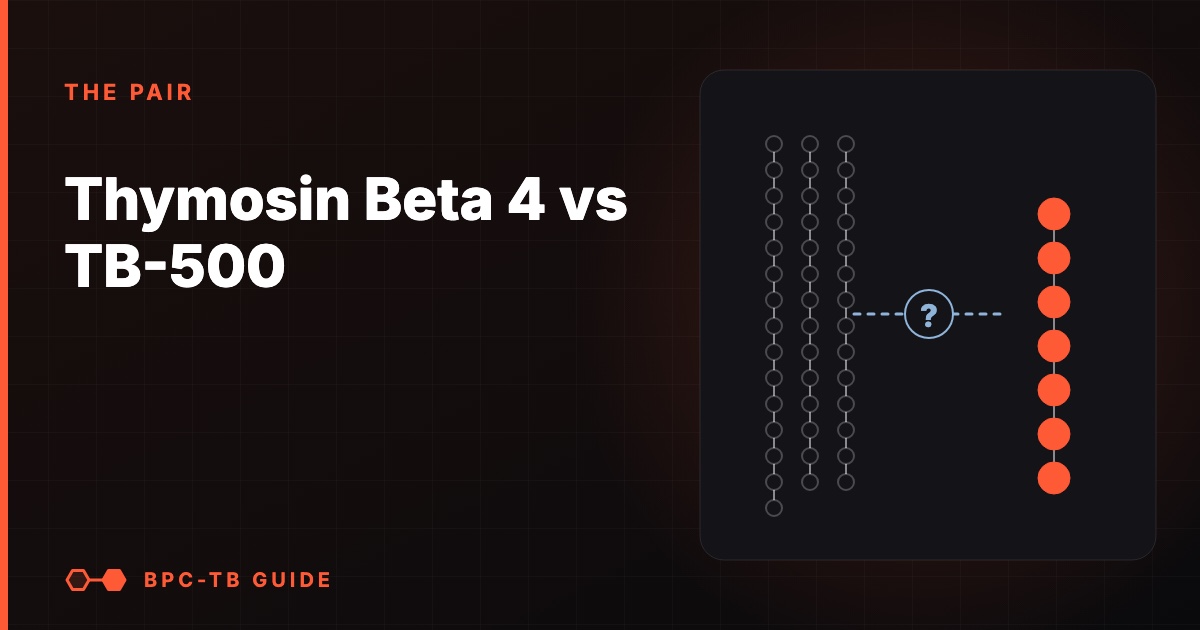
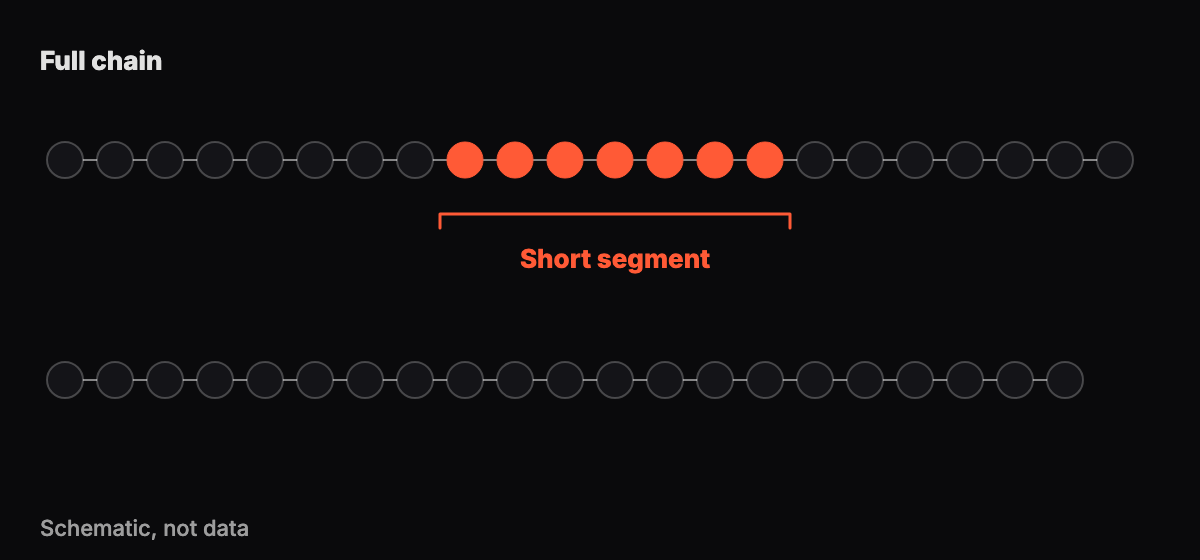
Thymosin beta 4 is a protein of 43 amino acids found in cells as a naturally occurring protein. UniProt, the public protein database, describes it as binding to actin, a structural protein inside cells. Reviews credit it with many roles in cell movement and tissue response, mostly from cell and animal work. It is the full protein. Our page on thymosin beta 4 and how it differs from TB-500 covers it in detail.
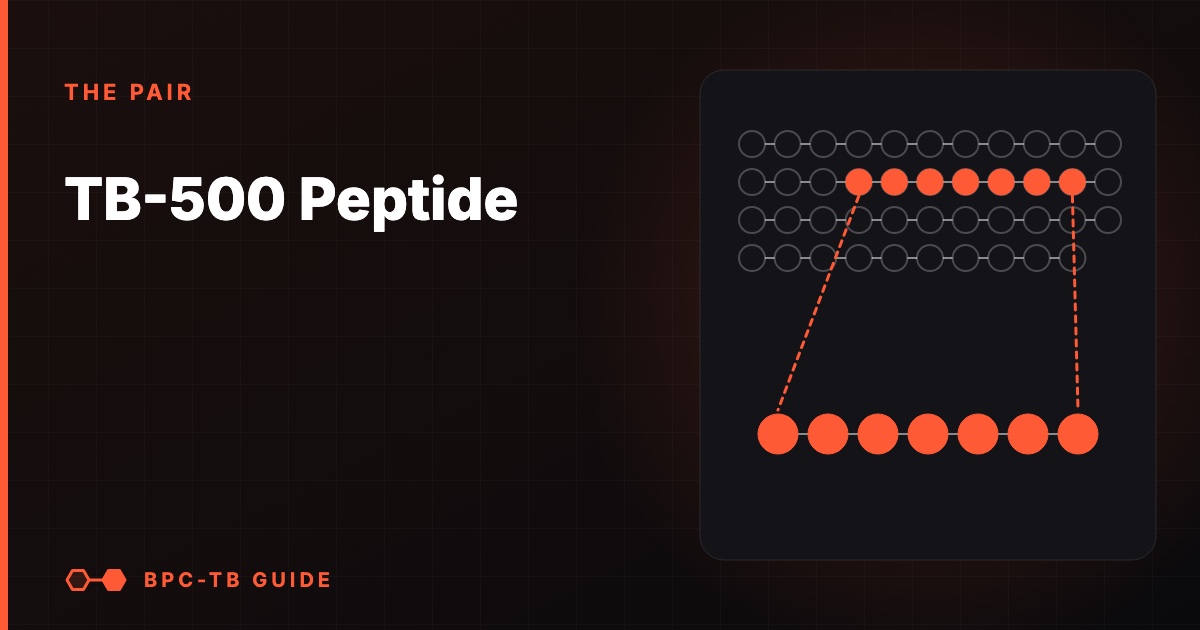
TB-500 is something else. Doping-control chemists who analyzed products called TB-500 in 2012 and 2013 reported that the key ingredient was a seven-amino-acid piece, written LKKTETQ, with an acetyl group added at one end. That piece matches positions 17 to 23 of the natural protein. Those same papers call TB-500 "a veterinary preparation," a phrase from the abstract of a 2012 equine study (PMID 23084823). FDA's briefing adds that a veterinary preparation of TB-500 appeared in 2011 and was marketed for equine and greyhound sports. We found no source that says who first coined the name, so we do not say.
FDA uses the same definition. In its briefing document for the July 2026 advisory meeting, the agency describes TB-500 as "a seven amino acid synthetic fragment of thymosin beta-4." A footnote states the two are "not the same substance," in the agency's words.
The definition problem
Here is where the confusion starts. The name does not mean the same thing in every source we read.
| Source | How it defines TB-500 |
|---|---|
| Equine chemistry papers, 2012 and 2013 | The acetylated fragment LKKTETQ |
| FDA briefing and category page, 2026 | The fragment LKKTETQ, distinct from the whole protein |
| WADA 2026 List | "Thymosin-ß4 and its derivatives e.g. TB-500," with no structure given |
| A 2025 anti-doping paper (PMID 39314109) | Online products claim "a synthetic acetylated fragment of TB4 or TB4 itself" |
| Some 2026 reviews | Use "thymosin beta-4 or TB-500" as if one item |
As of 2026-10-09 this table is our reading of those sources. The practical point is that no document we read can tell you what a given bottle contains. The fragment, the whole protein or something else could sit behind the same label, and the sources describing retail products say so themselves.
Fragment versus whole protein
Why does it matter? Evidence is attached to a specific substance. Studies of the full protein cannot be carried over to a seven-amino-acid piece, any more than results for a sentence tell you about one word of it.
A 2024 laboratory and rat study of the acetylated fragment (PMID 38382158) makes the point sharply. Its authors wrote that the "biological effects of TB-500, however, have not been documented." In cultured skin cells, one of the breakdown products they identified, a shorter piece called Ac-LKKTE, showed activity in a wound assay, while the parent fragment did not. The authors suggested that earlier reports of activity "may be due to its metabolite." This is a cell-dish and rat-urine study, not a trial, and it does not show any effect in a person. FDA's briefing records a similar in-vitro finding.
What exists in animals
The only direct animal test of the pairing we found is a 2026 rat study of Achilles tendon repair (PMID 42542926, Joint Diseases and Related Surgery). It used 32 rats in four groups of 8: control, BPC-157, TB-500 and both together, given by injection into the abdominal cavity for four weeks. The abstract does not say which chemical form of TB-500 was used.
Results as stated: strength at failure was significantly higher in the TB-500 group than in controls, with lower tendon-damage scores on two histology scales. The group given both compounds was significant on one of those scales only. The authors wrote that the combination "did not confer additional benefits compared to either agent alone." They call the work an "exploratory rat model study."
What it does not show: anything in people, anything beyond four weeks, or that a different dose or form would behave the same. It is a single small study. Other animal work cited for the whole protein (rat skin and ligament models, mouse heart models) tested thymosin beta 4 itself, not the fragment. A mouse model lacking the protein altogether had normal hearts (PMID 22158707), which is one reason reviews describe its role as contested.
What exists in humans
Every human trial we found of anything in this family tested full-length thymosin beta 4: eye drops, topical gel for skin ulcers, and an intravenous form after heart attack. None tested the fragment, and none targeted tendon, muscle or joint injury. The thymosin beta 4 page walks through that record.
Searches of ClinicalTrials.gov and PubMed on 2026-10-09 by our research agent found no human trial of TB-500 and no tendon, muscle or joint trial of thymosin beta 4. A 2026 orthopaedic primer states that "human orthopaedic data are lacking" for both (PMID 41476424). FDA's briefing is blunter: it found "no articles" in which TB-500 was given to humans, and says the potential safety risks in humans "are unknown."
A registry record that is not a trial
Searching ClinicalTrials.gov for "TB-500" returns exactly one record, NCT07487363, presented as a recruiting cardiovascular study. Its own summary begins by calling itself a "fictional study" and an example record. It cannot be cited as evidence of anything. We mention it for one reason: a registry listing is not proof that a real study exists, and sellers or forum posts may point to listings as if it were. Check what a record says about itself.
What FDA says
The FDA page on bulk drug substances for compounding, current as of 2026-04-22, places "Thymosin beta-4, fragment (LKKTETQ), also known as TB-500" under "Bulk drug substances nominated but withdrawn." Those substances were previously in category 2 of the agency's interim policies until the nominators withdrew them. Some commercial pages still say "category 2"; FDA's own page no longer does. The agency's text for TB-500 cites a risk of immunogenicity, meaning an immune reaction, from aggregation and peptide-related impurities, and says it has not identified human exposure data.
On 2026-07-23 FDA's Pharmacy Compounding Advisory Committee was scheduled to discuss TB-500 for the use FDA evaluated, wound healing. The briefing says there is no United States Pharmacopeia monograph for TB-500 and that it is not a component of an approved drug. It also states that FDA-approved therapies exist for wounds and that nonclinical evidence for that use "is currently lacking." FDA staff proposed that TB-500 not be added to the 503A bulks list.
News outlets reported a narrow committee vote in favor of adding it. FDA's meeting page, current as of 2026-08-06, posts briefing documents but no vote summary. The committee's recommendations are non-binding. As of 2026-10-09 we found no FDA final decision, proposed rule or enforcement statement; check FDA's pages directly, since this can change. Our legal status page follows the details.
What WADA says
The WADA Prohibited List for 2026, in effect from 2026-01-01, names "Thymosin-ß4 and its derivatives e.g. TB-500" in section S2.3, growth factors and growth factor modulators. The section is headed prohibited at all times, in and out of competition. TB-500 sits in a class where substances are non-Specified, unlike BPC-157, which is under S0. Some websites put TB-500 under S0 as well, but the List text does not. WADA updates the List each January, and USADA's 2027 advisory (published 2026-10-06) says the new list takes effect on 2027-01-01, so check the current version. Details are on our sports ban page.
Claims you will see, and what supports them
Sellers, clinic pages and forum posts attach several claims to TB-500. We grade each on a fixed five-level scale. The key: Human trials support, Small human reports only, Animal or lab studies only, No published support found, Contradicted by sources. See the benefits page for the full key and the other compound.
| Claim as marketed | Who says it | What supports it | Grade |
|---|---|---|---|
| "Speeds recovery of injured tendons" | Forum posts, shop blogs, clinic pages | One 2026 rat Achilles study with significant results in the TB-500 group; no human tendon trial found | Animal or lab studies only |
| "TB-500 is the same as thymosin beta 4" | Shop blogs, some reviews' wording | FDA's briefing and equine chemistry papers define them as different substances | Contradicted by sources |
| "Reduces inflammation and builds new blood vessels" | Clinic pages, forums | Reviews of the whole protein describe such effects in cells and animals; nothing found for the fragment in people | Animal or lab studies only |
| "Proven in human studies" | Some shop blogs | Human trials exist only for full-length thymosin beta 4, not for TB-500 | No published support found |
| "Works better together with BPC-157" | Forum posts, clinic pages | The one rat study found no overall added benefit over TB-500 alone, though the pair was significant on one tendon score | Animal or lab studies only |
| "Carries little risk" | Shop blogs, forum posts | FDA states human risks are unknown and cites immunogenicity and impurities | No published support found |
As of 2026-10-09. A grade describes the published evidence we found, not a verdict on any person's experience.
Related reading
For how the two compounds compare directly, see TB-500 versus BPC-157 and the BPC-157 page. Questions on dosing, oral products and safety have their own pages: why no dose is set, capsules and oral forms and side effects. Our pages on tendon injuries, joint pain, muscle recovery and forum claims cover how people use these names in practice. Glow and Klow blends are a separate product type. The question of where products come from is answered on its own page: FDA has approved none. Return to the homepage for the full map.
Sources
- FDA: Certain bulk drug substances for use in compounding that may present significant safety risks page current as of 2026-04-22, read 2026-10-09
- FDA: July 23-24, 2026 Pharmacy Compounding Advisory Committee meeting page current as of 2026-08-06, read 2026-10-09
- FDA: briefing document on TB-500 read 2026-10-09
- WADA: 2026 Prohibited List in effect 2026-01-01, read 2026-10-09
- USADA: What's new on the 2027 WADA Prohibited List published 2026-10-06, read 2026-10-09
- Bicer et al. 2026, Joint Diseases and Related Surgery PMID 42542926
- Ho et al. 2012, Journal of Chromatography A PMID 23084823
- 2012 synthesis and characterization paper, Drug Testing and Analysis PMID 22962027
- 2013 horse plasma method, Analytical and Bioanalytical Chemistry PMID 23318763
- Rahaman et al. 2024, Journal of Chromatography B PMID 38382158
- 2025 equine anti-doping paper, Drug Testing and Analysis PMID 39314109
- Mayfield et al. 2026, American Journal of Sports Medicine PMID 41476424
- Banerjee et al. 2012, Circulation Research PMID 22158707
FAQ
Is TB-500 the same as thymosin beta 4?
No, according to FDA's briefing, which calls them "not the same substance." Thymosin beta 4 is a 43-amino-acid protein; TB-500 is described by FDA and by anti-doping chemists as a seven-amino-acid fragment. Some sellers and reviews use the names loosely.
Has TB-500 been tested in humans?
We found no published human trial of TB-500 and no real registry record of one as of 2026-10-09. Human trials exist for full-length thymosin beta 4, for other conditions. FDA says it found no articles in which TB-500 was given to people.
Where does the name TB-500 come from?
The name appears in 2012 and 2013 equine anti-doping papers describing a "veterinary preparation." We found no source naming who coined it, so we make no claim about its origin.
Is TB-500 approved by FDA?
No. No FDA-approved drug contains TB-500 as of 2026-10-09. FDA's page lists it as nominated but withdrawn for compounding, and the briefing says there is no pharmacopeia monograph for it.
Is TB-500 banned in sports?
WADA's 2026 List prohibits "Thymosin-ß4 and its derivatives e.g. TB-500" at all times under S2.3. Drug-tested athletes should check the current List and USADA's Drug Reference Line, because the List is revised each year.
Does adding BPC-157 to TB-500 add anything, according to studies?
One 2026 rat study found the combination gave no added benefit over TB-500 alone on its main measures, and the combination was significant on only one score. No human study of the pair exists in the sources we read.
Why do some pages say TB-500 is in a trial?
Some pages may point to a registry listing. The only ClinicalTrials.gov record using the name describes itself as fictional, so it is not evidence. Read what a record says about itself before relying on it.
Not medical advice. See the medical disclaimer.