Quick answer: A BPC-157 and TB-500 "blend" is a single product that a seller says contains both compounds. No FDA-approved combination product exists as of 2026-10-09, because no FDA-approved drug contains either one. A blend label is a claim by the maker, and by itself it cannot show what is inside, how much, or whether the pair was ever studied together in people.
Blends are how many readers first meet these compounds. The pitch is convenience: one product, two names, a familiar nickname. This page explains in words what a blend is, what its label can and cannot establish, what FDA has said about combination products sold online, and which labeling features should raise questions. It contains no strengths, no mixing information and no instructions.
What a "blend" is
A blend is a product whose label names more than one active ingredient. In this market the most common pairing is BPC-157 with TB-500, sold under the "Wolverine" nickname. The nickname has no fixed definition: sources describe it as two peptides, as four, or as BPC-157 alone (see the Wolverine stack guide).
Larger blends exist. According to a health educator's newsletter post and a clinic-style education blog, a "Glow" blend adds GHK-Cu, and a "Klow" blend adds a fourth ingredient, KPV. One clinic page describes a four-peptide version that adds two growth-hormone-releasing compounds. These are sellers' and educators' descriptions, and none of the pages we read cites a human trial of any blend. The three-part and four-part versions are covered on the Glow and Klow page.
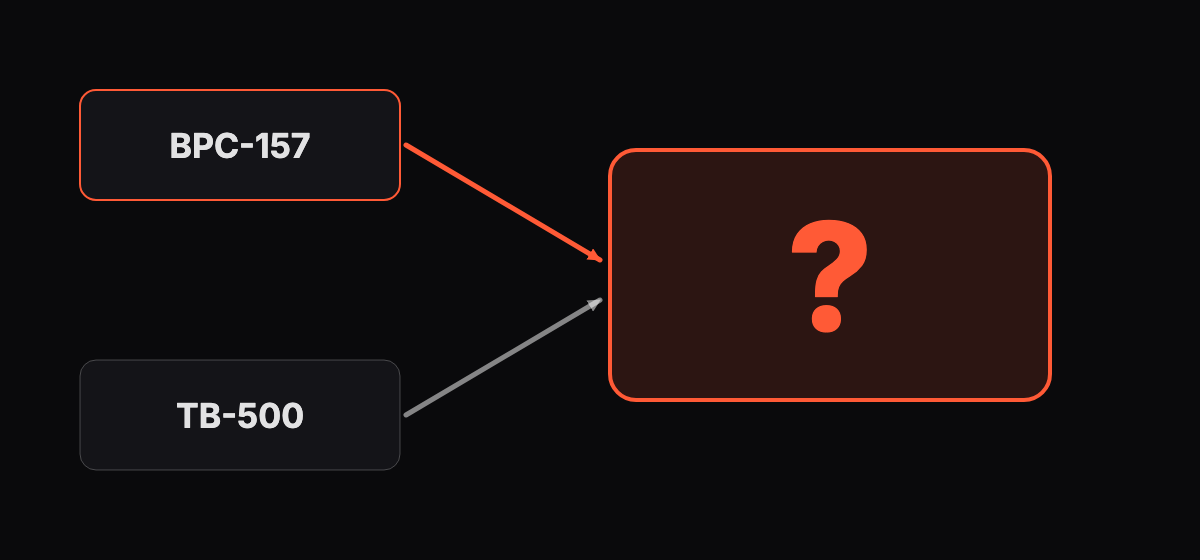
For the two-peptide version, what matters is that a blend combines two separate questions. Each compound has its own record, covered on the pages for BPC-157, TB-500 and thymosin beta 4. Combining them adds a third question, whether the pair does anything together, and the answer is not in the literature we reviewed.
What a blend label can and cannot prove
A label is text that the maker chose to print. Nothing in the printing process checks it. In a blend, an extra problem appears: a mix of two ingredients makes it harder to see which one is responsible if something goes wrong.
| Label element | What it can show | What it cannot show |
|---|---|---|
| Ingredient names | What the seller intends to sell | That the contents match, or which TB-500 is meant (a fragment or the whole protein) |
| Printed amount per ingredient | What the maker says it put in | That the container holds that amount of each ingredient |
| "Research use only" or "not for human consumption" | That the seller wants a legal disclaimer | That the product is not meant for people; FDA warning letters say such wording does not change intended use |
| Batch or lot number | That a batch exists | That any testing was done on it |
| Certificate of analysis | That some lab produced a document | That it describes the vial in your hands, that the lab is independent, or that sterility and endotoxin were tested |
| "Pharmacy grade" or "third-party tested" | A marketing phrase | Any standard; the phrase has no regulatory meaning in this setting |
| Purity figure | A single number from one method | Identity, the presence of related impurities, or safety |
As of 2026-10-09. The FDA statements come from its bulk drug substances page (current as of 2026-04-22) and its July 2026 briefing documents; the full reading guide is on How to read a peptide label and COA.
Forum users, according to the claim types we mapped, trade tips on "pharmacy-grade versus research-grade" quality and on judging a lab report. That talk exists because people have no regulator-reviewed document to rely on. See also the Reddit claims graded by evidence.
No approved combination exists
As of 2026-10-09 no FDA-approved drug contains BPC-157 or TB-500. FDA's briefing documents state that neither has a USP monograph and neither is a component of an approved drug (documents on FDA's July 2026 advisory committee meeting page, current as of 2026-08-06). A combination of two substances that are each not in any approved drug cannot be an approved combination.
The FDA bulk drug substances page, current as of 2026-04-22, lists both substances in a table headed "nominated but withdrawn." For TB-500 the page says FDA "has not identified any human exposure data." The July 23, 2026 advisory committee discussed both substances for possible inclusion on a pharmacy-compounding list. News outlets reported a narrow vote in favor, but the committee's role is non-binding, and FDA's page, current as of 2026-08-06, posted no vote summary. As of 2026-10-09 we found no final FDA decision. See the legal status explained.
FDA's BPC-157 briefing also remarks on how the pair is sold. It notes websites marketing BPC-157 and TB-500 combination products "for research purposes only and not for human or veterinary use." FDA's warning letters in 2025 and 2026 to sellers of other peptides repeat a consistent position: a research-only label does not alter a product's intended use if the seller's marketing points to human use. The ten letters do not mention BPC-157 or TB-500 by name. A 2023 letter, dated 2023-06-12, does name both, describes them as sold in injectable and nasal spray form, and cites safety concerns about the injectable and intranasal routes. See also Research use only peptides: what the label means.
What the evidence says about the pair together
The honest summary is that there is very little.
- Humans. We found no published human study of BPC-157 and TB-500 given together. A small knee-pain series from one private clinic included four patients who received BPC-157 with thymosin beta 4, which is not TB-500, and that group is too small to say anything about a combination (PMID 34324435). One protocol-reference page concedes that "no study has tested the specific combination."
- Animals. A 2026 study in 32 rats, eight per group, is the only direct comparison we found. TB-500 alone differed significantly from control on tendon strength and tissue scores. The combination was significant on one score, and the authors reported it did not confer additional benefits over either agent alone (PMID 42542926). It was exploratory, in rats, over four weeks.
- Safety reports. FDA's adverse-event database, searched through 2025-12-04 for the BPC-157 briefing, returned three reports for BPC-157, all injectable. One involved a product labeled for research purposes only that combined BPC-157 and TB-500, with skin and gum darkening that recurred when the product was used again. FDA said it could not tell which ingredient was responsible and that it cannot draw definitive safety conclusions from such reports alone. In the TB-500 briefing, FDA also found two consumer complaints about "blended TB-500 and BPC-157," with no safety assessment.
That second point is the practical problem with blends. When a product has two or more ingredients and something happens, nobody can say which one, or whether a contaminant was involved. Single-ingredient products have the same uncertainty, but a mix doubles the question.
For the larger four-peptide versions, the World Anti-Doping Agency's 2026 Prohibited List (in effect 2026-01-01) names CJC-1295 and ipamorelin among growth-hormone-releasing substances in S2.2.4, and places BPC-157 under S0 and TB-500 under S2.3. Athletes who are drug tested should check the current list, which changes each January.
Red flags on blend labels and listings
- Flag. A listing states a dose or schedule for the blend. No human dose is established for either compound, so any figure lacks a source. (FDA briefings; see the dosage explanation)
- Flag. A "research use only" disclaimer, which FDA says does not change intended use, sits beside text that describes benefits for people. FDA warning letters read marketing as evidence of intended use. (FDA warning letters, 2025-2026)
- Flag. A certificate of analysis with no batch number, no lab name, or no link to the lot in front of you. It cannot show that your container was tested. (How-to-read page)
- Flag. The page claims "pharmacy grade" or approval without naming an FDA product, because none exists for these compounds as of 2026-10-09. (FDA briefings)
- Flag. The name TB-500 is used with no statement of what the ingredient is. FDA says TB-500 and thymosin beta-4 are not the same substance. (FDA TB-500 briefing)
- Flag. Claims that a blend works better than either part alone, offered without a study. One rat study found no added benefit over TB-500 alone. (PMID 42542926)
- Flag. Slogans stand in for evidence. An influencer's "We ARE the human studies" is a slogan, not a trial. (Newsletter post, 2025-08-19)
If you want a size on how much is known about each part, the dosing chart page and the calculator page show what a chart or tool would need, and why neither can be sourced. Return to the home page for the full guide list.
Sources
- FDA: Certain Bulk Drug Substances for Use in Compounding That May Present Significant Safety Risks page current as of 2026-04-22, read 2026-10-09
- FDA: July 23-24, 2026 Pharmacy Compounding Advisory Committee meeting page current as of 2026-08-06, read 2026-10-09
- FDA briefing document: BPC-157 read 2026-10-09
- FDA briefing document: TB-500 read 2026-10-09
- FDA: warning letters index letters posted 2025-02-26 to 2026-08-24 and one dated 2023-06-12, read 2026-10-09
- WADA: 2026 Prohibited List in effect 2026-01-01
- Lee and Padgett 2021, Alternative Therapies in Health and Medicine PMID 34324435
- Bicer et al. 2026, Joint Diseases and Related Surgery PMID 42542926
FAQ
Is there an approved BPC-157 and TB-500 blend?
No. As of 2026-10-09 no FDA-approved drug contains either compound, so no approved combination exists. Products sold as blends are not FDA-approved.
Does a blend label prove what is inside?
No. A label is the maker's statement. Only independent testing of the specific batch can address contents, and a certificate of analysis alone does not show that your container was tested.
Has the combination been tested in people?
We found no published human study of the pair together. A rat study found no added benefit over TB-500 alone, and a small knee-pain series had only four patients on a combination that used thymosin beta 4.
What does FDA say about blends sold as research products?
FDA's BPC-157 briefing notes that websites sell combinations with a research-purposes label. Its warning letters say a research-only label does not change intended use when marketing points to human use.
Are Glow and Klow blends different?
Sellers describe them as adding GHK-Cu or KPV to the pair. We found no human trial of either blend. See the Glow and Klow page for what is known about each added part.
Where can I check the current FDA position?
FDA's bulk drug substances page and advisory committee meeting page. We found no final FDA decision as of 2026-10-09.
Not medical advice. See the medical disclaimer.