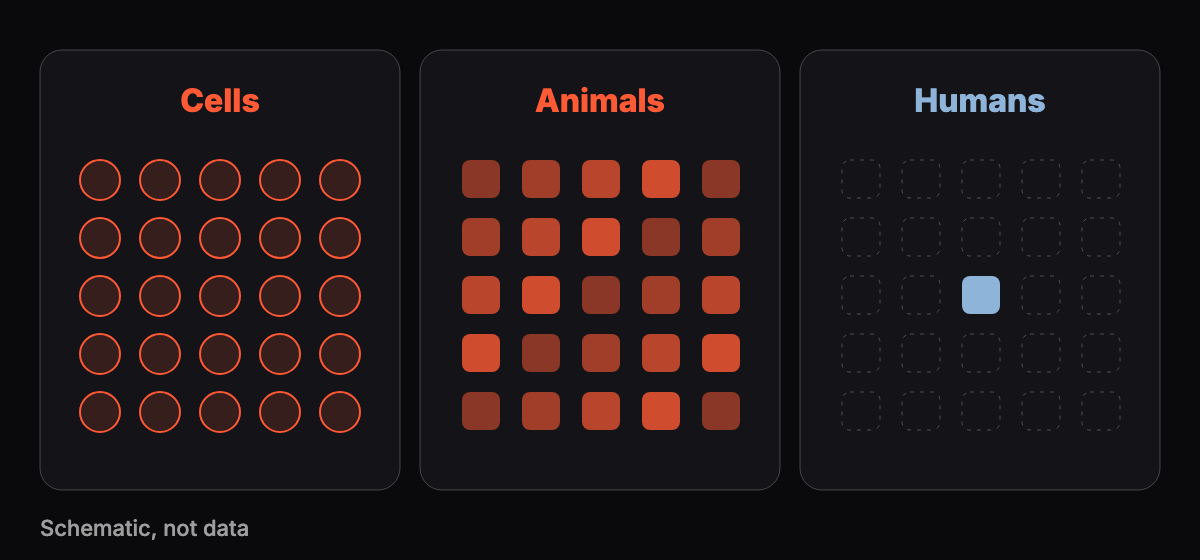
Quick answer: No FDA-approved drug contains BPC-157 or TB-500 as of 2026-10-09. For muscle injury and recovery, the published evidence on both is from animals and cells. We found no controlled human study with a posted result. Human trials do support some everyday factors, such as protein intake during resistance training and sleep, though they measure training gains and performance, not injured muscle. This page grades the main claims.
"Muscle recovery" is used for three different things: getting over a strain or tear, getting over hard training, and gaining muscle. Peptide pages blur them. Studies do not. A trial of a torn hamstring tells you nothing about soreness after a workout, and a mouse study of a muscle disease tells you nothing about either. Keeping the three apart is the first step in judging a claim.
What "recovery" means in studies
Researchers measure recovery in specific ways. For an injury they might measure return to sport, strength, or the size of the injury on a scan. For training they measure strength, muscle size, soreness or performance. In animals they often measure the load a repaired muscle can bear before it fails, how the tissue looks under a microscope, and whether the animal walks normally.
Each measure answers a narrow question. A peptide page that says "faster recovery" without naming the measure, the species and the comparison group is not describing a study.
What the human evidence supports
A 2018 meta-analysis in the British Journal of Sports Medicine pooled 49 randomized trials and 1,863 healthy adults (PMID 28698222). It found that protein supplementation during resistance training modestly increased strength and muscle size, with no further gain beyond a point. It does not show that protein speeds repair of an injured muscle. It is about training gains in healthy adults.
A 2019 narrative review of sleep for athletes (PMID 31288293) reports that sleep deprivation harms reaction time, accuracy, submaximal strength and endurance, and that improving sleep quality is a simple and helpful step. Again this concerns performance, not tissue repair.
These two examples show what ordinary evidence looks like: trials in people, with a comparison group and a stated measure. They are not exciting. They are the standard a peptide claim has to be held to.
What the animal studies on BPC-157 show
Most of the muscle work on BPC-157 comes from one research group in Zagreb, and every study below is in rats.
- Cut quadriceps (2006, PMID 16609979). After a quadriceps cut, daily injections were followed for 72 days. The authors report improved load of failure, walking function and fiber regeneration markers compared with controls.
- Crushed calf muscle (2008, PMID 18668315). The authors report improvements in the appearance and function of the muscle and in blood enzymes at 14 days, by injection or by cream on the skin.
- Quadriceps detached from bone, oral route (2025, PMID 39861766). With 6 rats per group per time point and follow-up to 90 days, the authors report that rats given BPC-157 regained the muscle-bone connection while controls showed failure of repair.
A 2026 critical review of BPC-157 studies in rodents (not on muscle, but on a related injury model) describes the evidence as heterogeneous, with short observation periods, and says blinded replication and controlled human studies would be required (PMID 42794771). That is the clearest independent comment we found on how far the animal base can be pushed.
An independent 2026 rat Achilles study that included BPC-157 found it did not reach significance on total tendon scores (PMID 42542926). See the tendon page for the design.
What is known about TB-500 and thymosin beta 4 for muscle
For TB-500 specifically, we found no human study of muscle. The animal and cell work uses the whole thymosin beta 4 protein:
- A 2010 mouse study in a muscular dystrophy model found more regenerating muscle fibers after six months, but no significant improvement in grip strength, heart function or scarring (PMID 20126456).
- A 2011 mouse study found that thymosin beta 4 messenger RNA rises early in injured, regenerating muscle, and that the protein moved cultured muscle precursor cells in a dish (PMID 20880960). That shows the body makes more of it after injury, not that giving more helps.
The name TB-500 is used differently by different sources. Papers on anti-doping chemistry describe a short fragment, while WADA's list refers to thymosin beta 4 and its derivatives. Whole-protein results do not carry over to the fragment. See TB-500 and thymosin beta 4.
What reviews say about peptides for athletes
A 2026 review in Sports Medicine of 12 peptides says many unapproved ones show favorable results in animal models while "rigorous human safety data are scarce" (PMID 41966639). A 2026 scoping review in the American Journal of Sports Medicine of six peptides writes that claimed benefits "remain unsubstantiated by current human trials" (PMID 42578445). A structured review in JBJS Reviews describes regenerative peptides, including BPC-157 and thymosin derivatives, as investigational with uncertain safety, product quality concerns and anti-doping restrictions (PMID 42160466).
One BPC-157 human trial for a muscle injury is registered: a Phase 2 placebo-controlled study of acute hamstring strain, recruiting as of 2026-10-09 (NCT07437547). It has no results.
Compound by evidence grade
| Compound or factor | Use claimed | What supports it | Grade |
|---|---|---|---|
| Protein during resistance training | Gains in strength and muscle size | 49 randomized trials in healthy adults | Human trials support |
| Sleep quality | Better performance and recovery | A narrative review of athlete studies | Human trials support |
| BPC-157 | Faster recovery from muscle injury | Rat quadriceps and calf studies, mostly one group | Animal or lab studies only |
| TB-500 | Muscle repair and recovery | No human study; mouse studies used the whole protein | No published support found |
| BPC-157 plus TB-500 | Synergy for recovery | One rat tendon study; no muscle study of the pair | Animal or lab studies only |
| Four-peptide "stacks" with growth-hormone releasers | Whole-body recovery | Clinic pages; no trial of the combination found | No published support found |
As of 2026-10-09. Grades describe the published record, not whether a product is safe. The first two rows address training and performance, not repair of an injured muscle.
A note for drug-tested athletes
The WADA 2026 List, in effect from 2026-01-01, places BPC-157 in section S0, non-approved substances, and lists thymosin beta 4 and its derivatives, for example TB-500, under S2.3, growth factors. The S0 entry covers BPC-157 at all times, in and out of competition. The list changes every January, so check the current version on the WADA site. Our sports page covers the details, with dates.
How to judge a recovery claim
Ask which meaning of recovery is being used, which species was studied, how many animals or people, what the comparison was, and who ran the study. Be wary when a page cites only rat studies and speaks as if the result applied to people. Be wary of before and after claims in any form, which this site does not use because they cannot separate a peptide from time, rest and expectation. Strain recovery varies a lot between people, and most strains improve on their own.
The tendon page, the joint pain page and the side effects page cover the neighboring questions, the benefits page grades each claim on a fixed scale, and the home page lists every guide. If you have a muscle injury, a licensed clinician can examine it and explain which options have human trial support.
Sources
- WADA: 2026 Prohibited List in effect from 2026-01-01, read 2026-10-09
- FDA: Certain bulk drug substances for use in compounding that may present significant safety risks page current as of 2026-04-22, read 2026-10-09
- Meta-analysis of protein supplementation in resistance training, 2018, British Journal of Sports Medicine PMID 28698222
- Sleep hygiene for athletes, narrative review 2019, International Journal of Sports Medicine PMID 31288293
- Staresinic et al. 2006, Journal of Orthopaedic Research PMID 16609979
- Novinscak et al. 2008, Surgery Today PMID 18668315
- Matek et al. 2025, Pharmaceutics PMID 39861766
- Demirtas 2026, International Journal of Molecular Sciences PMID 42794771
- Bicer et al. 2026, Joint Diseases and Related Surgery PMID 42542926
- Thymosin beta 4 in a mouse model of muscular dystrophy, PLoS One 2010 PMID 20126456
- Thymosin beta 4 in regenerating mouse muscle, Journal of Biochemistry 2011 PMID 20880960
- Mendias and Awan 2026, Sports Medicine PMID 41966639
- Scoping review of peptide supplements in sports medicine, American Journal of Sports Medicine 2026 PMID 42578445
- Villegas Meza et al. 2026, JBJS Reviews PMID 42160466
- ClinicalTrials.gov NCT07437547 read 2026-10-09
FAQ
Do peptides speed muscle recovery?
No published human study shows that BPC-157 or TB-500 does. The evidence is from rats and mice, and from cells in a dish.
Is there a human trial of BPC-157 for a muscle injury?
One is registered: a Phase 2 placebo-controlled study of hamstring strain, recruiting as of 2026-10-09. It has posted no results.
What does have human trial support for recovery?
Trials support protein intake during resistance training for strength and muscle gains, and reviews support attention to sleep for performance. Neither is a claim about repairing an injured muscle.
Are BPC-157 and TB-500 allowed in tested sports?
The WADA 2026 List prohibits BPC-157 under S0 and thymosin beta 4 and its derivatives, such as TB-500, under S2.3, (S0 applies at all times). Check the current list each year.
Why do some pages say TB-500 repairs muscle?
They usually cite animal work on the whole thymosin beta 4 protein, or on tendons. Neither shows a result in people, and the TB-500 name is not used consistently.
Does a four-peptide stack work more strongly?
Pages that sell such stacks say so. We found no trial of the combination, and the one rat study that tested the pair reported no added benefit over a single compound.
Not medical advice. See the medical disclaimer.