Quick answer: The benefits claimed for BPC-157 and TB-500 are supported mainly by animal and laboratory studies, mostly in rats. We found no randomized human trial of either as of 2026-10-09, and no human trial of TB-500 at all. Below, every common claim is graded on a fixed five-level scale. Almost all land at "Animal or lab studies only" or "No published support found." No FDA-approved drug contains BPC-157 or TB-500 as of 2026-10-09.
A page about benefits invites a list of good news. This one is a ledger instead. For each claim in circulation, it records who makes the claim, what the published record shows, and a grade. The grade does not tell you whether a claim is false. It tells you how strong the published support is, which is a different question. Nothing here is medical advice.
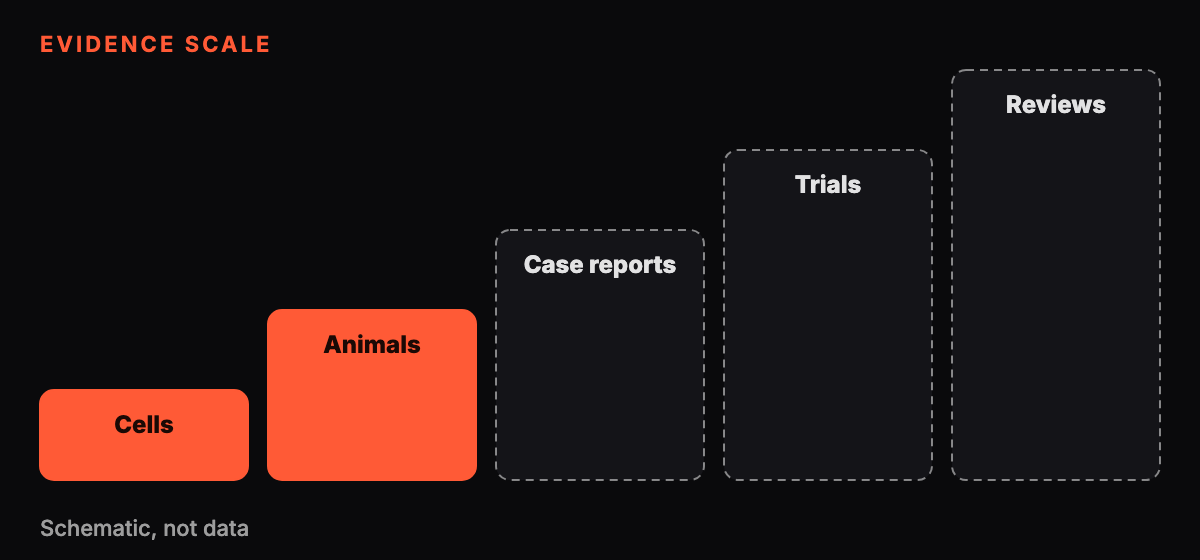
The five-level grade key
Every claim ledger on this site uses the same fixed set of grades. The order runs from strongest support to a claim that sources contradict.
| Grade | What it means here |
|---|---|
| Human trials support | At least one controlled human trial of the same substance, for the same use, reports a result that supports the claim |
| Small human reports only | Human data exist but are uncontrolled, small or both, such as a chart review or pilot |
| Animal or lab studies only | The support is from animals, cell cultures or tissue in a dish |
| No published support found | We searched and found nothing that bears on the claim, or only a marketing statement |
| Contradicted by sources | A regulator, a trial or a study says something that conflicts with the claim |
Two rules apply. A grade is never raised because a clinic page, shop blog or forum says so. And the grade attaches to the exact substance named: results for thymosin beta 4, the full protein, are not counted as support for the fragment sold as TB-500. As of 2026-10-09 no claim about either compound earns the top grade from the sources we read.
What exists in humans
Before the claims, a short inventory. For BPC-157, three small uncontrolled pilot reports from one author team exist (a knee-pain chart review, an interstitial cystitis pilot and a two-person intravenous safety report), plus four ClinicalTrials.gov records with no posted results. A 2025 systematic review of 544 articles included 36 studies, of which 35 were preclinical and 1 clinical. See the BPC-157 page for details.
For TB-500, we found no human trial. Every human trial in the thymosin beta 4 family tested the full 43-amino-acid protein for eye, skin or heart conditions, none for tendon, muscle or joint injury. The TB-500 page explains the definition problem. One ClinicalTrials.gov record using the TB-500 name describes itself as fictional and is not evidence.
Claim by claim
Tendon and ligament
Who says it: clinic pages, shop blogs and forum posts, which describe the pair as aiding tendon recovery. This is the most common claim on the web and the one our page on tendon injuries covers in depth.
What exists: rat models of cut Achilles tendons, tendon-to-bone detachment and a cut knee ligament, mainly from one Zagreb research group, in which the injected animals showed higher load to failure and more organized tissue. A 2026 independent rat study (PMID 42542926, 32 rats) found a significant result for TB-500 but not for BPC-157 alone on the total tendon scores, and said the combination "did not confer additional benefits." No controlled human tendon study exists in the sources we read. The only human data for BPC-157 near this area is a knee chart review of mixed knee conditions that used no outcome tools.
Muscle
Who says it: the same sources, plus fitness forums.
What exists: rat studies of cut and crushed muscle for BPC-157 (PMIDs 16609979, 18668315, 39861766), reporting better function and fiber regeneration in the authors' words. For thymosin beta 4, a mouse muscular-dystrophy study found more regenerating fibers but no improvement in grip strength (PMID 20126456). Nothing in humans. A hamstring-strain trial of BPC-157 (NCT07437547) is registered and recruiting, with no results posted as of 2026-10-09. Our muscle recovery page applies this to training goals.
Gut
Who says it: clinic pages and shop blogs, which describe BPC-157 as supporting the gut lining and colitis.
What exists: rat models of fistula, colitis, bowel joins and short bowel, almost all from the Zagreb group. Human claims rest on statements that the compound was in earlier trials for inflammatory bowel disease; we found no published results and no registered trial for that use. FDA evaluated BPC-157 for ulcerative colitis and stated that evidence of effectiveness was insufficient, and that approved therapies exist. See BPC-157.
Inflammation
Who says it: sellers and forum posts, for both compounds. The 2012 equine paper itself notes that TB-500 "is claimed" to reduce inflammation.
What exists: reviews of the whole thymosin beta 4 protein describe a role in inflammation from cell and animal work (PMID 36464872). For BPC-157, a 2026 critical review of rodent studies in one organ system called the evidence base heterogeneous. For the TB-500 fragment, the 2024 laboratory paper says its biological effects "have not been documented." No human inflammation outcome has been tested for either.
Joint pain
Who says it: clinics and forums.
What exists: one retrospective phone survey of 16 knee-pain patients at a private clinic, without a comparison group or outcome tools; the combination subgroup had 4 patients. The research record leaves joint pain at "Small human reports only" for BPC-157 and unsupported for TB-500. See joint pain.
Systemic effects
Who says it: sellers, who describe wide, body-wide benefits.
What exists: cell and animal work on blood vessel growth. A BPC-157 study in cells and rats (PMID 27847966) found a rise in a vessel growth receptor. A review by other authors raised a theoretical concern that this could matter if cancer cells are present, which the producing group disputes; there are no human data either way. A 2026 review noted a mismatch between a plasma half-life under 30 minutes and effects said to last hours or days. Reviews of unapproved peptides warn of "potential for serious harm" with scarce human safety data (PMID 41966639).
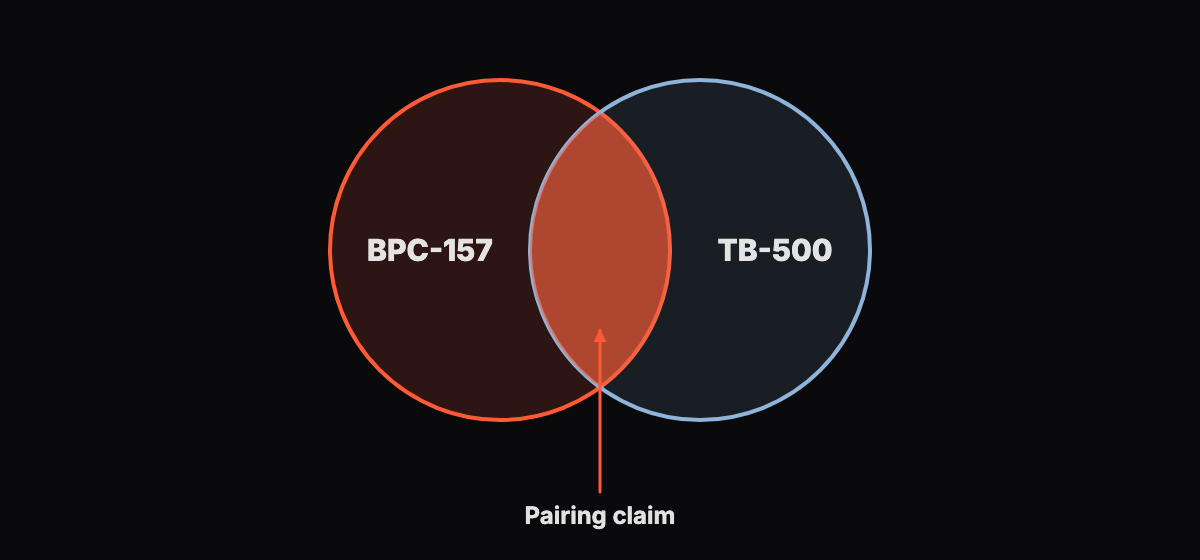
The pair together
Who says it: the Wolverine stack name itself, forum posts and clinic pages. See the Wolverine stack page.
What exists: one rat study of the combination, which did not show added benefit overall though one score favored the pair. Four patients in the knee series received a combination with a thymosin beta 4 product, too few to show anything. No human study of BPC-157 with TB-500 exists in the sources we read.
The full claim ledger
| Claim as marketed | Who says it | What supports it | Grade |
|---|---|---|---|
| "Speeds recovery of injured tendons and ligaments" | Clinic pages, forums, shop blogs | Rat tendon and ligament models for both; no controlled human study | Animal or lab studies only |
| "Rebuilds muscle faster after strains" | Fitness forums, shop blogs | Rat muscle models for BPC-157; mouse and cell work for thymosin beta 4; one hamstring trial still recruiting | Animal or lab studies only |
| "Calms the gut and colitis" | Clinic pages, shop blogs | Rat gut models, mostly one group; FDA found insufficient evidence for ulcerative colitis | Animal or lab studies only |
| "Lowers inflammation" | Sellers, forums | Review-level animal and cell work on the whole protein; none for the fragment in people | Animal or lab studies only |
| "Relieves knee and joint pain" | Clinic pages, forums | One uncontrolled retrospective chart review for BPC-157; nothing for TB-500 | Small human reports only |
| "Builds new blood vessels body-wide" | Sellers, forums | Cell and rat studies for BPC-157; theoretical safety concern raised in a review | Animal or lab studies only |
| "Proven in clinical trials" | Shop blogs | No randomized human trial published for either; trials exist only for full-length thymosin beta 4 | Contradicted by sources |
| "Works better together than alone" | Forums, clinic pages | One rat study: no overall added benefit, one score favored the pair | Animal or lab studies only |
| "Approved or legal to prescribe for these uses" | Some seller and clinic pages | FDA says no approved drug contains either; FDA staff proposed not listing them | Contradicted by sources |
| "Fine for drug-tested athletes" | Some forum posts | WADA's 2026 List prohibits both at all times | Contradicted by sources |
As of 2026-10-09. The ledger grades the published evidence we found; it makes no claim about any individual's experience.
Why animal studies cannot settle these claims
A rat with a cut tendon recovers on a four-week clock in a controlled setting. A person with a nagging tendon problem has a different injury, a different clock, and no way of knowing what they are given. Independent critical reviews make the same point in their own words: the efficacy "is yet to be confirmed in humans" (PMID 30915550), and a 2026 review calls BPC-157 a "hypothesis-generating investigational candidate" (PMID 42794771). A before-and-after story on a forum cannot fill that gap, because it cannot separate natural recovery, a placebo response or other care from any effect of the compound.
What FDA and WADA add
FDA's page on compounding bulk substances, current as of 2026-04-22, lists both under "nominated but withdrawn." In its July 2026 briefings FDA said evidence of effectiveness was lacking for the uses it evaluated and proposed that neither be added to the 503A bulks list. News outlets reported a narrow advisory vote in favor; FDA's meeting page, current as of 2026-08-06, posts no vote summary, and as of 2026-10-09 we found no final decision. WADA's 2026 List prohibits BPC-157 under S0 and TB-500 under S2.3 at all times. The legal status page has the detail. For sports, see side effects, and for why no dose is set, the dosing page.
Where to go next
Two compounds can be compared directly on TB-500 versus BPC-157. The pages on capsules and oral forms and Glow and Klow cover product types. Forum assertions get a page of their own: forum claims, graded. Start again from the homepage if you want the full map.
Sources
- FDA: Certain bulk drug substances for use in compounding that may present significant safety risks page current as of 2026-04-22, read 2026-10-09
- FDA: July 23-24, 2026 Pharmacy Compounding Advisory Committee meeting page current as of 2026-08-06, read 2026-10-09
- FDA: briefing document on BPC-157 read 2026-10-09
- FDA: briefing document on TB-500 read 2026-10-09
- WADA: 2026 Prohibited List in effect 2026-01-01, read 2026-10-09
- ClinicalTrials.gov: NCT07437547 read 2026-10-09
- Vasireddi et al. 2025, HSS Journal PMID 40756949
- Bicer et al. 2026, Joint Diseases and Related Surgery PMID 42542926
- Lee and Padgett 2021, Alternative Therapies in Health and Medicine PMID 34324435
- Gwyer et al. 2019, Cell and Tissue Research PMID 30915550
- Demirtas 2026, International Journal of Molecular Sciences PMID 42794771
- Mendias and Awan 2026, Sports Medicine PMID 41966639
- Hsieh et al. 2017, Journal of Molecular Medicine PMID 27847966
- 2023 thymosin beta 4 review, Current Protein and Peptide Science PMID 36464872
- 2010 muscular dystrophy mouse study, PLoS One PMID 20126456
- Staresinic et al. 2006, Journal of Orthopaedic Research PMID 16609979
- Novinscak et al. 2008, Surgery Today PMID 18668315
- Matek et al. 2025, Pharmaceutics PMID 39861766
- 2024 fragment metabolite study, Journal of Chromatography B PMID 38382158
- Ho et al. 2012, Journal of Chromatography A PMID 23084823
FAQ
What are the proven benefits of BPC-157 and TB-500?
None are proven in controlled human trials, according to the sources we read as of 2026-10-09. The claimed benefits are supported by animal and laboratory studies, plus a few small human reports for BPC-157.
Does BPC-157 help tendon injuries?
Rat studies report better tendon recovery measures. No controlled human tendon study was found. See the tendon page for details.
Is there any human evidence for TB-500?
We found no published human trial of TB-500. Human trials of the full thymosin beta 4 protein exist for eye, skin and heart conditions, and do not apply to the fragment.
Do the two work better together?
The one rat study of the pair found no overall added benefit, though one score favored the combination. No human study exists.
What does "Animal or lab studies only" mean?
It means the support comes from rats, mice, rabbits, cells or tissue in a dish, and nothing controlled in people. It is a statement about the evidence, not a rejection of the claim.
Why not just trust the people who report good results?
A personal report cannot separate natural recovery, expectation or other care from the compound. That is why the grades rely on published studies with comparison groups.
Not medical advice. See the medical disclaimer.