Quick answer: No one can give you a reliable side-effect list for TB-500 or BPC-157, because neither has completed human safety testing. FDA says the risks of TB-500 in humans "are unknown" and is concerned about immune reactions, impurities and the absence of human data. No FDA-approved drug contains BPC-157 or TB-500 as of 2026-10-09, so no official label exists to consult.
People searching for side effects usually want a list: nausea, flushing, injection-site reactions. Lists of that kind circulate on forums and seller pages, but they are not drawn from controlled studies. This page separates what is documented from what is merely reported, and from what is unknown, and shows where each statement comes from. General information, not medical advice. If you have taken a product or have symptoms, talk to a licensed clinician.
The known, reported and unknown table
| Category | What the sources say | Source |
|---|---|---|
| Known (animals) | A toxicology report on BPC-157 in mice, rats, rabbits and dogs found no serious toxicity; in dogs, one lab value (creatinine) fell at the highest dose tested and recovered after two weeks; local irritation was mild | PMID 32334036 |
| Known (humans) | No established side-effect profile for either compound; no randomized trial of either | FDA briefings; HSS review (search to 2024-06-03): "No clinical safety data were found" |
| Reported (BPC-157) | Three small uncontrolled human reports report no adverse events in one (12 women) and nothing adverse in another (2 people); the knee series abstract does not describe adverse events | PMIDs 39325560, 40131143, 34324435 |
| Reported (FDA reports) | Three adverse-event reports mentioning BPC-157, from which FDA said it could not draw definitive conclusions: one involving shortness of breath with an emergency visit and one involving darkened skin and gums with a combined product; none for TB-500 in a search through 2025-03-26 | FDA briefings |
| Reported (full thymosin beta 4) | Mild or moderate adverse events and no serious events in two phase 1 healthy-volunteer studies of the intravenous protein | PMIDs 20536472, 34346165 |
| Unknown | Long-term effects, interactions, use in pregnancy or in children, the effect of impurities, cancer risk, safe dose | FDA; reviews |
As of 2026-10-09. Animal findings do not predict human effects, and "no adverse events reported" in a small pilot is not the same as "no adverse events occur."
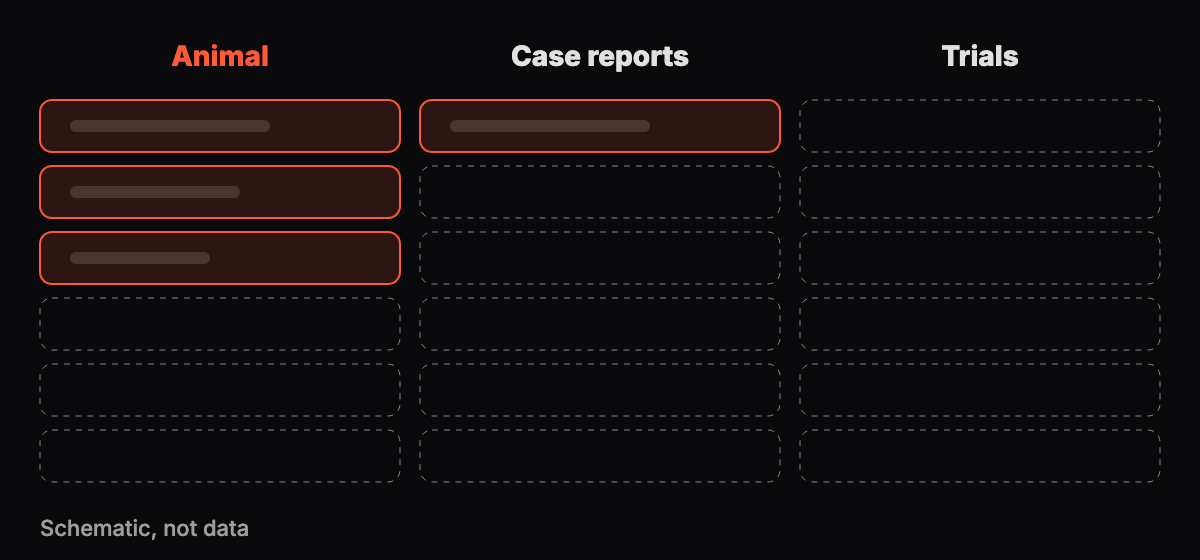
What a label would normally list, and why none exists
An FDA-approved drug comes with prescribing information built from its trials. A label for a drug normally lists the conditions it is approved for, who should not take it, warnings, a ranked table of adverse reactions with how often each occurred versus placebo, known interactions, use in pregnancy and in children, overdose information, and the exact ingredients and manufacturer. Every one of those parts depends on controlled human testing and regulatory review.
None of that exists for BPC-157 or TB-500. FDA's briefing documents state that neither has a United States Pharmacopeia monograph and neither is a component of an approved drug. A bottle sold under either name carries a seller's text, not a regulator-reviewed label. Some are marked "research use only," a phrase that does not change what a product is intended for: FDA warning letters dated between February 2025 and August 2026 say as much, and the one letter we found that names both compounds is dated 2023-06-12. Our page on reading a peptide label and certificate of analysis explains what such documents can and cannot show, and research use only peptides covers the label phrase in depth.
A related point: because there is no approval, there is no agreed strength, no dosing study and no safety margin. That is the subject of why no dose is set and of the explanation of why this site publishes no dosage calculator.
FDA's stated concerns, in its own words
The agency's wording is plain, and we quote it with short excerpts only. As of the pages current on 2026-04-22 and the briefings read 2026-10-09:
- Immunogenicity. FDA's category page says BPC-157 "may pose risk for immunogenicity for certain routes of administration" and, for TB-500, cites immunogenicity "due to the potential for aggregation as well as peptide-related impurities." Immunogenicity means the immune system may react to the substance. FDA frames this as a potential risk.
- Impurities. The same page points to "peptide-related impurities" and to problems characterizing the substance. The BPC-157 briefing says it is "considered not well-characterized."
- Absence of human data. The TB-500 briefing cites "a lack of clinical and nonclinical safety information," says FDA is "particularly concerned about the absence of human data," and concludes that potential risks in humans "are unknown." It found no articles in which TB-500 was given to people.
- Limited BPC-157 data. For BPC-157 the briefing counted five small clinical studies and described them as short with small samples and limited safety data. It added that no serious adverse events appear to have been reported, and that adverse-event reports in its database could not support firm conclusions.
FDA staff proposed that neither be added to the 503A bulks list. News outlets reported a narrow advisory vote in favor on 2026-07-23; FDA's meeting page, current as of 2026-08-06, posts no vote summary, and we found no final decision as of 2026-10-09. See the legal status page.
Reported events in the published literature, attributed
The literature is thin, so the list is short.
- Local injection effects. A 2025 review says BPC-157 "has been known to cause pain and/or necrosis" when given in certain solutions, a statement we did not trace to a primary study. In FDA's adverse-event reports, an injection-site reaction involved other injectables as well and so could not be pinned on BPC-157.
- Skin and gum darkening. One report in FDA's briefing involved a product labeled "research purposes only" that held both BPC-157 and TB-500, and recurred on re-exposure; FDA says it cannot tell which ingredient caused it.
- Breathing difficulty. A single FDA report involved shortness of breath and an emergency room visit; its cause is not established.
- Consumer complaints. FDA's briefing also lists two consumer complaints about blended TB-500 and BPC-157 with no safety assessment.
Each is a lone report, which signals a question, not an answer. They are not rates.
Product quality: the side effect nobody can measure
Several reviews warn that the product itself may be the bigger unknown. A 2025 systematic review says adverse effects are possible "due to unregulated manufacturing, contamination, or unknown clinical safety" (PMID 40756949). A 2026 review in Missouri Medicine lists contamination, manufacturing impurities and inaccurate dosing among severe potential risks of unapproved peptides including both of these (PMID 42757290). A blend sold under one name, as covered on our blend page, compounds this: a Glow or Klow product can add further ingredients. The same goes for capsules and sprays, which have even less human data.
The cancer question, attributed
A 2025 review raised a theoretical concern: BPC-157 increases a blood-vessel growth receptor in lab and rat studies, and that receptor family is found in many cancers, so caution may matter where cancer is undetected (PMC11859134). The producing Zagreb group replied that the concern is speculation and claims anti-tumor potential; no independent confirmation of that claim was found in our sources. For the thymosin beta 4 family, reviews report higher levels of the protein in some tumors, but also lower levels in myeloma cells (PMIDs 22856429, 20536459). Those are measurements in tissue, not studies of people given the compound. No human study of cancer risk was found for either. This is a gap, not a finding. See BPC-157 and thymosin beta 4.
Interactions and drug tests
We did not find interaction studies in the sources we read, and we could not confirm that any exist. A clinician reviewing medicines can only note that the compounds are unstudied.
Drug testing is a separate, documented risk. WADA's 2026 List, in effect 2026-01-01, prohibits BPC-157 under S0, where all substances are Specified, and prohibits "Thymosin-ß4 and its derivatives e.g. TB-500" under S2.3, non-Specified. USADA's athlete advisory (published 2026-10-06) says athletes are "strictly liable" and that peptides in general are named in S0 on the 2027 List, effective 2027-01-01. USADA's BPC-157 page says it is unknown whether a safe dose exists. Its own release on a 2024 case involved a supplement containing BPC-157 that a medical provider had recommended. FDA's briefing notes that BPC-157 is marketed as an ingredient in dietary supplement products, so a supplement label is worth checking. Details are on our sports ban page.

Claims about side effects
| Claim as marketed | Who says it | What supports it | Grade |
|---|---|---|---|
| "Has no downsides" | Shop blogs, forum posts | FDA says risks in humans are unknown; no controlled human safety study | Contradicted by sources |
| "Only mild side effects like redness or tiredness" | Forum posts, seller pages | Not drawn from a controlled study in the sources we read | No published support found |
| "Tested and shown to be tolerated in humans" | Some clinic pages | Three small uncontrolled BPC-157 pilots; none for TB-500 | Small human reports only |
| "Animal toxicity tests show it is harmless" | Seller pages | One toxicology report found no serious toxicity in four species; a creatinine change in dogs at the highest dose | Animal or lab studies only |
As of 2026-10-09. See benefits for the graded benefit claims, and forum claims and joint pain for common applications. The question of where products come from is covered on its own page; the sources describe no approved route. The homepage lists everything, and the pages on TB-500 cover the compound itself.
Sources
- FDA: Certain bulk drug substances for use in compounding that may present significant safety risks page current as of 2026-04-22, read 2026-10-09
- FDA: July 23-24, 2026 Pharmacy Compounding Advisory Committee meeting page current as of 2026-08-06, read 2026-10-09
- FDA: briefing document on TB-500 read 2026-10-09
- FDA: briefing document on BPC-157 read 2026-10-09
- WADA: 2026 Prohibited List in effect 2026-01-01, read 2026-10-09
- USADA: What's new on the 2027 WADA Prohibited List published 2026-10-06, read 2026-10-09
- USADA: BPC-157, what athletes should know page modified 2026-08-10, read 2026-10-09
- USADA: 2024 case release on an athlete's declared BPC-157 supplement use published 2024-08-22, read 2026-10-09
- Xu et al. 2020, Regulatory Toxicology and Pharmacology PMID 32334036
- Vasireddi et al. 2025, HSS Journal PMID 40756949
- Jozwiak et al. 2025 review PMID 40005999
- Moiz et al. 2026, Missouri Medicine PMID 42757290
- Lee et al. 2024, Alternative Therapies in Health and Medicine PMID 39325560
- Lee and Burgess 2025, Alternative Therapies in Health and Medicine PMID 40131143
- Lee and Padgett 2021, Alternative Therapies in Health and Medicine PMID 34324435
- 2010 healthy-volunteer study, Annals of the New York Academy of Sciences PMID 20536472
- 2021 first-in-human study, Journal of Cellular and Molecular Medicine PMID 34346165
- 2012 review on tumor expression, Critical Reviews in Eukaryotic Gene Expression PMID 22856429
- 2010 myeloma paper, Annals of the New York Academy of Sciences PMID 20536459
FAQ
What are the side effects of TB-500?
Not established. FDA's briefing reports no published account of TB-500 given to people and calls the human risks "unknown." Lists online are not drawn from controlled studies.
What are the side effects of BPC-157?
Three small uncontrolled human reports describe none, but they cover about 30 people at most and cannot establish safety. FDA's reports mention injection-site reactions, shortness of breath and skin darkening, each with confounders.
Why is there no official label?
Labels come from regulatory approval, and neither compound is approved. No FDA-approved drug contains BPC-157 or TB-500 as of 2026-10-09, and there is no pharmacopeia monograph.
Do these peptides cause cancer?
No human study of cancer risk was found. A review raised a theoretical concern about blood vessel growth, which the producing research group disputes, and the thymosin beta 4 literature is mixed. It remains unknown.
Can they cause a failed drug test?
WADA's 2026 List prohibits both at all times, and USADA says athletes are strictly liable for what they take. Check the current List and a supplement's ingredients.
Does "research use only" mean it has been checked?
No. According to FDA warning letters, that phrase does not change a product's intended use, and it is not a quality check. See the pages on labels and research-use peptides.
Not medical advice. See the medical disclaimer.