Quick answer: BPC-157 and TB-500 are different substances with different origins and different records. BPC-157 is a 15-amino-acid peptide with a large animal literature and three small human reports. TB-500 is described by FDA as a seven-amino-acid fragment of thymosin beta-4, with very little research under that name. No FDA-approved drug contains BPC-157 or TB-500 as of 2026-10-09, and both are prohibited by WADA.
People compare the two because they are sold together, discussed together and nicknamed together. A comparison is useful only if it keeps each compound's evidence separate, so this page does that. It lays out the facts in one table, grades the common claims, and then points you to the page that answers the question you are actually asking. The homepage gives the short version for BPC-157 and TB-500, and the full profiles are on the BPC-157 page and the TB-500 page.
Side by side, per the sources
| Fact | BPC-157 | TB-500 | Source |
|---|---|---|---|
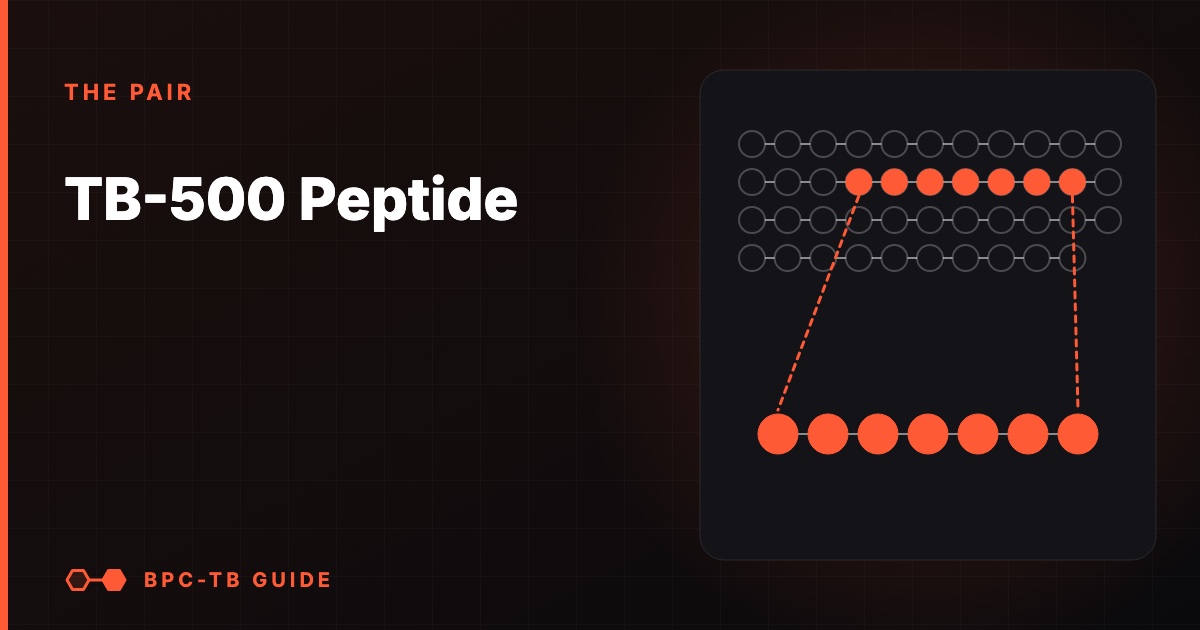
| Size and type | A synthetic 15-amino-acid peptide | FDA: understood today to be a seven-amino-acid synthetic fragment | PubMed 14554208; FDA TB-500 briefing |
| Origin of the sequence | A piece of a protein described in human gastric juice, named "body protection compound" by a Zagreb group in the early 1990s | A region of thymosin beta-4, a protein found in cells; the name appears in 2012 horse-testing papers describing a "veterinary preparation" | PubMed 8298609; 23084823 |
| Is the name consistent? | Yes, though some papers use older names such as PL 14736 | No. Chemists, FDA and WADA define it differently, and a 2025 paper says online products claim a fragment or the whole protein | PubMed 39314109; WADA 2026 List |
| FDA-approved drug | None; no USP monograph | None; no USP monograph | FDA briefings |
| FDA category page | Under "nominated but withdrawn" | Under "nominated but withdrawn" | FDA page current as of 2026-04-22 |
| Uses FDA evaluated in July 2026 | Ulcerative colitis | wound healing | FDA meeting page current as of 2026-08-06 |
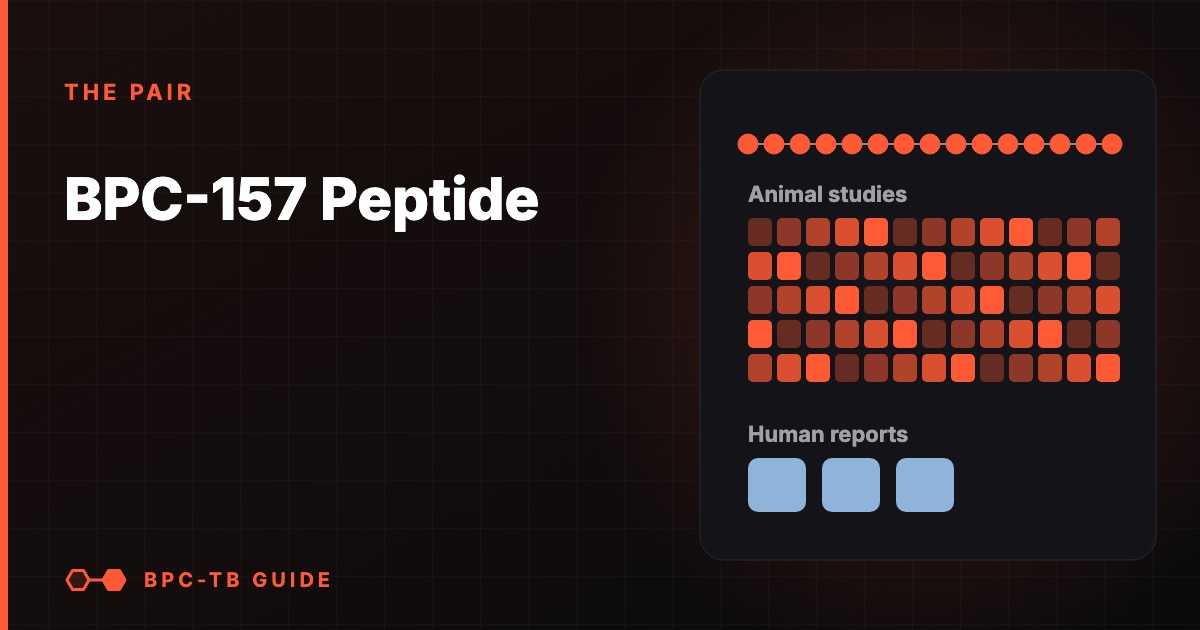
| Human data | Three small uncontrolled reports, about 30 people in total, one author team | No human administration of TB-500 found by FDA; trials exist only for full-length thymosin beta-4 | FDA briefings; PubMed |
| Main animal work | Many rat studies, 172 of 220 PubMed records list the same Zagreb author | A 2026 rat Achilles study of 32 animals, plus chemistry and cell work | PubMed 42542926 |
| WADA 2026 List | S0 non-approved substances, a Specified Substance | S2.3 growth factors, "Thymosin-ß4 and its derivatives e.g. TB-500," not Specified | WADA 2026 List |
| Registered trials | Four records; none has posted results | The one record using the name calls itself "fictional" | ClinicalTrials.gov |
Table current as of 2026-10-09. FDA statements are from pages and briefing documents read on 2026-10-09; WADA wording is from the List in effect from 2026-01-01.
A few rows deserve a sentence. FDA's TB-500 briefing includes a footnote saying thymosin beta-4 and TB-500 are not the same substance. That matters because the human trials that exist, in eye drops, skin gel and an intravenous heart-attack drug, used the full-length protein. Their results cannot be carried over to a seven-amino-acid fragment. The thymosin beta-4 page goes through that record.
Where the evidence is thin on both sides
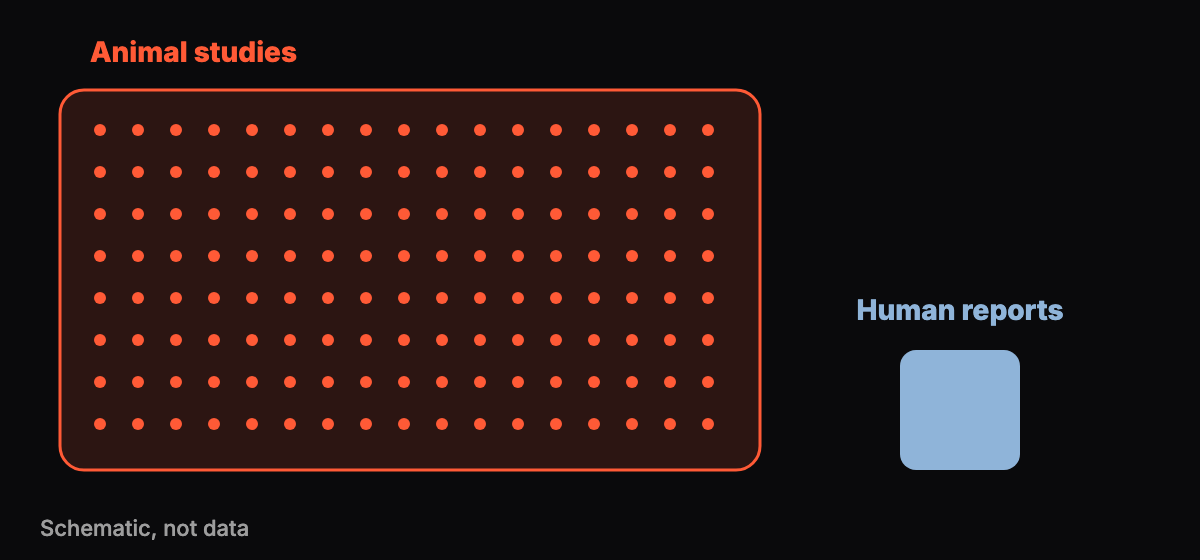
BPC-157's strength is volume. A PubMed count made for this site found 220 records that mention it in the title or abstract, and the animal studies cover tendon, ligament, muscle, bone, gut and nerve models. The weakness is who produced it and what is missing. A 2019 independent review said only a handful of research groups had studied it in depth and that its efficacy in humans was yet to be confirmed. A 2026 review described the clinical data as fewer than 30 subjects across three uncontrolled pilots. FDA's briefing calls BPC-157 "considered not well-characterized."
TB-500's weakness is the reverse. There is little research under the name at all. The papers that name it are mostly anti-doping chemistry: how to detect an acetylated seven-residue fragment in horse plasma and urine. They do not measure whether it works. A 2024 paper on the fragment and its breakdown products reported that only a metabolite, not the parent fragment, showed wound-related activity in cultured fibroblasts. It was a laboratory study, and the authors noted the biological effects of TB-500 have not been documented.
So the honest comparison is not "which is stronger." Each has a different kind of gap. For BPC-157 the gap is independent replication and controlled human data. For TB-500 the gap is basic definition and any human data at all.
The one head-to-head study
Only one study we found tested both in the same experiment. A 2026 rat Achilles tendon study from a training and research hospital used 32 male rats, 8 per group: control, BPC-157, TB-500 and both. Animals were given injections into the abdomen for four weeks.
Maximum load to failure was higher in both single-peptide groups than in controls but reached significance only in the TB-500 group. The Bonar score, a tendon-structure measure, was significantly lower in the TB-500 group. The Movin score was significantly lower in the TB-500 group and in the combination group. BPC-157 alone showed numerically lower scores that did not reach significance on the totals. The authors called it an exploratory rat model and wrote that the combination did not confer additional benefits compared to either agent alone, although the combination did score significantly lower on one measure.
What it does not show: anything about people, long-term results, other tendons or other kinds of injury, or how the result would change with other methods. It is one small study from one group. It also cuts against a common marketing line. Clinic pages claim the two are synergistic, and this study did not find an added benefit. The tendon injuries page puts it next to the rest of the tendon literature.
Claims people make when comparing them
| Claim as marketed | Who says it | What supports it | Grade |
|---|---|---|---|
| "BPC-157 acts locally and TB-500 acts systemically" | Clinic pages | Neither location was measured in people. | No published support found |
| "Together they are synergistic" | Clinic pages | One rat study reported no added benefit over either agent alone, with one score favoring the combination. | Animal or lab studies only |
| "TB-500 is stronger for muscle and BPC-157 for gut" | Forum posts | Rat studies exist for each tissue under each name, but no study ranks one over the other in muscle or gut. | Animal or lab studies only |
| "TB-500 is just thymosin beta-4" | Online product pages, as reported in a 2025 anti-doping paper | FDA's briefing on TB-500 describes them as different substances. | Contradicted by sources |
| "BPC-157 was shown to be tolerated in clinical trials for bowel disease" | Papers from the research group that developed it | We found no peer-reviewed results report and no registry record for those trials. A 2025 systematic review found one clinical study among 36. | No published support found |
| "Either one reduces knee pain" | Forum posts, clinic pages | One uncontrolled chart review of BPC-157 in 16 people, with no comparison group. Nothing for TB-500. | Small human reports only |
Grades use the fixed five-level key. Table current as of 2026-10-09. For the full list of benefit claims, see the benefits page.
Which question are you asking
| Your question | Where to look | What the sources say |
|---|---|---|
| Are they the same thing? | This page and the thymosin beta-4 page | No. FDA handles them as different substances, and TB-500's definition varies by source. |
| Which one is riskier? | Side effects | Neither has enough human safety data to rank. FDA says TB-500's risks in humans "are unknown." |
| Are they both legal? | Legal status | Neither is an approved drug. FDA lists both as nominated but withdrawn, and we found no final decision. |
| Is there a dose for each? | Why no dose is set | No published source sets a human dose for either, so none is given here. |
| What is the "stack"? | Wolverine peptide stack | A nickname with several definitions. |
| What is in Glow or Klow? | Glow and Klow | Blends that add GHK-Cu and sometimes KPV to the pair. |
Table current as of 2026-10-09. It never recommends a product or a dose.
Regulatory status, one at a time
FDA's compounding page, current as of 2026-04-22, lists both substances in a table headed "Bulk drug substances nominated but withdrawn," introduced as substances previously in category 2 that nominators withdrew. For BPC-157 the page cites a risk of immunogenicity for certain routes of administration and peptide-related impurities. For TB-500 it cites immunogenicity from aggregation and impurities, and says FDA has not identified human exposure data.
FDA's advisory committee discussed both on 2026-07-23 for possible inclusion on the 503A bulks list. News outlets reported a narrow vote in favor. FDA's meeting page, current as of 2026-08-06, posts briefing documents but no vote summary, and advisory committees make non-binding recommendations. As of 2026-10-09 we found no FDA final decision. Both briefings describe missing safety information, and the TB-500 document says FDA is "particularly concerned about the absence of human data."
For sports, the split is different. BPC-157 is in S0 and is a Specified Substance. TB-500 is named in S2.3 and is not. USADA's own pages describe the practical consequence in terms of default sanctions for those two categories, which differ. Some websites put both in S0, but the List text does not.
What neither one has
Neither has an approved product, a pharmacopoeia monograph, or a validated human dose, and neither has a controlled human trial for the injuries they are marketed for. Those are the facts that sit under every marketing claim. The practical question to ask a licensed clinician, if you are weighing either, is what the record is for the specific use, not which of the two names is more familiar.
Sources
- FDA: Certain bulk drug substances for use in compounding that may present significant safety risks page current as of 2026-04-22, read 2026-10-09
- FDA: July 23-24, 2026 meeting of the Pharmacy Compounding Advisory Committee page current as of 2026-08-06, read 2026-10-09
- FDA briefing document: BPC-157 read 2026-10-09
- FDA briefing document: TB-500 read 2026-10-09
- WADA: Prohibited List 2026 List in effect 2026-01-01, read 2026-10-09
- Vasireddi et al. 2025, HSS Journal PMID 40756949
- Gwyer et al. 2019, Cell and Tissue Research PMID 30915550
- Mateescu et al. 2026, Pharmaceutics PMID 42198317
- Bicer et al. 2026, Joint Diseases and Related Surgery PMID 42542926
- Ho et al. 2012, Journal of Chromatography A PMID 23084823
- Doping control of thymosin beta-4, 2025, Drug Testing and Analysis PMID 39314109
- TB-500 fragment and metabolites, 2024, Journal of Chromatography B PMID 38382158
- Sikiric et al. 1993, Journal of Physiology Paris PMID 8298609
- Staresinic et al. 2003, Journal of Orthopaedic Research PMID 14554208
FAQ
Is TB-500 the same as BPC-157?
No. BPC-157 is a 15-amino-acid peptide whose sequence comes from a protein described in human gastric juice. TB-500 is described by FDA as a seven-amino-acid fragment of thymosin beta-4. They have separate origins, separate research records and separate entries on regulators' lists.
Which has more research behind it?
BPC-157 has far more published animal work, about 220 PubMed records, mostly from one Zagreb group. TB-500 has little research under that name, and what exists is mostly anti-doping chemistry. A large number of papers is not strong evidence in itself, because the human data for BPC-157 total about 30 people.
Do they work better together?
Clinic pages claim so. The one study that tested them together, in 32 rats, reported no added benefit over either agent alone, though one tendon-structure score was lower in the combination group. No study in people tested the pair.
Are both prohibited in sports?
Yes, on the WADA 2026 List, in effect from 2026-01-01. BPC-157 is in S0 and TB-500 in S2.3, both prohibited at all times.
Is one of them safer?
No source supports ranking them. FDA's TB-500 briefing says its risks in humans are unknown, and BPC-157's human safety reports are too small to establish anything. The dosage page explains why no safe dose can be named for either.
Why are they always mentioned together?
Because sellers and forums bundle them under the "Wolverine" nickname. That is a marketing pairing, not a scientific one.
Not medical advice. See the medical disclaimer.