BPC-157 and TB-500 are two lab-made peptides that people meet on Reddit, in YouTube videos and on clinic blogs, usually together under the nickname "Wolverine stack." This guide separates what is established from what is merely claimed, and it grades every common claim on one fixed five-level scale. It sells nothing, links to no seller and carries no advertising.
Quick answer: No FDA-approved drug contains BPC-157 or TB-500 as of 2026-10-09. Both have animal and lab studies. BPC-157 has about thirty people in three small, uncontrolled clinic reports, and no human study of TB-500 for an injury was found. FDA's briefing documents call the human data lacking, WADA prohibits both at all times in 2026, and we found no final FDA decision on compounding.
- Approved product
None. No FDA-approved drug contains either one (as of 2026-10-09)
- FDA
Both listed as "nominated but withdrawn"; advisory meeting held 2026-07-23; no final decision found (as of 2026-10-09)
- WADA
BPC-157 in S0 and TB-500 in S2.3 of the 2026 List, prohibited at all times (as of 2026-10-09)
- Human trials
No controlled trial of either for an injury; three small BPC-157 reports (as of 2026-10-09)
Tiles reflect FDA pages current as of 2026-04-22 and 2026-08-06 and the WADA List in effect from 2026-01-01.
Three things to take away
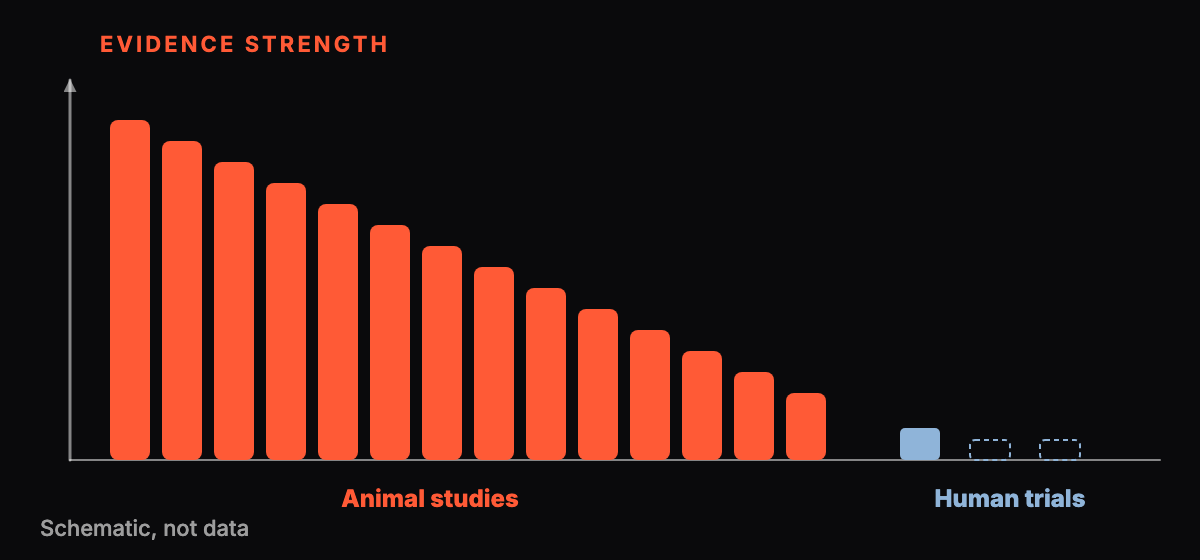
- The evidence is mostly from animals. A 2025 systematic review of BPC-157 found 36 studies, 35 of them preclinical and one clinical. The only direct test of the pair we found used 32 rats.
- Regulators have not approved either one. FDA's own pages describe missing human data, and sports bodies prohibit both. That is a status, not a verdict on any person's choices.
- Most claims you will read are not backed by a published human trial. Clinics, shops and forums make them. Below, each is graded and attributed.
How people search for this
People type "bpc157 and tb500" with no hyphens, add "stack," "Wolverine," "dosage," "legal" or "for sale," and land on a mix of clinic pages, shop blogs, forum threads and news articles. The hyphenated names are the ones used in the scientific record, so this site uses them. Each question has its own page, and the table further down shows where to go.
What each one is
| Fact | Detail | Source |
|---|---|---|
| BPC-157, origin of the name | The letters come from "body protection compound," a name a Zagreb research group gave in the early 1990s to a protein described in human gastric juice. BPC-157 is a 15-amino-acid piece of that sequence, made synthetically. | PubMed records 8298609 and 14554208 |
| BPC-157, who did the research | In a PubMed count made for this site on 2026-10-09, 172 of 220 records list the same Zagreb author. A 2019 independent review described the field as a handful of research groups. | PubMed 30915550 |
| TB-500, what it is said to be | FDA describes TB-500 as understood today to be a seven-amino-acid synthetic fragment of thymosin beta-4, and says the two are not the same substance. | FDA TB-500 briefing |
| TB-500, the name problem | Anti-doping chemists describe an acetylated fragment; WADA's list says "Thymosin-ß4 and its derivatives e.g. TB-500"; a 2025 paper says online products claim a fragment or the whole protein. | PubMed 23084823, 39314109; WADA 2026 List |
| FDA drug approval | FDA states neither is a component of an approved drug and neither has a USP monograph. | FDA briefing documents |
Table current as of 2026-10-09. FDA pages read were current as of 2026-04-22 and 2026-08-06.
The naming problem matters because evidence about the whole thymosin beta-4 protein cannot simply be carried over to a fragment. The thymosin beta-4 page walks through the human trials that did use the protein. For a full profile of each peptide, see BPC-157 and TB-500, and for a direct side-by-side, see TB-500 versus BPC-157.
What is known about people
BPC-157 has three small human reports, all from one author team working in private clinics: a knee-pain chart review with 16 people analysed, an interstitial cystitis pilot with 12 women, and an intravenous pilot with 2 people. Together that is about 30 people, none had a control group, and the intravenous paper itself says more work is needed to confirm safety. A 2026 review described the clinical data as coming from fewer than 30 subjects across three uncontrolled pilots. As of 2026-10-09, ClinicalTrials.gov lists four records that mention BPC-157, none with posted results: a Phase 1 study of unknown status since 2015, a Phase 2 hamstring strain trial listed as recruiting, a rotator cuff pilot not yet recruiting, and a consumer gummy product study that is not a drug trial.
TB-500 is thinner still. Every human trial of the parent protein, thymosin beta-4, used the full-length protein as eye drops, a skin gel or an intravenous heart-attack drug. As of 2026-10-09, our PubMed and ClinicalTrials.gov searches turned up nothing on thymosin beta-4 or TB-500 for tendon, muscle or joint injuries in people. One registry entry carrying the TB-500 name calls itself a "fictional" example, which makes it useless as evidence.
The one study that tested the pair together is a 2026 rat Achilles study: 32 rats, 8 per group, four weeks. The TB-500 group had significantly higher load to failure and a significantly lower Bonar tendon-structure score than controls. BPC-157 alone did not reach significance on the total scores. The authors reported no added benefit from the combination over either agent alone, although the combination scored significantly lower on one measure, the Movin score. It is an exploratory rat model, and it does not show what would happen in a person.
What the claims are, and how well they hold up
| Claim as marketed | Who says it | What supports it | Grade |
|---|---|---|---|
| "Speeds up tendon and ligament recovery" | Clinic pages, forum posts | Rat tendon and ligament studies, mostly from one research group; one 2026 rat study of 32 animals. No controlled human study. | Animal or lab studies only |
| "Reduces joint and knee pain" | Clinic pages, forum posts | One uncontrolled chart review at a private clinic. No placebo group, no validated outcome measure. | Small human reports only |
| "The two together are synergistic" | Clinic pages | The one head-to-head rat study reported no added benefit over either agent alone. Nothing in people. | Animal or lab studies only |
| "TB-500 works throughout the whole body" | Clinic pages | No source measured this in people. | No published support found |
| "Mild side effects only" | Forum posts, clinic pages | Very small uncontrolled reports; FDA says TB-500's risks in humans "are unknown." | No published support found |
| "Both are newly approved for compounding" | One health publisher's page | FDA's pages, current as of 2026-04-22 and 2026-08-06, list both as nominated but withdrawn, and we found no final decision. | Contradicted by sources |
| "A research use only label makes sale lawful" | Shop pages, forum posts | FDA warning letters dated between February 2025 and August 2026 say such wording does not change a product's intended use. | Contradicted by sources |
| "TB-500 and thymosin beta-4 are the same thing" | Some online product descriptions, per a 2025 anti-doping paper | FDA's TB-500 briefing says they are not the same substance. | Contradicted by sources |
Grades use the fixed five-level key. Table current as of 2026-10-09. A fuller version of this ledger is on the benefits page, and the most common forum statements are graded one by one on the forum claims page.
Which question are you asking
| Your question | Where to look | What the sources say |
|---|---|---|
| Are they approved or legal? | Legal status | No approved product exists. FDA's compounding pages and a July 2026 advisory meeting are covered, each dated. |
| What are the risks? | Side effects | Human safety data are very limited, so many risks are simply unknown. |
| Do they help tendon injuries? | Tendon evidence | Rat studies exist. No controlled human tendon study was found. |
| What about joint pain or muscle recovery? | Joint pain and muscle recovery | The pages compare what has been tested across several peptides and conventional care. |
| Are they banned in sports? | Sports rules | Both appear on the WADA 2026 List and are prohibited at all times. |
| What dose is right? | Why no dose is set and why there is no calculator | No published source sets a human dose, so this site gives none. |
| Is there a lawful way to get them? | What FDA status means | No approved product exists, and the page explains what that means. |
| What is the Glow or Klow blend? | Glow and Klow | Blends add GHK-Cu and sometimes KPV, with their own separate evidence. |
Table current as of 2026-10-09. It never recommends a product or a dose.
What FDA has said
FDA's compounding page, current as of 2026-04-22, lists BPC-157 and "Thymosin beta-4, fragment (LKKTETQ), also known as TB-500" under the heading "Bulk drug substances nominated but withdrawn." These were earlier in category 2, which FDA reserves for substances with identified significant safety risks. The page does not place either one in category 1.
FDA's Pharmacy Compounding Advisory Committee discussed both on 2026-07-23 for possible inclusion on the 503A bulks list, with the uses evaluated being ulcerative colitis for BPC-157 and wound healing for TB-500. FDA's briefing documents are blunt about the gaps. On TB-500 they cite "a lack of clinical and nonclinical safety information" and say FDA is "particularly concerned about the absence of human data." On BPC-157 they call the substance "considered not well-characterized." News outlets reported a narrow committee vote in favor of listing. FDA's meeting page, current as of 2026-08-06, posts briefing documents but no vote summary, and the committee is advisory and non-binding. As of 2026-10-09 we found no FDA final decision, proposed rule or enforcement statement on either substance. Check FDA's pages directly, because this can change.
The Wolverine name
The nickname is a reference to the X-Men character known for rapid recovery. No source we read says who coined it or when, and an Australian government-funded health information site calls it "a marketing term, not a scientific one." Sources do not agree on what is in the "stack." Most describe two peptides, BPC-157 and TB-500. One clinic page describes four, adding two growth-hormone-releasing peptides. A US news article uses "Wolverine peptide" for BPC-157 alone. The Wolverine peptide stack page lays out each definition, who uses it and what is sold under the name, and the blend page explains what a combined vial label can and cannot prove.
Why "research use only" is not a route
Many sellers label BPC-157 and TB-500 products "research use only" or "not for human consumption." FDA's position, repeated in warning letters dated between February 2025 and August 2026, is that such wording does not change what a product is intended for when the surrounding marketing points to human use. None of those ten letters names BPC-157 or TB-500; a separate letter dated 2023-06-12 names both. The label, in other words, is not a legal category and not a quality mark. The research use only page reads the warning letters in detail, and the for-sale status page covers what the absence of an approved product means in practice.
What could change this page
Three things are in motion as of 2026-10-09. FDA could post a final determination, a proposed rule or minutes of the July meeting. WADA publishes a new List each year, and USADA says an updated list takes effect on 2027-01-01. And two registered BPC-157 trials, one Phase 2 and one pilot, may eventually report results. This page will be updated with new dates when any of them posts.
FAQ
What is the difference between BPC-157 and TB-500?
BPC-157 is a synthetic 15-amino-acid peptide whose sequence comes from a protein described in human gastric juice. TB-500 is described by FDA as a seven-amino-acid synthetic fragment of thymosin beta-4, though the name is not used consistently. They have different origins and different records, which the comparison page sets out side by side.
Are BPC-157 and TB-500 FDA-approved?
No. FDA states that neither is a component of an approved drug, and name searches of the DailyMed label database on 2026-10-09 returned no product with either name. Their status on FDA's compounding lists is covered in the sections above.
Is there a safe dose of BPC-157 or TB-500?
No published source establishes one for people, and USADA's BPC-157 page says it is unknown whether a safe dose exists. That is why this site publishes no dose, chart or calculator, and why a licensed clinician is the person to ask.
Are they banned in sports?
On the WADA 2026 List, in effect from 2026-01-01, BPC-157 falls under S0 non-approved substances and TB-500 under S2.3, both prohibited at all times. Athletes subject to testing are strictly liable under USADA's description. Check the current List each year.
Are there side effects?
Two of the three small BPC-157 reports say no adverse events were reported (the third does not describe any), but they involved about 30 people in total and cannot establish safety. FDA found a handful of adverse event reports for BPC-157, including one involving a product labeled for research purposes only that also contained TB-500, and said it cannot draw conclusions from them. The side effects page gives the full picture.
Does this site recommend anything?
No. It describes what sources say and how strong the evidence is. Decisions about care belong with a licensed clinician. General information, not medical advice.
Sources
- FDA: Certain bulk drug substances for use in compounding that may present significant safety risks page current as of 2026-04-22, read 2026-10-09
- FDA: July 23-24, 2026 meeting of the Pharmacy Compounding Advisory Committee page current as of 2026-08-06, read 2026-10-09
- FDA briefing document: TB-500 read 2026-10-09
- FDA briefing document: BPC-157 read 2026-10-09
- WADA: 2026 Prohibited List page in effect 2026-01-01, read 2026-10-09
- USADA: BPC-157, what athletes should know page modified 2026-08-10, read 2026-10-09
- Vasireddi et al. 2025, HSS Journal PMID 40756949
- Gwyer et al. 2019, Cell and Tissue Research PMID 30915550
- Lee and Padgett 2021, Alternative Therapies in Health and Medicine PMID 34324435
- Lee et al. 2024, Alternative Therapies in Health and Medicine PMID 39325560
- Lee and Burgess 2025, Alternative Therapies in Health and Medicine PMID 40131143
- Mateescu et al. 2026, Pharmaceutics PMID 42198317
- Bicer et al. 2026, Joint Diseases and Related Surgery PMID 42542926
- Ho et al. 2012, Journal of Chromatography A PMID 23084823
- Doping control of thymosin beta-4, 2025, Drug Testing and Analysis PMID 39314109
- ClinicalTrials.gov: hamstring strain trial record record read 2026-10-09
- ClinicalTrials.gov: rotator cuff pilot record record read 2026-10-09
- Pages read as claim sources and not linked: one health publisher's page dated 2026-08-03, an Australian government-funded health information site (2026-04-24), a US news article (2026-09-18) and several clinic pages.
Not medical advice. See the medical disclaimer.