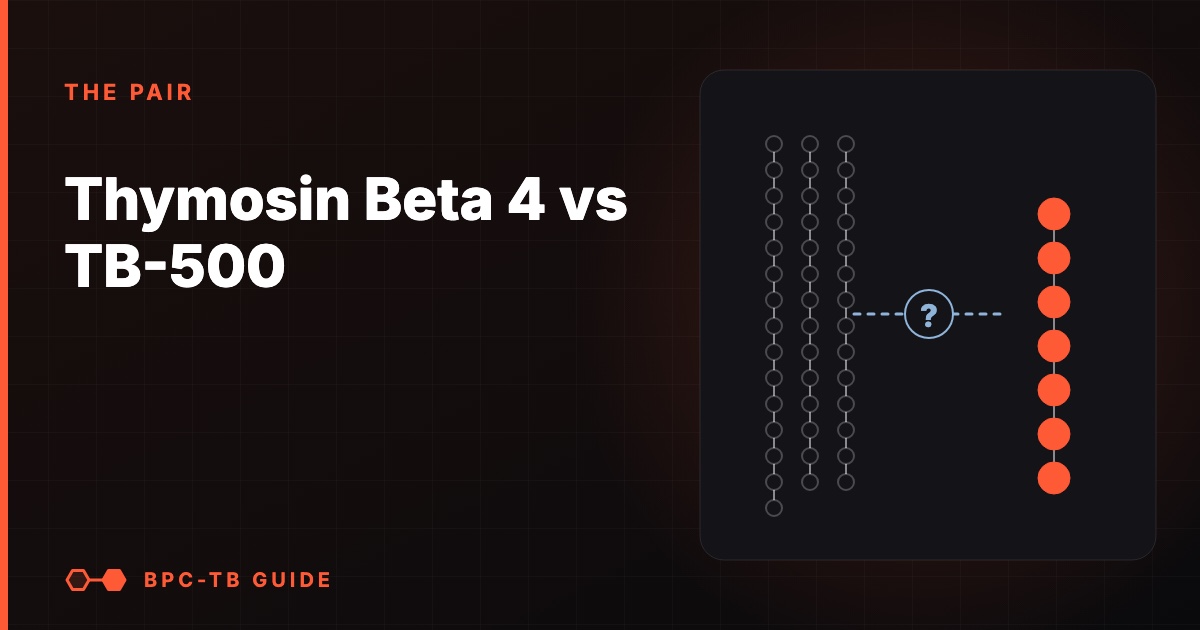
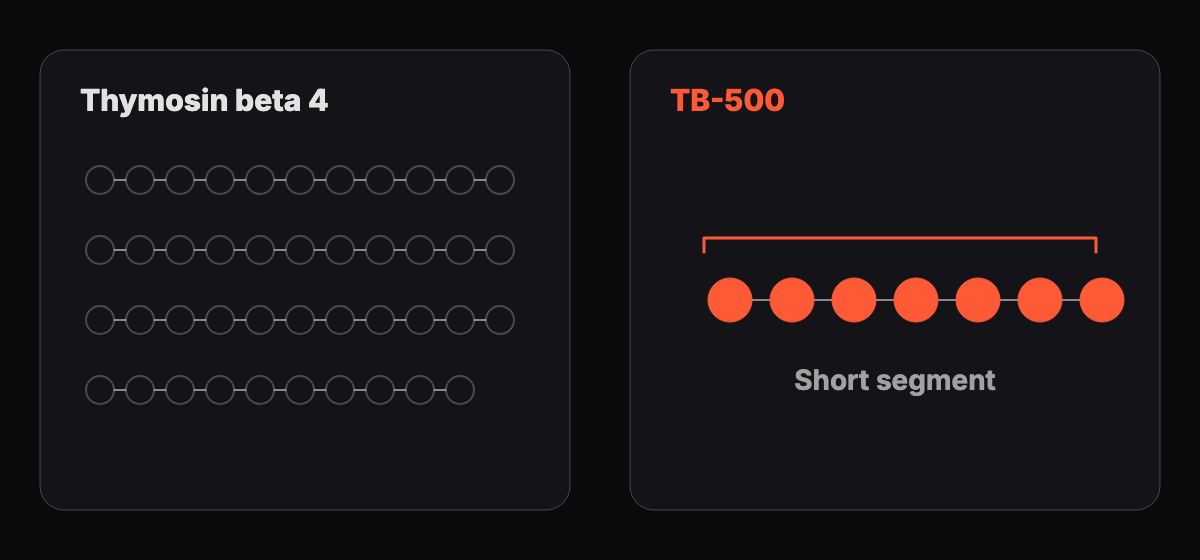
Quick answer: No. Thymosin beta 4 is a naturally occurring protein of 43 amino acids. FDA's 2026 briefing says it and TB-500 are "not the same substance," describing TB-500 as a seven-amino-acid fragment. Human trials used the full protein, never TB-500, and none targeted tendon, muscle or joint injury. No FDA-approved drug contains either as of 2026-10-09.
People searching for "thymosin beta 4" often land on pages that use the name as another word for TB-500. That shortcut is where most of the confusion about this pair starts. This page lays out what thymosin beta 4 is, what has been tested in people, and why that record does not carry over to the product usually sold as TB-500. General information, not medical advice.
The natural protein and its known biology
Thymosin beta 4, written Tβ4 in papers, is encoded by a gene on the X chromosome and, according to reviews, found in almost all human cells. UniProt, the public protein database, lists a mature chain of 43 amino acids that binds to actin, a building block of the cell's internal scaffold, and holds it in a free form. A 2023 review describes it as the most abundant of its family in humans. Reviews credit it with roles in cell movement, inflammation and blood vessel growth, nearly all based on cell and animal work.
One point of precision. The natural protein is itself acetylated at its first amino acid, which is a feature of the whole molecule. This is not the same as the added acetyl group on the seven-amino-acid fragment discussed below, and a related four-amino-acid piece, Ac-SDKP, is a separate cleavage product that is also not TB-500.
Evidence on its role is contested even in animals. Mice bred without the protein had normal hearts and normal early development in one 2012 study (PMID 22158707), while other groups reported the opposite for vessel development. This is the basic science, not a claim about any product.
"Same or different?" at a glance
| Question | Thymosin beta 4 | TB-500 |
|---|---|---|
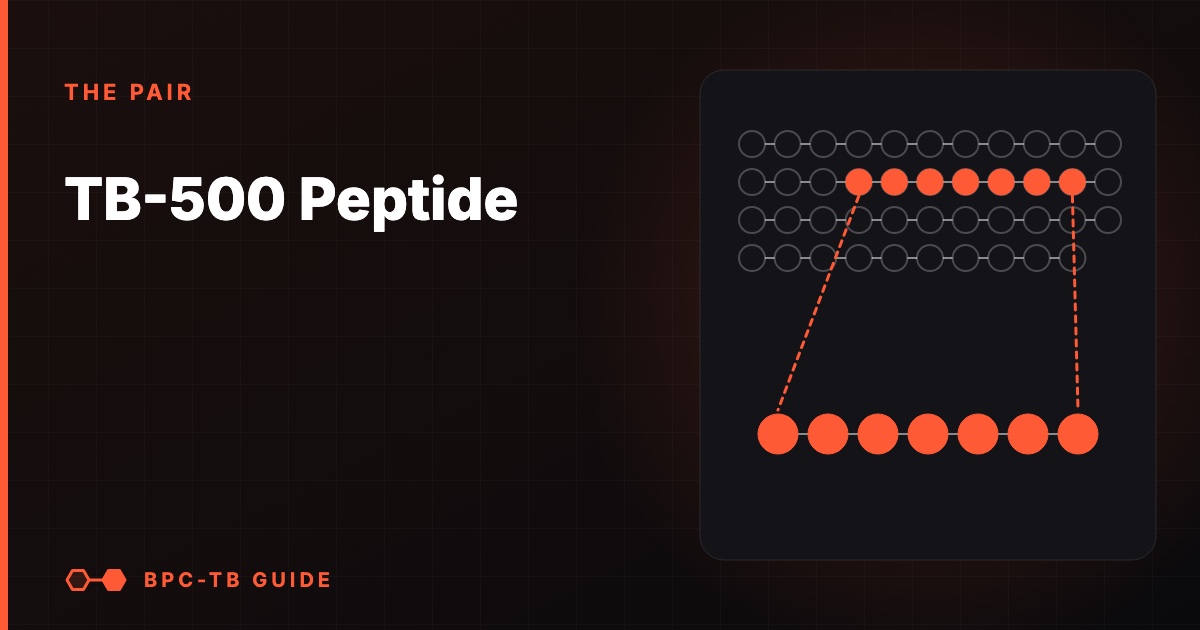
| What is it? | A 43-amino-acid protein the body makes | Defined by FDA and equine chemistry papers as an acetylated seven-amino-acid fragment (LKKTETQ) |
| Where in the protein? | The whole molecule | Positions 17 to 23 |
| FDA's view | A separate substance | "Not the same substance" (briefing footnote) |
| WADA 2026 List | Named in S2.3 | Named in S2.3 as an example of a derivative |
| Human trials | Yes, for full-length protein | None found |
| Approved drug | None found in FDA or EMA data | None found |
| Used loosely as a synonym? | Sometimes | Sometimes |
As of 2026-10-09. The structure column reflects FDA's April 2026 category page and its July 2026 briefing, and the anti-doping chemistry papers.
Trial record for full-length thymosin beta 4
We searched ClinicalTrials.gov and PubMed on 2026-10-09. Every human trial we found tested the full-length protein, in these settings.
Eye drops. The most advanced program is an ophthalmic solution for dry eye and for a corneal nerve condition. The company trials range from a small early study to phase 3 trials with several hundred participants. One early trial reported that neither of its two main measures showed a significant difference from control, while some secondary measures did (PMID 26056426). For the largest later trial, the registry posts group values that are nearly identical between arms and no statistical tests, and we found no journal paper for it. We therefore cannot say whether those trials met their goals and do not present the eye drops as a proven product.
Skin ulcers (topical gel). Phase 2 trials in pressure ulcers and venous ulcers were small. A published venous-ulcer report (PMID 20536470) described safety as acceptable and said the findings suggested the gel "may have the potential" to speed closure. A trial in a genetic blistering condition ended early and showed no significant difference. These are small, early studies.
Heart attack (intravenous). A set of phase 2 studies of a recombinant version in heart attack. A 2025 paper (PMID 41229390) reported that the overall difference in damaged heart tissue between the group given the protein and the placebo group was not significant, though a subgroup dosed early did show a difference. We call that mixed.
Healthy volunteers. Two phase 1 studies of intravenous thymosin beta 4 (PMIDs 20536472 and 34346165) reported that adverse events were mild or moderate, with no dose-limiting toxicity or serious adverse events reported in the abstracts. These were short studies in healthy adults.
The registry also lists several withdrawn or terminated records and some completed studies with no posted results.
Musculoskeletal trials: none found
Our searches of ClinicalTrials.gov and PubMed on 2026-10-09 found no human trial of thymosin beta 4 or TB-500 for tendon, muscle, ligament or joint injury. A 2026 orthopaedic primer says the same: "human orthopaedic data are lacking" for both (PMID 41476424). The rat and mouse work that gets cited for tendon and muscle uses the full protein, often applied at the wound inside a gel or sealant (PMID 23523891), and a mouse study in a muscular dystrophy model showed more regenerating fibers but no improvement in grip strength or fibrosis (PMID 20126456). None of it is a human result, and none of it tested the fragment.
How TB-500 is defined by sellers and by the sources
A 2025 equine anti-doping paper (PMID 39314109) says products online claim to contain "a synthetic acetylated fragment of TB4 or TB4 itself." In other words, even the sellers do not agree. FDA and the 2012 and 2013 chemistry papers say the fragment. WADA bans "Thymosin-ß4 and its derivatives e.g. TB-500" without a structure. The 2024 fragment study (PMID 38382158) states that its "biological effects" have not been documented.
Why the evidence does not transfer
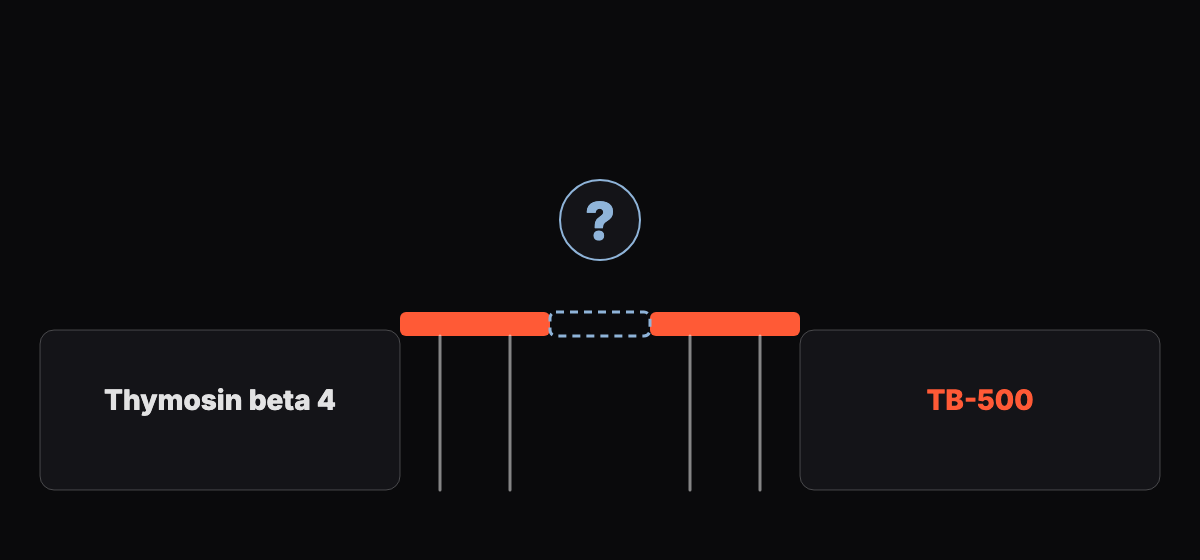
Three separate reasons, each enough alone.
- Different molecule. A trial of a 43-amino-acid protein tells you about that protein. The fragment is a tiny part of it and may be handled by the body differently. In the 2024 study, a metabolite of the fragment, not the fragment itself, was the piece that showed activity in a cell test.
- Different use. The full-protein trials were for eyes, skin ulcers and heart attack, not tendon, muscle or joint injury, using material supplied by the trial sponsors.
- Different route and duration. The intravenous and eye-drop studies were short. They say nothing about the injections people describe in forums.
The one animal study that tested "TB-500" directly in a tendon model was a 2026 rat Achilles study with 8 rats per group (PMID 42542926). It does not state which chemical form was used.
Safety data, as stated
Full-length thymosin beta 4 in healthy adults: mild or moderate adverse events and no serious events in the two phase 1 abstracts. Topical and eye-drop trials reported acceptable safety. FDA wrote of the fragment that it has not identified human exposure data and "lacks important information regarding any safety issues," and it cites a risk of immunogenicity from aggregation and peptide-related impurities. FDA's page is current as of 2026-04-22.
A tumor-related concern is raised in reviews, attributed here: thymosin beta 4 levels are higher in some tumors and linked to spread and blood vessel growth in lab work (PMID 22856429), while a myeloma paper found lower levels in those cells (PMID 20536459). These are measurements in tissue, not studies of people given the compound, and we found no human study of cancer risk after exposure.
Regulatory status
No drug containing thymosin beta 4 or a fragment turned up in DailyMed, openFDA Drugs@FDA or European Medicines Agency product data searched on 2026-10-09; that is a negative result for those databases, not for every country. WADA's 2026 List prohibits it at all times in S2.3, so drug-tested athletes face the same issue for either name; see our sports ban page and the legal status page. Compare the claims for each compound on TB-500 versus BPC-157, and see BPC-157 for the other half of the pair.
For what each claim supports, the benefits page grades it. Pages on muscle recovery and joint pain apply this to common goals, and the question of where products come from has its own answer. Go back to the homepage for the full guide.
Sources
- FDA: briefing document on TB-500 read 2026-10-09
- FDA: Certain bulk drug substances for use in compounding that may present significant safety risks page current as of 2026-04-22, read 2026-10-09
- WADA: 2026 Prohibited List in effect 2026-01-01, read 2026-10-09
- ClinicalTrials.gov: search for thymosin beta 4 read 2026-10-09
- 2012 knockout mouse study, Circulation Research PMID 22158707
- 2015 dry eye trial, Clinical Ophthalmology PMID 26056426
- 2010 venous ulcer trial, Annals of the New York Academy of Sciences PMID 20536470
- 2025 heart attack trial, Cardiovascular Research PMID 41229390
- 2010 healthy-volunteer study, Annals of the New York Academy of Sciences PMID 20536472
- 2021 first-in-human study, Journal of Cellular and Molecular Medicine PMID 34346165
- 2026 orthopaedic primer, American Journal of Sports Medicine PMID 41476424
- 2013 ligament study, Regulatory Peptides PMID 23523891
- 2010 muscular dystrophy mouse study, PLoS One PMID 20126456
- 2025 equine anti-doping paper, Drug Testing and Analysis PMID 39314109
- 2024 fragment metabolite study, Journal of Chromatography B PMID 38382158
- Bicer et al. 2026, Joint Diseases and Related Surgery PMID 42542926
- 2012 review on tumor expression, Critical Reviews in Eukaryotic Gene Expression PMID 22856429
- 2010 myeloma paper, Annals of the New York Academy of Sciences PMID 20536459
FAQ
Is TB-500 just thymosin beta 4?
No. FDA's briefing states they are "not the same substance." Thymosin beta 4 is the 43-amino-acid protein; TB-500 is described as a seven-amino-acid acetylated fragment. Some sellers and reviews blur the two.
Has thymosin beta 4 been tested in people?
Yes, the full protein, as eye drops, a skin gel and an intravenous form after heart attack, plus two small healthy-volunteer studies. Results ranged from mixed to unclear. None involved TB-500.
Did any trial test thymosin beta 4 for tendon or muscle injury?
We found none on ClinicalTrials.gov or PubMed as of 2026-10-09. Animal work exists for the full protein, but it is not a human result.
Is thymosin beta 4 a drug anywhere?
We found no approved drug containing it in FDA or European Medicines Agency product data on 2026-10-09. That covers those databases only.
Is it banned in sports?
WADA's 2026 List, in effect 2026-01-01, prohibits "Thymosin-ß4 and its derivatives e.g. TB-500" at all times. Check the current List, since it is revised each year.
Why does the difference matter if both are banned?
For sports the answer is often the same either way. For health evidence it is not: results for the full protein cannot be used to support claims about the fragment.
Not medical advice. See the medical disclaimer.