Quick answer: No FDA-approved drug contains BPC-157 or TB-500 as of 2026-10-09, so neither has a dose set by a regulator, a label or a completed dose-finding trial. The human reports are tiny, and no trial tested TB-500 in people. This page explains what a dose normally rests on, what exists for each compound, and what would have to happen first. It gives no numbers on purpose.
People search "what dose?" because they have seen a figure on a forum, a video or a clinic page. This page answers the question behind the search. A dose is a conclusion drawn from a body of human evidence, and for these two compounds that body of evidence has not been built. Below we show what exists, what it cannot tell you, and how the figures that circulate online come about.
What a dose means on an approved drug's label
On an approved medicine, the dose is the end point of a long chain of work. Makers first learn how the body absorbs and clears the substance. Then small human studies look for the amounts that cause problems. Larger controlled trials compare amounts against a placebo or an existing therapy. Regulators review the whole file, and the label that results states a strength, a route, a schedule and a duration. It also states which groups of people need adjustments, which other medicines interact, what side effects were seen and how often, and what to do when something goes wrong.
Every part of that label is tied to data from a specific preparation made to a specific standard. A figure only means something for the exact product that was tested. That is why the same peptide from two makers cannot be assumed to behave alike, and why a number copied from one source to another loses its meaning.
You can check whether a label of this kind exists. FDA's database search of Drugs@FDA through its public programming interface, and a search of the National Library of Medicine's DailyMed label database, each found no entry for BPC-157, thymosin beta-4 or TB-500 when we ran them on 2026-10-09 (DailyMed was published 2026-10-08). The FDA briefing documents for both substances also say that neither is a component of an FDA-approved drug and that neither has a USP monograph (briefing documents on FDA's July 2026 advisory committee page, current as of 2026-08-06).
What data exist for BPC-157
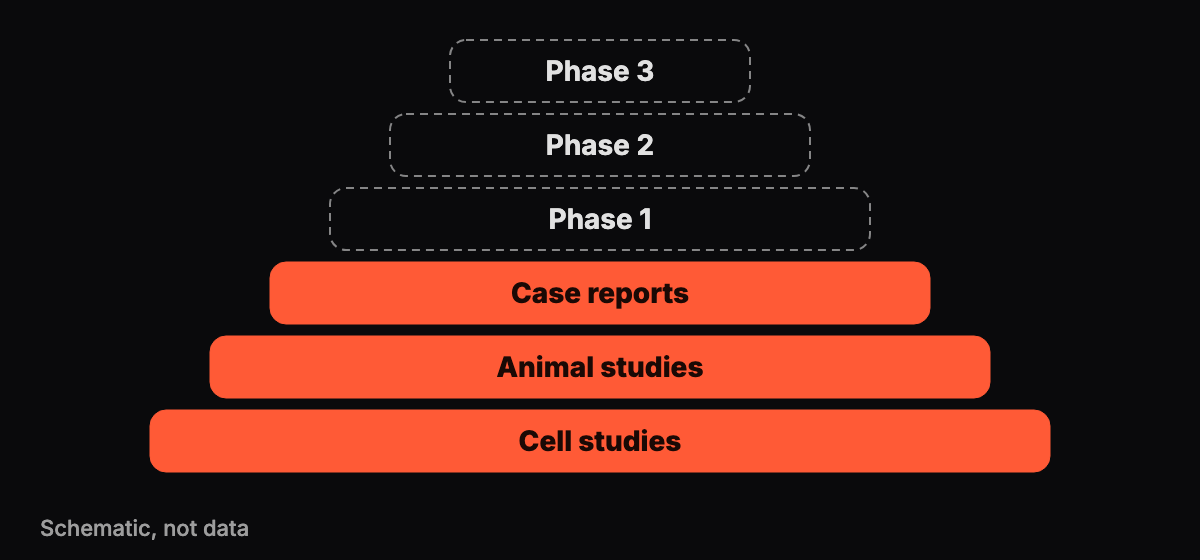
BPC-157 is a lab-made chain of 15 amino acids modeled on part of a protein reported in human gastric juice. Most of what is published comes from animal work, and a count of PubMed records on 2026-10-09 found that about four in five name one research group in Zagreb among the authors. An independent 2019 review wrote that most studies used small rodent models and that efficacy in humans is yet to be confirmed (PMID 30915550).
For people, the picture is thin:
- A 2025 systematic review in HSS Journal searched literature to 2024-06-03, identified 544 articles and included 36 studies, of which 35 were preclinical and one was clinical. It reported that no clinical safety data were found (PMID 40756949).
- Three small pilot reports, all from one author team and all described as private-clinic work, cover knee pain, interstitial cystitis and an intravenous safety check in two participants. Together they involve roughly 30 people. None had a placebo group, and the abstracts say the authors want larger studies (PMIDs 34324435, 39325560, 40131143).
- A 2026 review in Pharmaceutics counted fewer than 30 subjects across three uncontrolled pilot studies and described the field as having "no approved formulation, no validated dosing regimen, and no completed Phase II clinical trial" (PMID 42198317).
- ClinicalTrials.gov, searched on 2026-10-09, lists four BPC-157 records and none with posted results. One Phase 1 healthy-volunteer record has an unknown status and has not been updated since 2015-12-22. One Phase 2 hamstring trial is recruiting, and one rotator cuff pilot is not yet recruiting.
FDA's own briefing on BPC-157 reached a similar place. It describes BPC-157 as "considered not well-characterized" and records insufficient clinical safety information. It also notes that FDA found no human pharmacokinetic data for oral, subcutaneous, nasal or transdermal use. Pharmacokinetics is the study of how a substance moves through and out of the body, and it is the first thing a dose is built on.
What data exist for TB-500 and thymosin beta 4
TB-500 is the harder case, because the name is not used the same way by every source. FDA's briefing and its April 2026 page describe TB-500 as a seven-amino-acid synthetic fragment of thymosin beta-4 and state that the two are not the same substance. WADA's list refers to "Thymosin-ß4 and its derivatives e.g. TB-500" without giving a structure. A 2025 anti-doping paper says online products claim to contain either a fragment or the whole protein.
That difference matters for dosing because human data exist only for the whole protein:
- Every human trial we found of thymosin beta 4 used the full-length protein as eye drops, a topical gel or an intravenous product, mostly for eye, skin or heart conditions. None was for tendon, muscle or joint injury.
- Two Phase 1 studies in healthy volunteers gave intravenous thymosin beta 4. Their abstracts report adverse events that were mild or moderate and no dose-limiting toxicity or serious adverse events (PMIDs 20536472 and 34346165). They cannot speak to a seven-amino-acid fragment, to injections given repeatedly for weeks, or to people recovering from injuries.
- For TB-500 itself, the FDA briefing says no articles were found in which TB-500 was given to humans. It says the potential safety risks in humans "are unknown." On 2026-10-09 we searched ClinicalTrials.gov and PubMed and found no human trial of TB-500. The single registry entry using that name labels itself a "fictional" example, so it proves nothing.
The only head-to-head test of the pair that we found is a 2026 study in 32 rats, eight per group, over four weeks. TB-500 alone showed significant differences from control on tendon strength and tissue scores. The combination was significant on one tendon score only, and BPC-157 alone did not reach significance on the total scores (PMID 42542926). The authors called it exploratory. It is an animal result, and it contains no human dose information.
Why no established human dose exists
Put the pieces together and the answer to "what dose?" is that nobody has established one. The reasons are specific:
- No completed dose-finding trial in people. The step that produces a dose, comparing different amounts in a controlled human study, has not been published for either compound.
- No pharmacokinetic data in the routes people discuss. FDA's BPC-157 briefing found none for oral, subcutaneous, nasal or transdermal use. Animal data on how fast BPC-157 is cleared do not convert into a human amount.
- No standard preparation. The Pharmaceutics review notes that none of the human pilots used standardized pharmaceutical preparations. Without a defined product, a number has nothing to attach to.
- No agreed identity for TB-500. If a vial's contents could be a fragment or the whole protein, even a correct dose for one would be wrong for the other.
- Animal doses do not transfer. Rodent studies give amounts scaled to a rat's body, and the reports we read do not claim to translate them to a person. We print none.
- Safety data are too small. The FDA briefing on TB-500 cites "a lack of clinical and nonclinical safety information" and says FDA is "particularly concerned about the absence of human data." Small groups cannot show how often a problem occurs.
| Fact | Detail | Source |
|---|---|---|
| Approved product | None contains BPC-157 or TB-500 | FDA briefing documents, page current as of 2026-08-06 |
| Regulatory list status | Both appear in FDA's "nominated but withdrawn" table | FDA bulk drug substances page, current as of 2026-04-22 |
| Advisory committee | Met 2026-07-23; its role is non-binding | FDA meeting page, current as of 2026-08-06 |
| Final FDA decision | None found as of 2026-10-09 | FDA pages and Federal Register search, read 2026-10-09 |
| Human TB-500 data | None found | FDA briefing; our searches on 2026-10-09 |
As of 2026-10-09, those rows are the regulatory backdrop. News outlets reported a narrow committee vote in favor of adding both substances to a pharmacy-compounding list, but FDA's meeting page did not post a vote summary by 2026-08-06, and the committee's recommendation does not bind the agency. Readers should check FDA's pages for any later decision. For the legal side in plain terms, see Are BPC-157 and TB-500 legal?
What a clinician would need to decide anything
A licensed clinician who is asked about these compounds is in a position without a map. To reach even a provisional judgment, they would want answers that the public record does not currently supply:
- Which exact substance is in the product, and does a verified analysis of that batch support the label?
- Who made it, under what quality system, and with what testing for contamination and endotoxin?
- What human data exist for that substance, by that route, in a person like the patient?
- What is the patient's actual condition, and does an approved option with an established dose already exist? FDA's TB-500 briefing notes that FDA-approved therapies for the management of wounds exist, and FDA made a similar point about ulcerative colitis in its BPC-157 briefing.
- What other medicines does the patient take, and what monitoring would be possible?
- What would be done if a reaction occurred?
When these answers are missing, a clinician cannot responsibly set a number, and that is a statement about the evidence, not about any one clinician. If you are weighing these compounds, a licensed clinician who knows your history is the right person to ask. For what is documented about adverse events, see TB-500 and BPC-157 side effects.
How marketing "protocols" arise
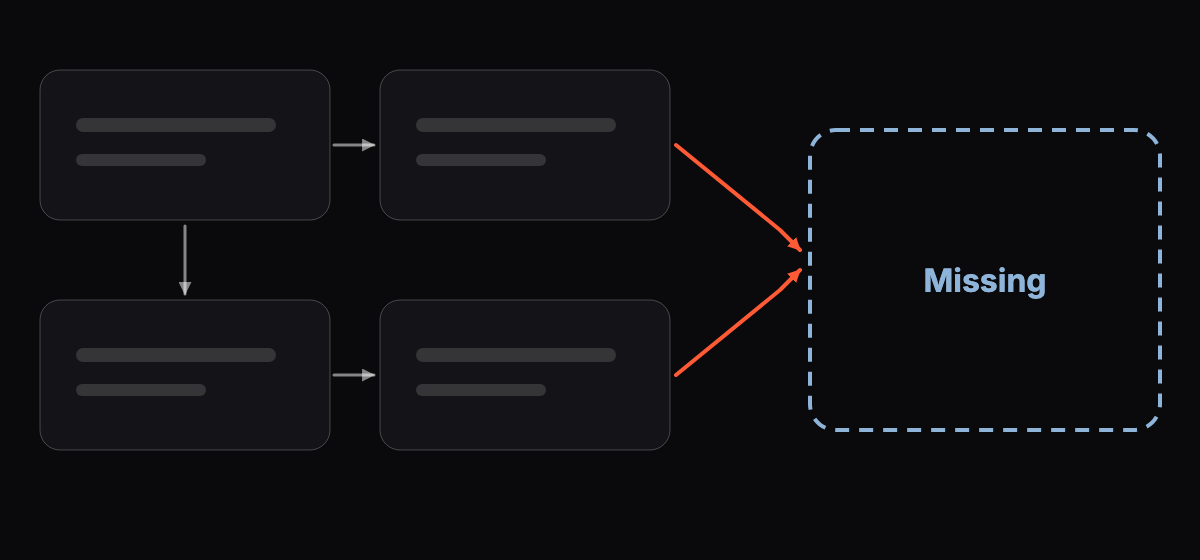
If no dose is established, where do the figures online come from? Several routes are visible in the sources we read:
- Animal studies. Published rat and mouse work reports the amounts given to animals. Posts sometimes rescale these into human amounts. No reviewed source supports that step.
- The small human reports. The pilot reports describe what one clinic gave a handful of people. They are not dose-finding studies and say so.
- Veterinary and anti-doping papers. TB-500 appears in 2012 and 2013 papers on horse doping, which describe a "veterinary preparation." Those papers measured what appears in horses, not what suits a person.
- Clinic and shop pages. Pages that market the pair publish "protocols" with no citation to a trial. One clinic page describes variation between clinics as normal, which is another way of saying there is no standard.
- Forums. People swap what they did and how they felt. Anecdotes cannot separate a peptide effect from rest, time, placebo response or chance.
Anyone who has seen a convincing-looking schedule has seen the product of these routes, and none of them is a dose-finding study. The same is true for charts and for calculators, which we address on their own pages: the dosing chart and the dosage calculator. Two related questions have separate pages as well: what a blend label can show and what is known about capsules and other oral forms.
What would be needed before a dose could be set
This is the list a sponsor or independent research group would have to complete. None of the steps has been published for either compound.
- A defined, characterized product, with an analytical method that separates the intended peptide from related impurities.
- Human pharmacokinetic studies in each route proposed.
- A controlled safety study in healthy volunteers, with immune response measured, because FDA flags immunogenicity for certain routes.
- Dose-ranging in the intended patient group, with a placebo or active comparator.
- A trial with a clear, pre-registered outcome, such as the recruiting hamstring and planned rotator cuff studies, with results posted.
- Independent replication of the main finding.
- Review by a regulator and a label that records the result.
Until then, the honest answer to "what is the dose?" is that the sources do not contain one. If you want the wider claims and how strong they are, read what the evidence supports, or start from the compound pages for BPC-157 and TB-500. The animal tendon work and its limits are covered in the tendon injuries page, and the pair's nickname is explained in the Wolverine stack guide. The home page lists every guide.
Sources
- FDA: Certain Bulk Drug Substances for Use in Compounding That May Present Significant Safety Risks page current as of 2026-04-22, read 2026-10-09
- FDA: July 23-24, 2026 Pharmacy Compounding Advisory Committee meeting page current as of 2026-08-06, read 2026-10-09
- FDA briefing document: BPC-157 read 2026-10-09
- FDA briefing document: TB-500 read 2026-10-09
- DailyMed, National Library of Medicine database published 2026-10-08, searched 2026-10-09
- Vasireddi et al. 2025, HSS Journal PMID 40756949
- Mateescu et al. 2026, Pharmaceutics PMID 42198317
- Gwyer et al. 2019, Cell and Tissue Research PMID 30915550
- Lee and Padgett 2021, Alternative Therapies in Health and Medicine PMID 34324435
- Lee et al. 2024, Alternative Therapies in Health and Medicine PMID 39325560
- Lee and Burgess 2025, Alternative Therapies in Health and Medicine PMID 40131143
- Bicer et al. 2026, Joint Diseases and Related Surgery PMID 42542926
- Thymosin beta 4 healthy-volunteer study 2010, Annals of the New York Academy of Sciences PMID 20536472
- Thymosin beta 4 first-in-human study 2021, Journal of Cellular and Molecular Medicine PMID 34346165
- Anti-doping paper on TB-500 and equine products 2025, Drug Testing and Analysis PMID 39314109
- ClinicalTrials.gov: BPC-157 records NCT02637284, NCT07437547, NCT07803250 searched 2026-10-09
FAQ
Is there a standard BPC-157 and TB-500 dose?
No. As of 2026-10-09 no FDA-approved drug contains either compound, and no completed dose-finding trial in people has been published. Figures online come from animal papers, clinic pages and forums, not from a trial that set one.
Why won't this site list the numbers other websites show?
A number printed without a trial behind it would look like guidance when it is not. We report what the sources say, and the sources contain no human dose. Quoting forum or clinic figures would add the appearance of authority without the evidence.
Did the small human studies give a dose I could rely on?
No. The BPC-157 reports are uncontrolled pilots with a handful of people, and the authors say larger studies are needed. They describe what one clinic did, not what has been shown to be appropriate for others.
Can animal doses be converted to human ones?
The reports we read do not claim a reliable conversion for these peptides, and we do not offer one. Animal results show that an effect appeared in that animal model. They do not give a human amount.
Does the FDA advisory committee meeting change any of this?
News outlets reported a narrow committee vote on 2026-07-23, but the committee's role is advisory and non-binding, and FDA's meeting page (current as of 2026-08-06) posted no vote summary. As of 2026-10-09 we found no final FDA decision. A listing would not by itself create a dose either.
What should I ask a clinician?
Ask what is known about the exact product, who made it, what evidence exists in people for your situation, and what approved alternatives exist. A clinician who knows your history can weigh those answers. We cannot.
Not medical advice. See the medical disclaimer.