Quick answer: A label and a certificate of analysis (COA) are documents a seller or lab produces; neither is an FDA approval. No FDA-approved drug contains BPC-157 or TB-500 as of 2026-10-09, and FDA says neither has a USP monograph, so no official specification exists to test against. A COA can show what one tested sample contained. It cannot show that your vial matches, or that it is safe.
Pages that sell peptides often display a COA as proof of quality. This page explains, in plain terms, what each part of a label and a COA means, what it cannot establish, and which features should lower your trust. It uses only what FDA, published reviews and plain definitions support. It names no vendor and does not tell you whether to use any product. For the legal background, see the explainer on research-use wording and the where-to-buy page.
What a label shows
For an approved drug, the label is a reviewed document: FDA has examined it, and DailyMed publishes it. We searched DailyMed and the Drugs@FDA data on 2026-10-09 for BPC-157, TB-500 and thymosin names and found nothing. So no approved label exists to compare against. Any label on a BPC-157 or TB-500 vial is a seller's own text.
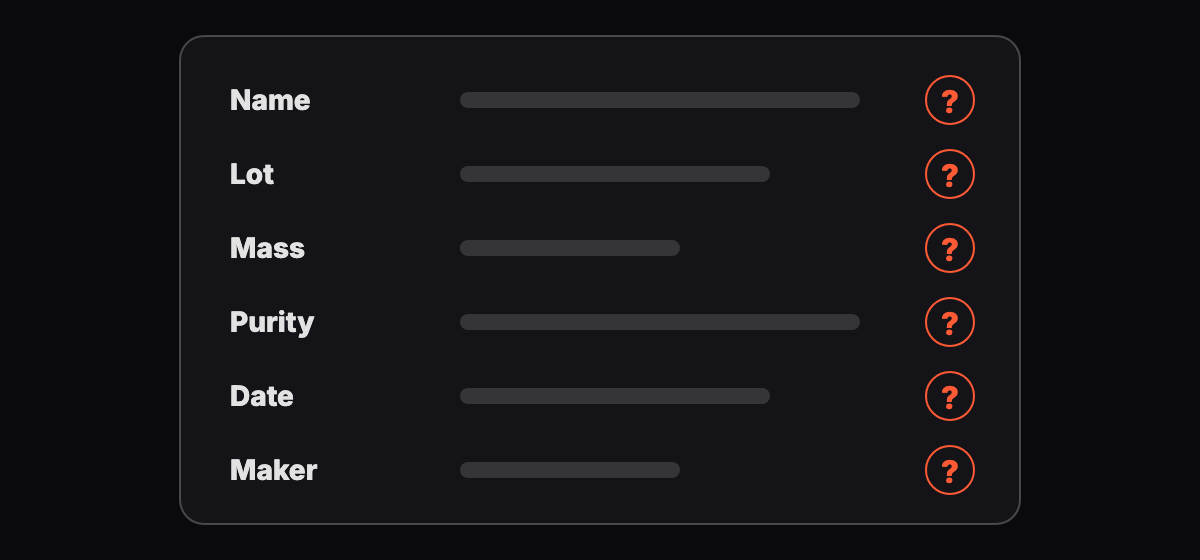
That does not make every item on it meaningless. Read each field for what it can tell you:
- Product name. It says what the seller calls the contents. "TB-500" is not used consistently. FDA's briefing describes a seven-amino-acid fragment of thymosin beta-4 and says the two are not the same substance, while a 2025 anti-doping paper says online products claim to be either the fragment or the whole protein. A name alone does not say which.
- Batch or lot number. It lets a manufacturer trace a production run. It is the key that should link a vial to a COA. A missing batch number means no document can be tied to the contents.
- Quantity and form. The amount of powder or liquid stated. It is a claim about the vial, not a measurement you can see.
- Manufacturer name and address. A responsible party you could contact. A label that leaves this vague gives you no one to ask.
- Dates and storage statements. Manufacturing or expiry dates, if present, are the seller's statements.
- Use statements. Wording such as the research-only disclaimer is the seller's choice and, per the FDA warning letters we read, does not change a product's intended use when marketing shows human use.
What a COA is
A certificate of analysis is a report listing tests run on a sample and the results. It is not a regulator's document. Anyone can produce one, including the seller. The useful questions are which lab, which sample, which tests and which method.
| Test | What it asks | What a good result would show | What it cannot show |
|---|---|---|---|
| Identity | Is the main substance what the label says? | Usually mass spectrometry confirming the expected molecular mass | That a nearby related fragment is absent; that the structure matches what a buyer assumed |
| Purity | What share of detected material is the main peptide? | Often a chromatography (HPLC) result given as a percentage | What the remainder is; whether the remainder is harmful; the amount in the vial |
| Content | How much peptide is actually present? | A measured amount per vial | That the measured vial is yours |
| Endotoxin | Are bacterial fragments present? | A value below a stated limit | Anything about identity or purity |
| Sterility | Were living microbes found? | No growth in a stated test | That a later handling step kept it sterile |
As of 2026-10-09. The test names are general laboratory terms, not requirements FDA has set for these two substances.
Researchers do use these techniques on the compounds. A 2012 chemistry paper (PMID 22962027) reports detecting the N-terminal acetylated 17-23 fragment of thymosin beta-4 in a TB-500 product by HPLC and high-resolution mass spectrometry. That shows identity can be tested; it does not show that any specific product matches.
What a COA cannot show
A COA describes a sample from a batch. Several limits follow, whatever the document says.
First, it cannot tell you that your vial is from the tested batch unless a batch number on the vial matches one on the report, and even then it only shows that the numbers match, not that the vial was filled the way the tested sample was.
Second, it cannot establish independence. A report on a seller's letterhead, or from a lab that shares ownership, is the seller's evidence. A report that names an independent lab, lists a date, method and signatory, and can be confirmed with the lab itself carries more weight than a plain image.
Third, it cannot define "good." For approved drugs, FDA and the USP set specifications. FDA's briefings state there is no USP monograph for BPC-157 or TB-500, and FDA calls BPC-157 "not well-characterized" in naming and quality data. Without an agreed specification, a 99 percent purity figure, for example, is only a number: purity of what, measured how, against what reference?
Fourth, it cannot show safety or effect. FDA's pages cite immunogenicity, meaning an immune reaction, for peptides given by certain routes, and aggregation and peptide-related impurities. A clean COA does not remove those concerns, and it says nothing about whether the compound does anything in a person. For what is known, see the side-effects page.
Fifth, a COA for a single substance says little about a blend. Blend labels add the question of whether each component was tested; see the blend page.
Red flags and why
Each flag below lowers confidence in a document or page. None proves a product is bad, and a page with no flags is not proven good.
- Research-only wording on a product marketed for human goals. FDA's warning letters, dated 2025-02-26 to 2026-08-24, say the wording does not change intended use when the seller's marketing shows human use. (FDA warning letters)
- A claim that the product is FDA-approved or "pharmaceutical grade". No FDA-approved drug contains either substance. (FDA briefing documents, read 2026-10-09)
- A claim of recent approval for compounding. FDA's page, current as of 2026-04-22, lists both substances as "nominated but withdrawn", and we found no final FDA decision as of 2026-10-09. (FDA bulk-substance page)
- Health or recovery claims beside the product. FDA's 2023-06-12 letter cites a firm's website claims as evidence of intended use. (FDA warning letter, 2023-06-12)
- A dosing chart, calculator or preparation guidance on the same site. FDA's August 2026 letters regard supplying such tools next to a diluent as evidence of intended drug use. This site publishes none; see why there is no dosage calculator and why no dosing chart can be sourced. (FDA warning letters, 2026-08-24)
- A COA with no batch number, no date, no lab name or no method. Without these, the report cannot be tied to a vial or checked. (Plain definition of a COA)
- A purity percentage with no endotoxin or sterility result for a product meant to be injected. Purity says nothing about those two risks. (FDA names impurities and immunogenicity as concerns; FDA bulk-substance page)
- An identity line that says only "TB-500" with no structure. FDA says thymosin beta-4 and TB-500 are different substances. (FDA TB-500 briefing)
- Claims that a product has no risk. FDA says the safety risks of TB-500 in humans are unknown, and it found limited safety information for BPC-157. (FDA briefings)
- Pages that still say "Category 2". That is stale wording from before FDA's 2026-04-22 page. (FDA bulk-substance page)
What to do with this
This page does not tell you to use or avoid any product. If a clinician has discussed these compounds with you, ask them which document supports the supplier's claim and who stands behind it. The sourcing questions are identical for any peptide: which substance, which supplier, which legal basis, which batch, which independent lab. If any answer is missing, you have learned something. The homepage lists the evidence pages for the compounds themselves.
Sources
- FDA briefing document: BPC-157 read 2026-10-09
- FDA briefing document: TB-500 read 2026-10-09
- FDA: Certain bulk drug substances for use in compounding that may present significant safety risks page current as of 2026-04-22, read 2026-10-09
- FDA: Warning letters database letters dated 2023-06-12 and 2025-02-26 to 2026-08-24, read 2026-10-09; not linked individually
- DailyMed name searches for BPC-157, TB-500 and thymosin, database published 2026-10-08, run 2026-10-09
- Synthesis and characterization of the N-terminal acetylated 17-23 fragment of thymosin beta 4 identified in TB-500, 2012 PMID 22962027
- Equine doping controls of thymosin beta-4, 2025 PMID 39314109
- Moiz et al. 2026, Missouri Medicine PMID 42757290
FAQ
Does a COA mean a peptide is pure?
It means a lab reported a purity figure for one sample. It does not show that the vial in your hand is from that sample, or what the remaining percentage is.
What should a batch number match?
The batch number on the vial should match the number on the report. A match shows the paperwork is connected to the vial; it does not show how the vial was filled.
Is a higher purity number always reassuring?
No. Purity is measured by a method against a reference, and for these two substances there is no USP monograph that sets a standard. The number is only as informative as its method.
Why do endotoxin and sterility results matter?
They address contamination, which is separate from purity. Reviews of unapproved peptides list contamination and impurities among the risks, per a 2026 abstract (PMID 42757290).
Can a COA prove a peptide works?
No. A COA concerns what is in a sample, not what it does in a person. FDA's briefings found little or no human data on these compounds.
Who regulates these documents?
For these two substances, no regulator reviews a seller's label or COA, because no approved product exists. FDA's pages and letters are the relevant source.
Not medical advice. See the medical disclaimer.