Quick answer: No FDA-approved drug contains BPC-157 or TB-500 as of 2026-10-09. FDA's page, current as of 2026-04-22, lists both among bulk substances "nominated but withdrawn". An FDA advisory committee met on 2026-07-23 about adding them to the compounding list, and we found no final FDA decision as of 2026-10-09. Neither appears on the DEA list we read. General information, not legal advice.
"Is it legal?" is really several questions, and each has a different regulator and a different answer. This page separates them: whether a drug is approved, whether a pharmacy may compound it, what FDA has said about products sold online, whether the DEA schedules it, and what a state can add. Every statement carries the date of the page it comes from, because this area is moving. For the sports question, see the WADA page.
- Approved product
None. No FDA-approved drug contains BPC-157 or TB-500 (as of 2026-10-09)
- FDA
Both listed as "nominated but withdrawn" bulk substances; advisory meeting held 2026-07-23; no final decision found (as of 2026-10-09)
- WADA
BPC-157 in S0 and TB-500 in S2.3 of the 2026 List, in effect 2026-01-01 (as of 2026-10-09)
- Human trials
No human TB-500 study found by FDA; BPC-157 has a handful of small, short studies per FDA's briefing (as of 2026-10-09)
What "approved" means
FDA approves a drug after a manufacturer submits evidence that it works for a stated use and that its benefits outweigh its risks, and after the product's manufacturing is reviewed. An approved drug has a label that says what it is for. Nothing like that exists for either substance. FDA's briefing documents for the July 2026 meeting state that each substance has no United States Pharmacopeia monograph and "neither is a component of an FDA-approved drug". We also searched DailyMed and the Drugs@FDA data on 2026-10-09 for the names BPC-157, TB-500 and thymosin; every search returned nothing, while a control search returned results.
A related point: FDA says in its compounding questions page (current as of 2025-09-16) that compounded drugs are not FDA-approved, so the agency does not verify their safety, effectiveness or quality before marketing. A pharmacy's involvement therefore never turns a substance into an approved drug.
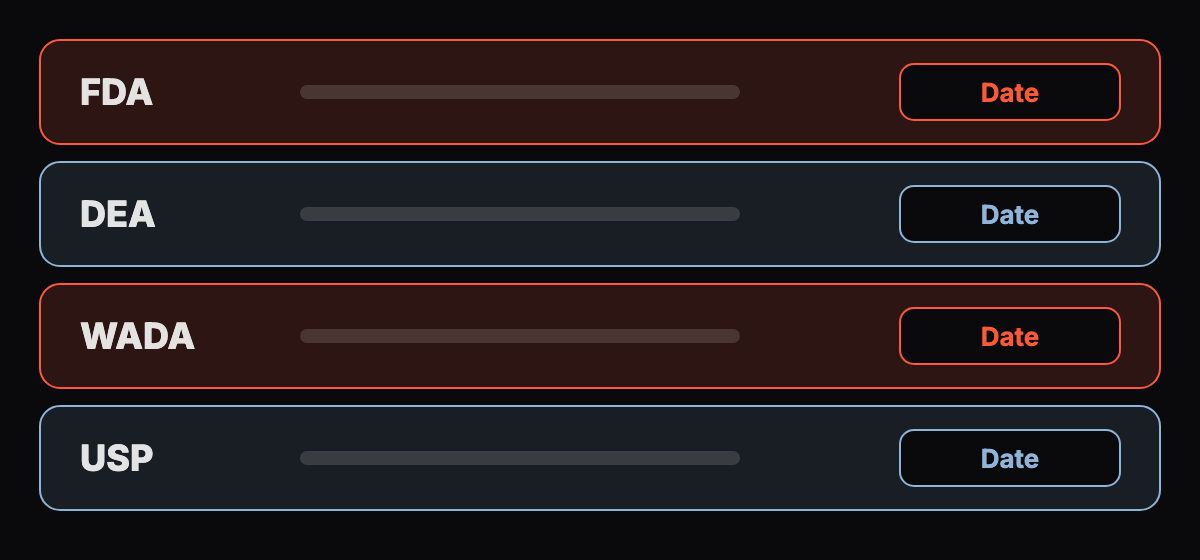
The regulator-by-regulator table
| Fact | Detail | Source |
|---|---|---|
| Approved-drug status | No FDA-approved drug contains either substance; no USP monograph exists for either (as of 2026-10-09) | FDA briefing documents for the 2026-07-23 meeting |
| FDA bulk-substance page | Both listed under "nominated but withdrawn"; page current as of 2026-04-22 | FDA page on bulk substances that may present significant safety risks |
| FDA advisory committee | Met 2026-07-23 to discuss adding both to the 503A bulks list; meeting page current as of 2026-08-06 posts briefings but no vote summary | FDA meeting page |
| Reports of the vote | News outlets reported a narrow committee vote in favor on 2026-07-23; these reports are secondary (read 2026-10-09) | Several news and trade outlets |
| Final FDA decision | None found as of 2026-10-09 | Searches of FDA and Federal Register pages, 2026-10-09 |
| 503A statute | A compounded drug keeps its exemptions only if bulk substances meet one of three conditions (page read 2026-10-09) | 21 U.S.C. 353a, via Cornell Law |
| DEA scheduling | No entry for either name in the alphabetical controlled-substances list dated 2026-08-27 | DEA Diversion Control Division list |
| Warning letters | Ten letters dated 2025-02-26 to 2026-08-24 read; none names either substance (as of 2026-10-09) | FDA warning-letter database |
As of 2026-10-09. A dated cell describes the page we read, not the law forever.
FDA's bulk-substance category page
FDA keeps a page on bulk drug substances for compounding that may present significant safety risks. As of its "content current" date of 2026-04-22, BPC-157 and "Thymosin beta-4, fragment (LKKTETQ), also known as TB-500" sit in a table headed "Bulk drug substances nominated but withdrawn". The table's introduction says these substances were "previously in category 2" and that the nominators withdrew them.
Many commercial pages still say both are in "Category 2". That wording does not match FDA's own page, which (as of its 2026-04-22 date) lists them as nominated but withdrawn. We also read one health publisher's page, dated 2026-08-03, that says the peptides are "newly approved for compounding". FDA's pages say no such thing, and we do not repeat it as fact.
What FDA wrote on that page, while the substances were in category 2, is still informative. For BPC-157 it cited a risk of immunogenicity for certain routes of administration and "complexities" with peptide-related impurities. For TB-500 it said FDA had not identified human exposure data for products containing the fragment. Immunogenicity means the immune system reacting to a substance, and aggregation means peptide molecules clumping, which can raise that risk. The page does not say "safe" or "unsafe"; it says FDA lacks information.
Press and law-firm commentary says leaving category 2 does not make a substance eligible for compounding. FDA's bulk-substances overview page (current as of 2026-05-14) says the agency does not intend to act against compounding with category 1 substances under its interim policy; it does not state that policy for substances outside category 1. How that applies to these two names is the commentators' reading, so we present it as attributed.
What 503A and 503B limit
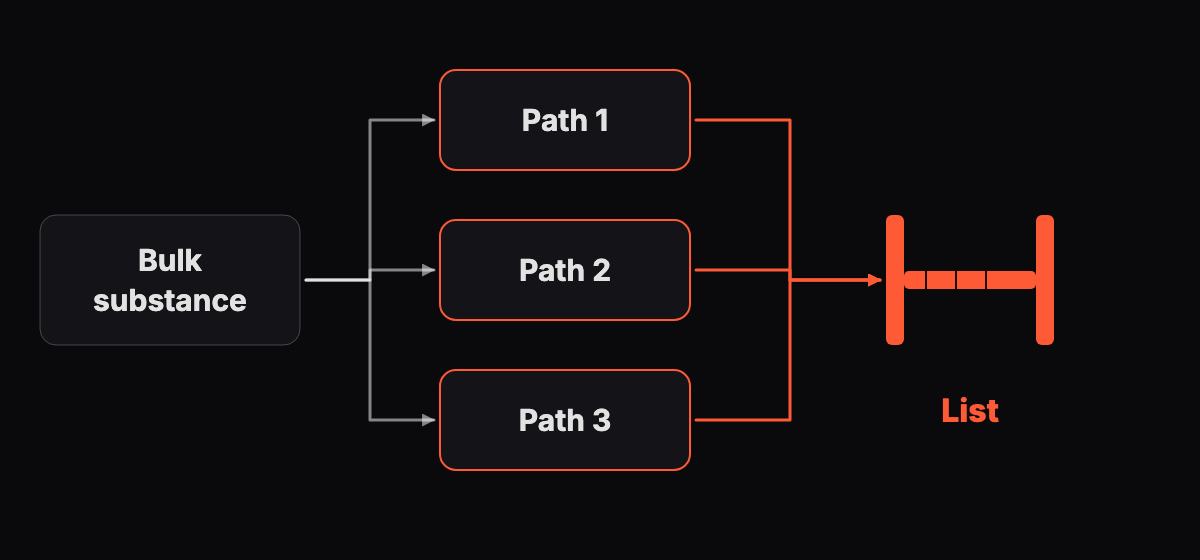
Section 503A of the Federal Food, Drug, and Cosmetic Act covers pharmacists and physicians compounding for an identified patient. Its text exempts a compounded drug from several requirements only if the compounder uses bulk drug substances that meet one of three conditions: they comply with an applicable USP or NF monograph; if no monograph exists, they are components of drugs approved by the Secretary; or, if neither applies, they "appear on a list developed by the Secretary through regulations". The page we read is the Cornell Law reproduction of 21 U.S.C. 353a, read 2026-10-09.
FDA's briefings say neither substance has a monograph or is part of an approved drug. Applying the statute, the exemption could apply to them only if they were on the bulks list. We found no source that uses the phrase "illegal to compound"; the sources say the exemption conditions are not met unless the list condition is satisfied. Section 503B, which covers registered outsourcing facilities, has its own conditions that we did not read in full, and FDA's outsourcing-facility data showed no reported compounded BPC-157 products from January 2017 to June 2025, per the BPC-157 briefing.
The July 2026 advisory committee meeting
FDA's Pharmacy Compounding Advisory Committee met on 2026-07-23 and 2026-07-24. On the first day its agenda covered BPC-157, TB-500, KPV and MOTs-C. FDA lists the use evaluated for BPC-157 as ulcerative colitis and for TB-500 as wound healing. The meeting page (current as of 2026-08-06) says advisory committees make non-binding recommendations and that FDA generally follows them but is not legally bound to do so.
FDA's briefing documents, posted before the meeting, reach these conclusions in the agency's words:
- For TB-500, FDA cites "a lack of clinical and nonclinical safety information", says it is "particularly concerned about the absence of human data", and says potential safety risks in humans "are unknown". It also notes FDA-approved therapies exist for wound management.
- For BPC-157, FDA calls the compound "not well-characterized" and cites insufficient clinical safety information. It says its search of PubMed and Embase found five clinical studies that used BPC-157, and it concludes there is insufficient clinical safety information to characterize the safety profile.
- Each briefing ends with a proposal. The BPC-157 and TB-500 documents both say "we propose not adding" the substance, in free-base and acetate forms, to the 503A bulks list.
Several news and trade outlets reported that the committee voted narrowly in favor of recommending both substances. We do not print a tally, because FDA's meeting page, as of its 2026-08-06 date, posts briefings, questions, agenda and presentations but no minutes or vote summary. One outlet reported that FDA must still review the meeting record and publish proposed rules, and that this can take a long time; that is a secondary claim.
As of 2026-10-09, we found no FDA final decision, proposed rule or enforcement statement on listing either substance. Check FDA's meeting page before relying on this paragraph.
Warning letters
FDA has sent warning letters to online sellers of peptide products. We read ten, dated between 2025-02-26 and 2026-08-24. They concern unapproved new drugs, misbranded products and unlawful internet sales, and each says that a "research use only" label does not change what the products are intended for when the seller's marketing shows human use. None of the ten names BPC-157 or TB-500. One older letter, dated 2023-06-12, does name both, among other products. We do not link letters, because their addresses contain recipient names. For what the label wording means, see the research-use-only explainer.
Controlled-substance status
The DEA's alphabetical list of controlled substances, dated 2026-08-27, has no entry for BPC-157, TB-500, thymosin or "body protection compound" when searched on 2026-10-09. We say only that neither appears on that list; we did not search the underlying regulations.
State law and personal import
We found little reliable state-level material. One enacted example: Louisiana Act 374 of the 2026 Regular Session, whose enrolled text says licensing boards may not bar providers with prescriptive authority from supplying peptides shipped from a registered outsourcing facility or a 503A pharmacy that complies with federal law (the legislature's bill page shows it signed and effective 2026-08-01). The text does not name BPC-157 or TB-500 and defers to federal compliance, so it does not by itself make compounding these two substances lawful. We could not confirm any other state's rule from an official page.
On personal import, FDA's page (current as of 2025-08-18) says bringing drugs in for personal use is illegal in most circumstances, often because the drugs lack approval, and that an unapproved new drug cannot be imported. The page also describes limited discretion; that is not a right.
For how these rules bear on buying, see the where-to-buy page. For the evidence and risk picture, see TB-500 and BPC-157 side effects, the pages on TB-500, BPC-157 and dosing, the Wolverine stack, blend labels and forum claims. The homepage lists everything.
Sources
- FDA: Certain bulk drug substances for use in compounding that may present significant safety risks page current as of 2026-04-22, read 2026-10-09
- FDA: Bulk drug substances used in compounding under section 503A page current as of 2026-05-14, read 2026-10-09
- FDA: July 23-24, 2026 meeting of the Pharmacy Compounding Advisory Committee page current as of 2026-08-06, read 2026-10-09
- FDA briefing document: introduction read 2026-10-09
- FDA briefing document: BPC-157 read 2026-10-09
- FDA briefing document: TB-500 read 2026-10-09
- Federal Register: meeting notice and docket, 2026-04-16 read 2026-10-09
- 21 U.S.C. 353a (FD&C Act section 503A) read 2026-10-09
- FDA: Compounding and the FDA, questions and answers page current as of 2025-09-16, read 2026-10-09
- FDA: Personal importation page current as of 2025-08-18, read 2026-10-09
- FDA: Warning letters searched by letter number, read 2026-10-09
FAQ
Is BPC-157 illegal to own?
We found no source that says possession is a crime, and neither substance appears on the DEA list we read (version dated 2026-08-27). That is not the same as approved or lawful to sell as a drug. We give no legal conclusion; ask a licensed attorney.
Can a pharmacy compound BPC-157 or TB-500?
Under the statute text, a compounder using bulk substances without a monograph or approval relies on the bulks list, and as of 2026-10-09 we found no final FDA decision adding either. FDA's briefing documents propose not adding either substance to that list.
Did the July 2026 vote make them legal?
No. FDA's meeting page says committee recommendations are non-binding, and as of 2026-10-09 we found no final FDA decision. News outlets reported a narrow vote, but a recommendation is not a rule.
Why do some pages still say Category 2?
Those pages may predate FDA's page current as of 2026-04-22, which uses "nominated but withdrawn". Check the date on any page that states a category.
Does a research-use-only label make a sale lawful?
FDA warning letters we read say the label does not change intended use when the seller's marketing shows human use. See the page on what that label means for the dated reading.
Where can I check the current status?
FDA's bulk-substance page and the meeting page above, plus the Federal Register. Statuses change, so use the "content current" date on each page.
Not medical advice. See the medical disclaimer.